
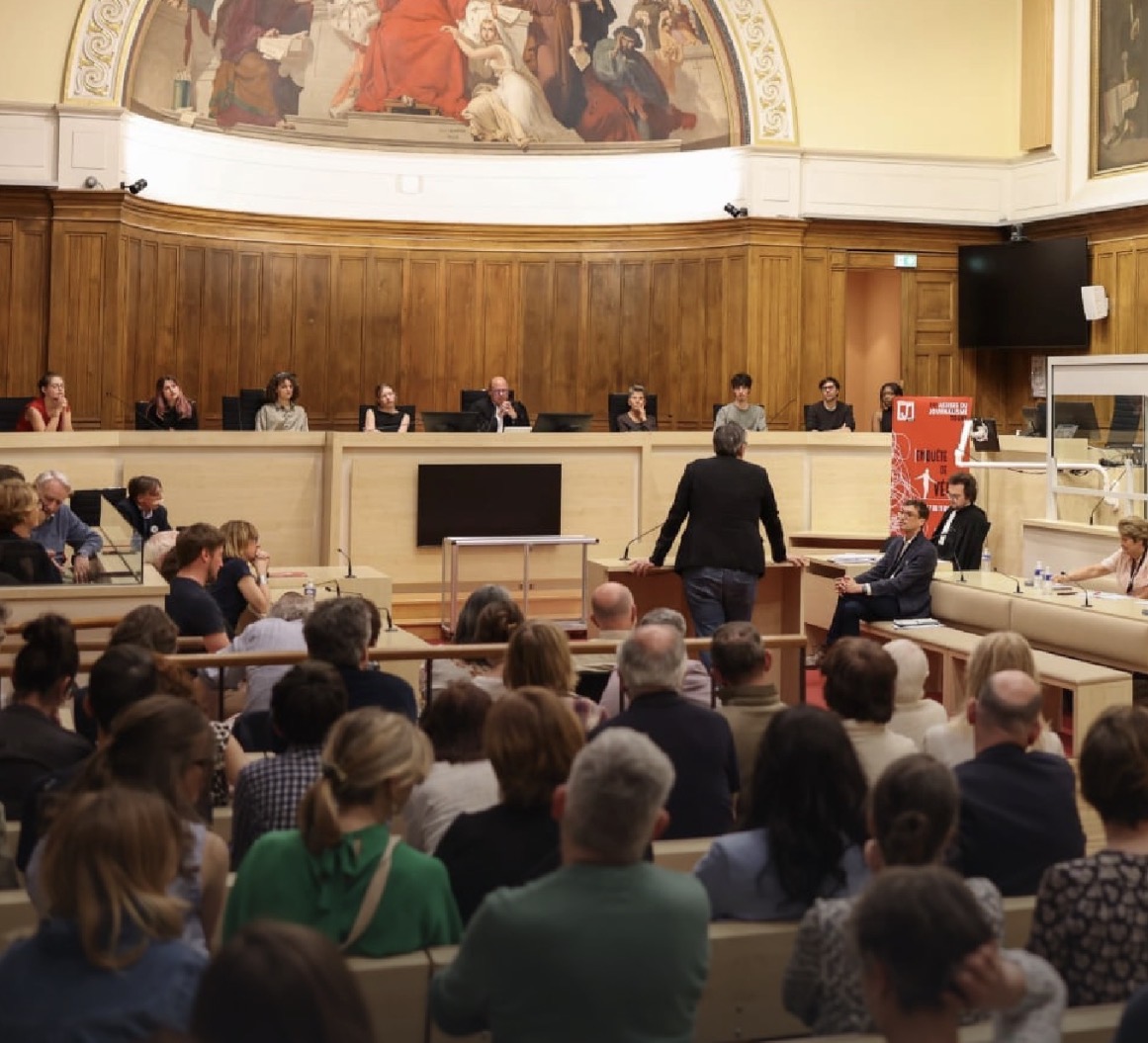
At the Journalism Conference in Tours, the labeling of information in the dock
Towers. Can we certify the reliability of information without undermining press freedom? The question was at the heart of a “real-false trial” organized at the Tours courthouse this Thursday, on the sidelines of the 2026 Journalism Conference.
In a setting inspired by judicial codes, journalists, experts and media professionals were called upon to debate the relevance of information labeling in the face of rising information disorder.
At the stand, the roles were clearly distributed: the prosecutor, Étienne Gernelle, editor-in-chief of Le Point, faced the defendant, Benjamin Sabbah, director of the Journalism Trust Initiative (JTI). The defense was provided by Thibaut Bruttin, director general of Reporters Without Borders, while the debates were chaired by journalist Dominique Verdeilhan.
At the center of discussions: the JTI Label
Launched in 2018 by Reporters Without Borders, this system offers to certify, through independent certification, that a media outlet respects strict standards in terms of transparency, governance and verification of information, among other indicators.
Faced with an ecosystem saturated with content and marked by the proliferation of false information, its defenders see it as a tool to restore public confidence. “We are proposing a certification standard for the quality of information for citizens,” defended Benjamin Sabbah, highlighting an initiative now deployed on an international scale: more than 2,400 media involved, in around a hundred countries, with 127 accredited certifiers.
But for its detractors, the approach is not without risk. Some players in the sector fear a standardization of journalism, or even a form of labeling which could, in the long term, weaken editorial freedom.
Throughout the hearing, witnesses and experts took turns to provide food for thought to the randomly selected jurors. Among them: Cécile Dubois, co-president of the Independent Online Information Press Union (Spiil), Yann Guégan, vice-president of the Council of Journalistic Ethics and Mediation, Jean-Pierre de Kerraoul, vice-president of the European Newspaper Publishers Association, as well as academics Arnaud Mercier and Joëlle Toledano.
Their interventions helped to highlight the multiple issues of labeling: economic transparency of the media, editorial independence, accountability to the public.
A question still open: who guarantees the truth?
Beyond the staging, this trial revealed a fundamental question: who can and who must guarantee the reliability of the information?
In a context marked by distrust of the media and the massive circulation of unverified content, the search for credibility mechanisms appears essential. But it comes up against an equally essential requirement: preserving freedom of the press.
This trial is part of the 19th edition of the Journalism Conference in Tours, organized from April 7 to 11, 2026.
The event brings together more than 300 speakers around 80 debates and meetings devoted to contemporary issues in journalism. Four evenings open to the general public, as well as several exhibitions in the city’s cultural venues, complete the program.
DD
