
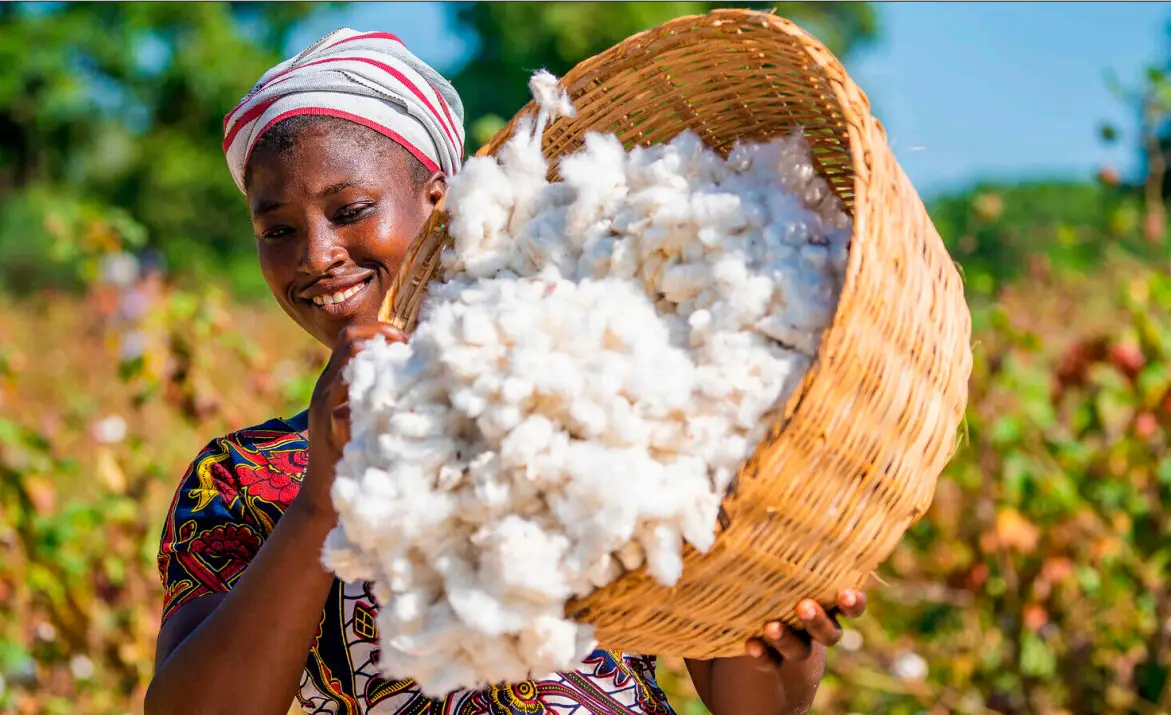
Cotton sector: a dynamic bringing hope
The Senegalese cotton sector is gradually returning to its ambitions, driven by a convergence between political will, industrial revival and mobilization of producers. Long considered a pillar of the national economy, it has today found a strategic place in the country’s economic transformation agenda. Rightly so. In fact, the sector supervises more than 16,000 producers, covers more than 20,000 hectares and supports more than 500,000 people.
It also generates between 400 and 700 direct jobs depending on production levels, including 270 permanent ones, and distributes 3.5 billion CFA francs in income to producers and rural stakeholders. At the heart of this dynamic, the commitment of the authorities appears decisive. On an economic tour, the President of the Republic, Bassirou Diomaye Faye, showed a firm desire to reposition the sector as a major lever of economic sovereignty.
Between an uncompromising diagnosis and ambitious prospects, the President set the course during his visit to Vélingara, to the Sodefitex facilities: “We are still far from the 1991 record. At the time, we produced 50,000 tonnes. Today, we peak at 25,000 tonnes. In two years, production increased from 15,000 to 25,000 tonnes. The milestone of 100,000 tonnes is achievable if we maintain this pace,” he said.
In an interview with Le Soleil, Papa Fata Ndiaye, general director of Sodefitex, welcomed the start of renewal in the sector, marked by the gradual return of several players. This had the direct impact of a 20% growth in production, which went from 13,000 to 15,500 tonnes. The objective, he said, is “to reach 25,000 tonnes from the next campaign”.
An interesting progression
An interesting progression, but still below potential. Sodefitex alone has an installed industrial potential of around 65,000 tonnes. “If the structuring investments are implemented, we believe that it is realistic to reach 100,000 tonnes of cotton.
However, it is crucial to remember that Senegal will never be a producer of the size of Benin, Burkina Faso or Mali, where cotton is a real national priority, comparable to the importance of peanuts here,” he stressed. To reach this cruising speed, efforts still need to be made, particularly in improving yields. According to the general director of Sodefitex, the priority is to improve agricultural yields. In West and Central Africa, he says, “we are around one tonne of cotton per hectare, compared to 4 to 5 tonnes in Brazil and more than 10 tonnes in Australia”.
Today, the authorities have great ambitions. The Minister of Agriculture, Livestock and Food Sovereignty, Dr Mabouba Diagne, welcomed the progress which has made it possible to go from less than 15,000 tonnes to more than 25,000 tonnes in two years, with the ambition of reaching 100,000 tonnes by 2030.
Local transformation
Increasing production, increasingly convinced players, a demonstrated political will: the cotton sector seems to bring together all the ingredients for a lasting recovery. This significant progression reflects a renewed confidence in the sector. With nearly 30,000 producers mobilized, cotton is gradually regaining its place in the Senegalese agricultural landscape. But for the President of the Republic, the issue goes far beyond gross production. We must transform locally to create value, by building a solid industrial chain capable of absorbing national production.
As if to materialize the directions of the Head of State, Sodefitex and Domitexka-Saloum signed a strategic partnership agreement on Thursday April 30, in a context marked by a remarkable increase in national cotton production. Between a producer and an industrialist, the challenge of local processing should undoubtedly be taken up.
This is the conviction of the Minister of Agriculture: “This agreement lays the foundations of a coherent industrial ecosystem, linking production, processing and the market. Through this structuring agreement, Sodefitex consolidates its role as sector integrator and strategic supplier of cotton fiber. Domitexka Saloum asserts itself as a key player in the revival of the national textile industry,” he indicated.
For Masse Thiam, general administrator of Domitexka, “beyond the relaunch of an emblematic textile unit in the Kaolack region, this is a strong signal in favor of the industrialization and territorialization of economic policies, in perfect coherence with the orientations of the Senegal 2050 Plan. The imminent arrival of equipment and the establishment of the industrial unit open up concrete prospects in terms of job creation and local economic revitalization “.
For the general director of Sodefitex, this agreement shows the priority given to the supply of local processing, considering that “the cotton sector is positioned today as a strategic lever, whose performance is based on a harmonious articulation between agricultural production and industrial processing”. Minister Mabouba Diagne goes further: for him, it is about producing in Senegal, processing in Senegal and consuming Senegalese.
An orientation which finds its full expression in this partnership, a real lever for supplying national industries with raw materials and meeting the strategic needs of the country, particularly in school, military and professional uniforms, believes the Minister of Agriculture. It is already planning towards segments with high added value, in particular organic cotton, “proof of the ambition to sustainably integrate the Senegalese sector into international standards and niche markets”.
Oumar Fedior
