
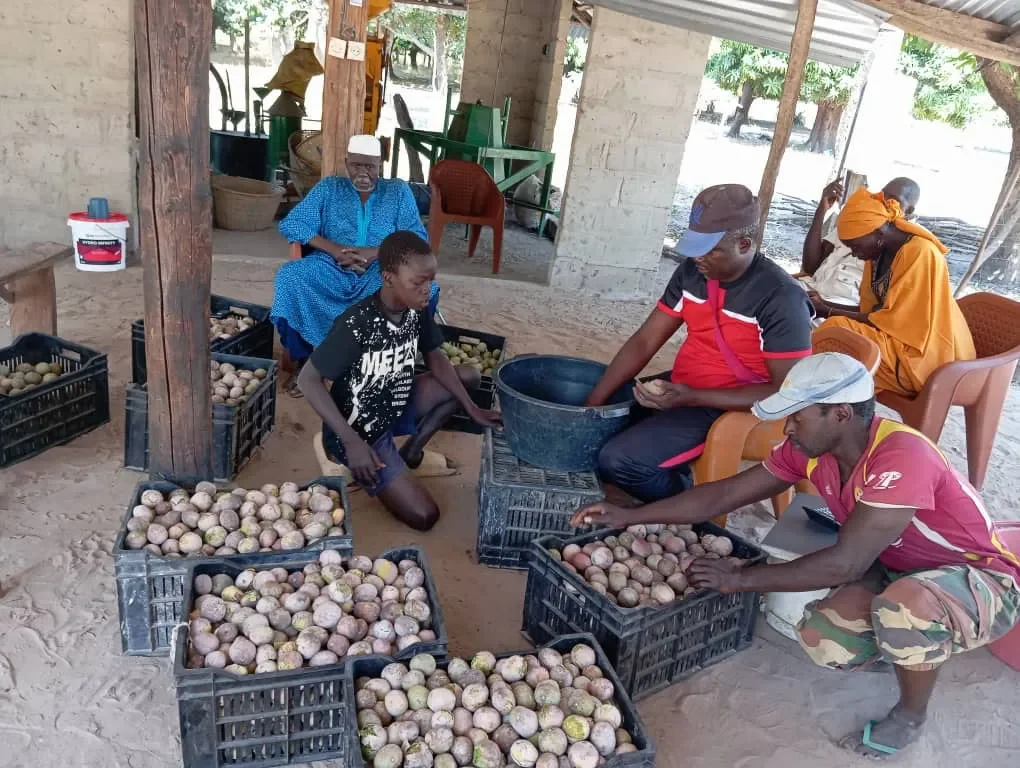
Thiobon, an economy driven by the “ditakh” (1/2) In Casamance, the organization and harvesting techniques give the “ditakh” of Thiobon a rather particular flavor. This forest fruit supports the economy of this village in the department of Bignona. It’s a good time for resellers and processors. However, the latter denounce the increase…
In Casamance, the organization and picking techniques give the “ditakh” of Thiobon a rather particular flavor. This forest fruit supports the economy of this village in the department of Bignona. It’s a good time for resellers and processors. However, the latter denounce the increase in the tax, which went from 15 to 50 FCfa per kilogram.
BIGNONA – Thiobon became famous thanks to its “Bukut” (initiation into Diola country), celebrated in August 2025. But long before this cultural and religious event, this village was already known to fans of “ditakh”.
This woody forest fruit (Detarium senegalense) constitutes a real local economy for the inhabitants of this village in the commune of Mangagoulack, in the department of Bignona. Unanimously appreciated for its flavor, this fruit, with its green, tangy and sweet pulp, is mainly consumed fresh or transformed into juice.
“Ditakh” is exceptionally rich in vitamin C, “up to ten times more than an orange”, we learn. Even if it is present in certain regions of Casamance, this fruit represents the identity of Thiobon because of its unique taste. The secret to this flavor lies in the production techniques.
“We don’t pick unripe ditakhs,” confides Vieux Sitapha Coly. According to the president of the Gie “Aroka”, the village has only hired young volunteers to monitor the forest. The Thioboese do not joke with this rule.
“If we catch a trafficker, we withdraw his collection which we give to the unions. In the event of a repeat offense, we simply ask him not to set foot in the forest again and to stay at home,” explains Sidaty Mané, president of the Gie “Aroka” organization.
“We are also looking for partners to support us in paying the volunteers responsible for monitoring the forest. The traffickers tire us,” he says.
The organization around the “ditakh” goes from the flowering of the fruit to marketing, including picking. During this period, no one ventures into the forest in search of this fruit, because there are days exclusively reserved for the opening and closing of the forest. Collection and marketing only take place on weekends.
An original and ancestral paid organization
Thus, on Saturdays from noon, young people, women and even the youngest go to the forest to pick and collect the “ditakh”. “The young people climb the trees and pick the fruit. The women collect and gather. Then, we send the collections to the “unions”. On site, people from the village buy the collection to resell it to foreigners,” explains Ndèye Fatou Coly.
In this organization, each district has its “union” or Gie, which takes care, in turn, of delivering orders to merchants coming from outside.
Fruit is sorted at these points of sale. Everything is tidy. Here, it is the Gie who come into play. For ditakhs with an unbroken shell, the 90 kg basket is sold at 16,000 FCfa, while those with a non-intact shell are sold at 7,000 FCfa.
The Gie buy from the pickers four unbroken “ditakhs” at 25 FCfa, and for the broken ones, five “ditakhs” are sold at 10 FCfa.
“We sell them by the box, by the basket or by the bucket. For unbroken ditakhs, the black bucket used by masons is sold at 2,000 FCfa, and broken ones at 1,500 FCfa,” explains Vieux Sitapha Coly.
For the Thioboese, the “ditakh” must ripen on the tree before being picked. Beyond the search for a better taste, this picking technique avoids waste and preserves the environment.
“Cutting branches reduces production and poses a real threat to our environment. From our ancestors to today, we have always refused to pick unripe ditakhs here in Thiobon,” explains the president of the Gie “Aroka”.
This know-how makes all the difference between the “ditakh” of Thiobon and that of other localities in Casamance. “The ditakh must be ripe. Elsewhere, people pick unripe ditakh to gas it,” laments Sidaty Mané.
Traders come from the interior of the country, from Gambia and even other localities, in search of the “ditakh” of Thiobon.
This traditional organization allowed the village to benefit from “ditakh”. The benefits generated by the marketing of the fruit made it possible to invest in infrastructure, finance activities and other village events. The income also covers the children’s education.
“It is also thanks to the savings from this fruit that we were able to fence our nine-hectare garden and make many other investments,” says Vieux Sitapha Coly.
Furthermore, according to the president of the Gie “Aroka”, bank credits are granted to members of the Gie.
Real impact on the village
Today, the Thioboese would like to have at least one ditakh processing unit so as not to export all the raw material. This would allow them to create added value and increase yields.
However, it is difficult to estimate the annual tonnage of this informal activity, but very lucrative for Thiobon. Weekly harvests vary between 65 and 100 baskets of 90 kg.
“On Saturdays only, we reach 4 to 5 tonnes. On Sundays, we harvest less than that,” informs Vieux Sitapha.
Children’s education and women’s empowerment
In Thiobon, children’s education is financed by income generated by the marketing of ditakh. This activity also allows them to take care of their health and the specific needs of families.
In addition, “ditakh” contributes to the process of empowerment of women in this locality in the department of Bignona.
“We collect the fruit in the forest. We buy it to resell it. Our income allows us to ensure the education of our children and, if necessary, their health,” relates Ndèye Aminata Coly, member of the “Kambeng Kadiamor” Gie, recalling that women wish to benefit from training in order to better transform the ditakh on site.
