
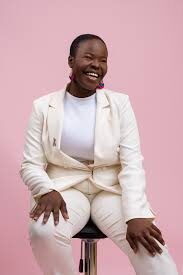
Stéphanie Damiba, doctor of medicine:The thesis despite cancer
Diagnosed with breast cancer at 24, Stéphanie Damiba, now 29, went through treatments while continuing her medical studies. In 2025, she defended her thesis. A journey where faith, scientific rigor and a quiet will served as a compass.
Breast cancer was not included in her university curriculum. Moreover, no amphitheater prepares for such an ordeal. In 2019, while she was dissecting organs, memorizing protocols and learning to treat others, Stéphanie Damiba suddenly became her own clinical case. “I received my first diagnosis of breast cancer at 24,” she says, looking back to distant memories. Diagnosis made, prognosis suspended.
So, she did not learn medicine standing up, wearing an impeccable coat and tidy certainties. Stéphanie Damiba learned it lying down, IV in her arm, body tested. And yet, here she is, at only 29 years old, taking the final step in her journey: she brilliantly defends her doctoral thesis in medicine. Scientific proof to support that the body can waver without the mind giving up.
However, while still a student, she received a diagnosis that no one wanted to believe: breast cancer. Too young, they said. She knew. “I think I have breast cancer,” she says in a calm voice to a doctor who refuses to believe it. Too early for a young woman. Too improbable.
The ultrasound shows nothing at first. So she continues her life. Sixth year medical student, in the midst of Covid-19, disrupted internships, normalized fatigue. In medicine, we learn very early to ignore our own body. Stéphanie will pay dearly for it.
Eight months later, the signs are clear. Another medical view is concerned. We mention a senologist. They are rare in Senegal. It still drags on until December 2020. This time, the exams are coming one after the other. January 2021: breast cancer. It’s clear now. Like rock water.
Medicine suddenly changes sides. In young women, the disease is more aggressive. We have to go quickly. Very quickly. Chemotherapies. Severe side effects. Pains. Extreme fatigue.
But, Stéphanie refuses to suspend her studies. “I did what I could: go to the exams,” she adds. Resilience ? “Even during chemotherapy sessions, we accompanied him to the hospital with our lessons to help him revise. And despite everything, she always kept a smile and an energy that commanded admiration,” testifies Dr. Julie Borges, a friend.
Covid-19 paradoxically works in its favor: online courses, reduced internships. She’s forcing. She holds. “I didn’t give up,” confides Stéphanie.
The strength of faith
For what ? She hesitates, then smiles: “I am the ray of sunshine in my family. If I had faltered, everything would have collapsed.” The eldest of three children, Stéphanie was born to a father who was a telecommunications engineer and a mother who was a former flight attendant.
His parents wanted a break. For the sake of their daughter. Stéphanie refuses. Not now. Not after all this journey. Her father, Erick Damiba, would later say: “She was the one who supported us. We should have been the ones to help him, but it was the other way around. His tenacity gave us strength.”
Dr Julie Borges corroborates: “One word sums up Stéphanie: positivity”. His mother, Philomène Siga Faye, speaks of absolute shock. “When you tell a parent that their child has cancer, it’s like the sky is falling. But, Stéphanie was zen. She did not show her pain. I imagined it. Her strength has become ours,” testifies the native of Mbodiène in a soft and calm voice.
The role of friends was also decisive throughout the fight. “I remember that at the start of her treatment, I accompanied her to her first chemotherapy session. There were three friends present. By the second session, his friends no longer wanted me to attend. Now she went with them,” her mother recalls with gratitude.
There is also faith. Stéphanie does not brandish it; she puts it down. “I am a Catholic Christian. My faith carried me. I told myself that this ordeal was a lesson.” So, not a punishment, but a passage, a parallel training.
The student learns medicine differently: from the waiting room, from the treatment room, from the anguish of patients undergoing chemotherapy. The following years are not linear. There are complications. Relapses. Some of the treatments are done in Senegal, the majority in France.
“There were not the necessary resources in Senegal for the stage of my illness,” she explains. New treatments work. Monitoring continues abroad. Stéphanie advances slowly, methodically, without heroic speeches.
His thesis arrives later than expected: in 2025, two years late. But the subject is anything but trivial: “The quality of life of patients undergoing chemotherapy, about 35 cases at the Amitié clinic in Dakar”.
“It was a choice of subject that my Professor suggested to me and which really interested me because we don’t often talk about the quality of life of patients undergoing chemotherapy in Africa,” she emphasizes. Stéphanie continues: “A study was carried out a few years ago on this subject, but it is the only one we know of in Senegal. I wanted to make my contribution, to bring more light, because cancer patients undergoing chemotherapy experience very complicated things.”
The thesis well mastered
Stéphanie knows what she is talking about. She has experienced what she measures. Daughter of a Burkinabè father and a Senegalese mother, she takes it without breaking down, as one learns very early to do when one is the eldest: in silence, with responsibility.
Where some would have put their lives on hold, it transforms the illness into a learning environment. In terms of studies, Stéphanie followed her entire school career in Dakar, from Sainte-Bernadette primary school to Sacré-Cœur high school where she obtained her baccalaureate in 2014, before joining the Saint Christopher School of Medicine.
In Dieuppeul, in the family living room ordered like a structured thought, short hair, without jewelry or bracelet, the young woman’s black complexion radiates calm joy, contrasting with her immaculate smile. Stéphanie is one of those who understood that surviving is already a form of victory.
Here, the resistance is neither heroic nor spectacular. She is methodical. Human. Sustainable. Her mother insists: “cancer is scary because we see death in it. We thought about it too. But Stéphanie’s morale was very strong. The mind counts as much as the treatments. Faith was also there,” reveals Ms. Damiba.
In his opinion, “our leaders must also think of the citizens”. “When they are sick, they go abroad for treatment. We were fortunate, but there is care that our policies could put in place here. All it would take is real will,” she pleads.
Stéphanie doesn’t shout. She speaks gently to young patients: “There is always a light at the end of the tunnel. Even when sick, you can continue to dream. Taking a break is not giving up, but moving forward despite everything.”
Today, she is a doctor. But, not like the others. Stephanie knows what it means to wait for a result. She knows what it means to be afraid. She knows the cost of the word “patience”.
She will now heal with knowledge, but also with memory. And this is, perhaps, the true singularity of his journey: having learned medicine where it hurts the most, on the side of those who hope.
Yes, tomorrow, Stéphanie will practice. Stephanie will listen. Stéphanie will take care of it. And no doubt, when faced with a worried patient, she will certainly know how to find the right words, those that cannot be learned from any manual.
Because she knows the disease. Because she knows fear. Because she now knows that you can fall very low without ever giving up on getting back up.
She is the proof: supporting her thesis despite cancer and the “Very honorable” mention with congratulations from the jury as a result.
Congratulations, Stephanie.
By Adama NDIAYE
