
The poetic soul of the Senegalese struggle March 29, 2026
Before the bodies clashed in the arena, the Senegalese struggle first gave way to words. Through the “bàkk”, the wrestler himself sang of his bravery, proclaimed his lineage and recounted his exploits. A true poetry of the arena, this ritual combines rhetoric, memory and staging to build the legend of the fighter. Between cultural heritage and modern spectacle, “bàkk” remains one of the most emblematic expressions of the wrestling tradition in Senegal.
In the Senegalese arena of the past, the fist only struck after the voice. Before the fight, the wrestler conquers space through words. With the “bàkk”, he imposed his legend, his history and his prestige. Each word was a blow, each sentence an invisible weapon that knocks down the opponent before the body engages.
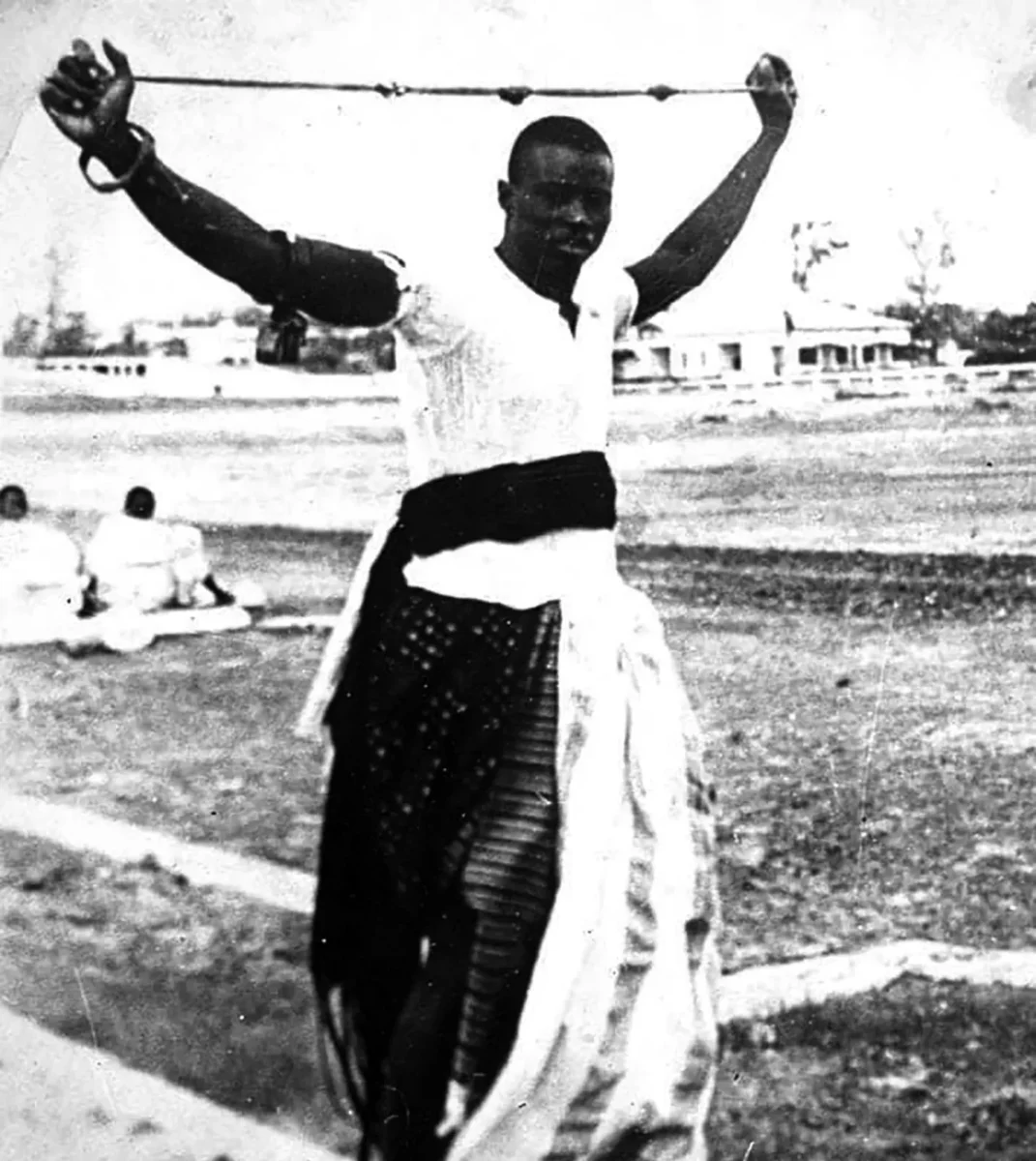
Standing facing the audience, loincloth tied around the waist, the wrestler raised his voice while the griot struck the drum. He proclaimed his strength, his lineage and his exploits. This performance called “bàkk” or “bàkku” was a true poetry of the arena, a refined form of oral literature where the wrestler became at the same time warrior, poet and storyteller of his own legend.
A word to build the legend
In his end-of-studies thesis entitled (The “bakk” and the “bàkku”: gymnastic and choreographic dance of Senegalese wrestlers) defended at the National Higher Institute of Popular Education and Sport (Inseps), Modou Seck specifies that “it is the one that the wrestler declaims and this can happen before a fight, during the preliminaries, either before the choice of the opponent, or after the choice of the opponent”.
“bàkku”, a reflexive form of the word, literally means to sing to oneself, to glorify oneself, to parade. This was not mere boasting. In ancient tradition, the wrestler became both warrior and poet. His speech obeyed a precise structure: a motto, a genealogy and the listing of his victories.
The griot struck the drum, set the rhythm, and the wrestler responded with words and dance. The “bàkku” then served several purposes: to assert one’s reputation, to impress the opponent and to galvanize the supporters. The wrestler sought to impose his presence in the public imagination.
Thus, in his famous “bàkku”, Abdourahmane Ndiaye known as Falang, the “Lion of Diender”, proclaimed his power by evoking his past battles “Ñaari kuuy bu ñu fenxoo ci mbalka naan fa du yomb, Te ñaari mbër bu ñu fenxoo ci géew da ñuy njuga rell! Te man Falang ku ma janool ci làmb yobbu sa bayre” (Editor’s note: When two rams collide at the trough, it becomes difficult to drink from it. When two wrestlers meet in the arena, they confront each other. But I, Falang, the one who finds me in the fight, I take away his prestige).
In these words, the image of the clash of the rams already announces that of the wrestlers. The metaphor is warlike, total assurance. Falang not only defeats his opponents, he takes their prestige with him. The “bàkku” transformed the arena into a dramatic scene. The wrestler didn’t just talk about his strength. He also wrote his story there.
The legendary Mame Gorgui Ndiaye de Fass thus recalled his reputation and his victories in an almost infinite enumeration: “Ma ne lim du wër ub réew, Man Njaay ndaanaan laa ñaari yoon, Man Njaay foo jàpp fa laa mane” (Listing and enumerating my victories will never go around a country. Me Ndiaye, I am doubly a star. Where I am seized, I can fight).
In this heroic rhetoric, speech becomes a tool of symbolic domination. Even before fighting, the wrestler imposes his status, impresses the opponent and galvanizes the public.
A living memory
Some “bàkku” even went beyond self-praise to become stories of memory. In his, Njuga Tine from Dakar evokes missing wrestlers, ancestors and lineages. His words almost become an elegy “Tey ma jooy Bàllago ndey siin… Man kay sama mame a nga daanoo Lāmbaay… Waaye maa juddoo Làmbaay, Maa yaroo Làmbaay, Fekk baax ca Làmbaay” (Today, I cry Ballago Ndèye Sine… My grandfather fell in Lambaye… But I was born in Lambaye, I was raised in Lambaye, and I received honors in Lambaye).
Through these words, wrestling ceases to be a simple sport. It becomes a family heritage, a historical continuity, a collective memory.
His metamorphosis
But, over time, the Senegalese struggle has profoundly changed. Media coverage, high fees and sponsors have transformed the arena into a real entertainment industry. Consequence? The “bàkk” itself has evolved.
Where the ancients favored poetic density and epic words, modern wrestlers now multiply choreographies, ballets and spectacular stagings. Dancing often takes up more space than speaking. The formula of the great champion Mame Gorgui Ndiaye perfectly summed up the original balance: “Bàkku wax la ak fecc” (bàkku is speech and dance).
Today, some observers believe that the balance now tilts more towards spectacle than poetry. This transformation is not trivial. It reflects a broader mutation: that of a struggle that has gone from a cultural ritual to a sports and media industry.
The “bàkk”, once an instrument of memory and social prestige, gradually becomes an element of staging in a sports show. However, despite these changes, the words of former wrestlers continue to resonate in the collective memory.
Because deep down, in the Senegalese tradition, a great wrestler is not measured only by the strength of his arms. He is also measured by the power of his word. And as long as the drums of the griots continue to beat in the arena, the echoes of the “bàkku” of Falang, Njuga Tine, Mame Gorgui Ndiaye and others will remind us of a simple truth: before the wrestlers overthrew their opponents, they were already overturning the arena with their words.
At a time when “bàkk” are becoming rarer in the arena, a few wrestlers are standing up as defenders of this tradition. Lassana Cissé, Tapha Gueye 2 and Ousmane Diop are part of this handful of enthusiasts determined to keep alive this art which has long accompanied combat.
In an increasingly modernized world, these wrestlers appear today as true guardians of tradition, reminding us that Senegalese wrestling is not only a sport, but also a cultural heritage.
By Djibril Joseph KAMA
