
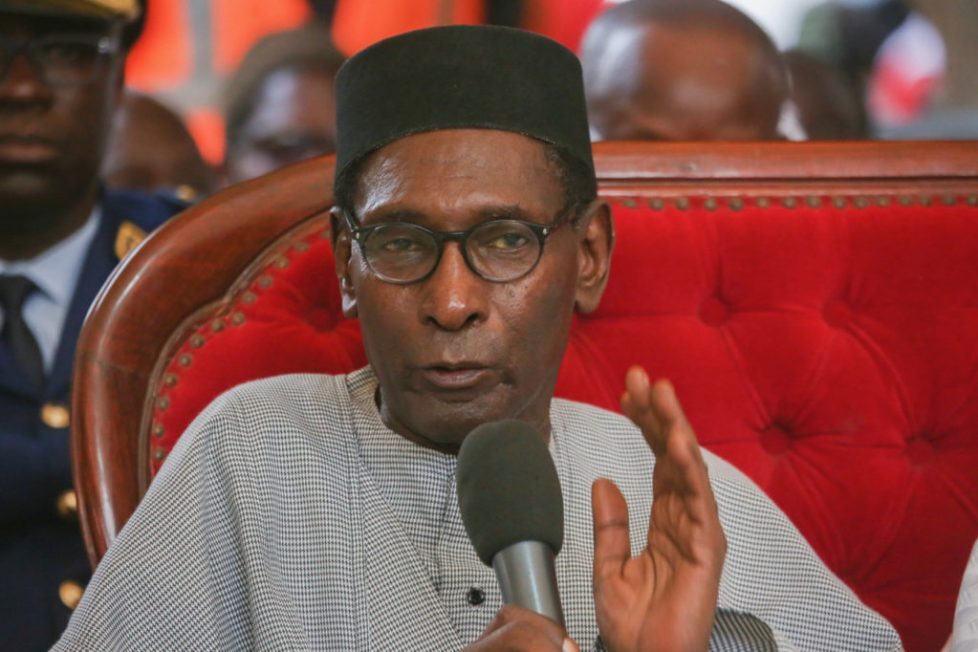
Seven years after his call to God, Ndiassane celebrates Ahmed Bachir Kounta
Ndiassane remembers, this January 17, a great man, the one who defended the religious city until his last breath: Mohiddin Ahmed Bachir Kounta. Spokesman for the Caliph Generals of Ndiassane from 1973 to 2019, he was a statesman, but also a renowned journalist, specialist in the translation into Wolof of official messages during major moments of the Republic. A fervent Muslim, he invoked God until his last breath.
He would have been 89 years old in 2026 if he had not been called to God on January 17, 2019. A distinguished and eloquent journalist, Ahmed Bachir Kounta was particularly known for the translation into the national Wolof language of presidential speeches at the end of the year and on Independence Day. After the official speeches of the Presidency during the key moments of the Senegalese nation, it was he who appeared on the screen, symbolically taking the place of the head of state. With solemnity, presence and serenity, he faithfully relayed the message to the nation to the vast majority of Senegalese who did not master the language of Molière.
Very composed, his presentation left no one indifferent. He chose each word carefully, communicating wisely, transmitting his message without offending public opinion while capturing the attention of viewers and listeners. He spoke Arabic, French and Wolof, the language of Kocc Barma, easily. He was also a specialist in sports reporting.
Mohiddin Ahmed Bachir Kounta bowed out after 82 years of loyal service to the nation and to Ndiassane, including a little over 40 years at Senegalese Radio-Television, from ORTS to RTS.
A model journalist
Born in 1937 in Saint-Louis, Ahmed Bachir Kounta is one of the rare, if not the first, grandsons of the founder of Ndiassane to have attended French school, in addition to the Sufi training specific to religious families. This gave him an excellent command of the French language.
He grew up between Saint-Louis and Tivaouane, with his aunt Marième Kounta, wife of Seydi Ababacar Sy, first caliph of Seydi El Hadji Malick Sy.
According to Professor Mohamed Kounta, he had attended the Faidherbe high school and was an excellent writer, a true grammarian. “If I chose to study modern literature at university, it is thanks to Bachir Kounta,” he admitted.
Son of the sixth Caliph General of Ndiassane, El Hadji Mame Bouh Mamadou Kounta, Professor Mohamed Kounta emphasizes that Ahmed Bachir also instilled in him punctuality and rigor in his work.
He joined Senegalese Radio and Television in 1957, where he was supervised by El Hadji Ousseynou Seck, one of the pillars of RTS.
“El Hadji Bachir Kounta embodied intellectual rigor: very correct, very cultured, methodical, language technician, self-made man, fervent defender of brotherhoods, particularly Khadria,” testified Mouhamed Kounta.
A link between the brotherhoods
Spokesman for the Caliphs of Ndiassane from 1973 until his death in 2019, he was also their advisor and worked hard for the unity of the brotherhoods. Mouhamed Kounta remembers his words affirming that Touba, Tivaouane, Ndiassane and the Layènes had the same spiritual founder. “It is a person with many faces who has appeared in these religious homes,” he said, to signify that the brotherhoods are one and indivisible.
Close to Serigne Fallou Mbacké and Serigne Babacar Sy, the grandson of Mame Bou Kounta, founder of Ndiassane, was a tireless soldier of Islam. He was not only the spokesperson for Ndiassane, but that of all the brotherhoods. He refused any falsification of history, often recalling: “We can violate history, but we cannot give it a child. »
Endowed with an exceptional memory, he remembered the dates of major events and sometimes even the most precise details, down to vehicle numbers, underlined Mouhamed Kounta.
A statesman
Ahmed Bachir Kounta was also a statesman, testified his wife, Sokhna Astou Kounta. Pious, generous, humble, respectful of the principles of Khadria and Islam, he was a true Sufi. He never made malicious remarks about others in his absence.
For his wife, Ndiassane lost a man of inestimable value.
“I witnessed his last moments of life and he never stopped calling on God until his last breath,” she confided with emotion, seven years after her call to God. “Today we continue to pray for him and ask for divine mercy,” she added.
He accompanied almost all the heads of state of Senegal, without ever divulging the slightest secret. An exemplary family man, he was very methodical and organized.
