
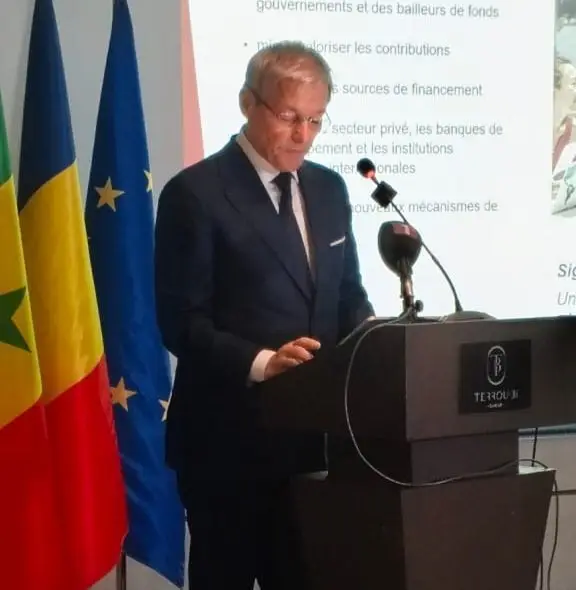
Race for the General Secretariat of La Francophonie: Romanian candidate Dacian Cioloş reveals his vision in Dakar
Former Romanian Prime Minister Dacian Cioloş chose Senegal, “spiritual and political home” of the French-speaking world, to officially unveil his program for the post of secretary general of the International Organization of La Francophonie (OIF). Accompanied by a large ministerial delegation, the candidate met the President of the Republic of Senegal before presenting, in front of an audience of diplomats, a resolutely pragmatic project, focused on youth employment, the overhaul of governance, the economy and food sovereignty.
This Monday, June 8, 2026, Dakar was the center of French-speaking diplomacy. By choosing the Senegalese capital to officially launch his international campaign, Dacian Cioloş did not indulge in a simple exercise in political style. He anchored his approach in history. Facing the diplomats and guests gathered in Dakar, the Romanian candidate immediately paid vibrant tribute to the founding fathers of the institution: “Senegal is not a pillar member state, it is one of the spiritual and political homes of the Francophonie”. Referring to the tutelary figures of Léopold Sédar Senghor and Abdou Diouf, Mr. Cioloş recalled that the future of this linguistic community could only be written with “Africa at the heart”. More than a diplomatic courtesy, this choice establishes Senegal as one of Romania’s main partners in the region, illustrated by decades of academic and human exchanges.
Before unveiling his five priority projects during a cocktail dinner, the Romanian candidate, with his past as Prime Minister and European Commissioner for Agriculture, spoke with the Senegalese head of state. This summit meeting made it possible to discuss the challenges and issues of the day for the Francophonie.
To respond to these major challenges, Dacian Cioloş proposes a real breakthrough in method. According to him, the secretary general must no longer be the simple head of an administration, but a facilitator “at the service of member states and governments”. This requires a global overhaul of governance, focused on transparency, accountability and sound management of human resources. The stated objective is pragmatic: modernize the institution to attract new funding and reassure international donors in order to give substance to field projects.
Transforming the French language into an opportunity
The heart of Dacian Cioloş’s project lies in the transformation of the French-speaking area into a truly dynamic economic community. If culture remains the unwavering glue of the OIF, it must now be accompanied by concrete tools for growth. “Young people will learn French if they benefit from it, if the language offers them real opportunities,” insisted the candidate.
To do this, the program plans to intensify partnerships between businesses, universities and networks of women and young entrepreneurs. By emphasizing employability and professional integration after training, the Romanian candidacy hopes that the Francophonie will become a major commercial and investment lever, capable of competing with other global linguistic spaces.
Agriculture and sustainable transition as major axes
This is undoubtedly the most striking innovation of this electoral platform: the introduction of food sovereignty issues at the heart of the French-speaking agenda. Aware of the exceptional agricultural potential of the African continent and Senegal in particular, Mr. Cioloş wants to leverage his past expertise as manager of the European Common Agricultural Policy (CAP).
Far from wanting to encroach on the role of specialized international agencies, the candidate envisages the OIF as a unique network for technology transfer, sharing of good practices and sustainable management of natural resources in the face of climate change. This involves supporting the creation of efficient agricultural sectors, encouraging local processing of agri-food products and generating added value directly in rural areas, thus stabilizing young populations through employment.
A space of peace, culture and mediation
Finally, the Romanian project reaffirms the values of dialogue, cultural diversity and political moderation. At a time when geopolitical tensions are increasing, the candidate wishes to position the Francophonie as a privileged space for preventive diplomacy and conflict management. Facing African countries, Dacian Cioloş highlighted the singularity of Romania’s history, free from any colonial past on the continent. An asset, according to him, for building renewed cooperation, based exclusively on mutual respect, listening and the constant search for consensus.
He took the opportunity to salute the “realistic and committed” vision of the new generation of Senegalese leaders. The Romanian candidate leaves Dakar, laying the foundations for a candidacy that aims to be inclusive, bold and resolutely focused on the future of its citizens.
Daouda DIOUF
