
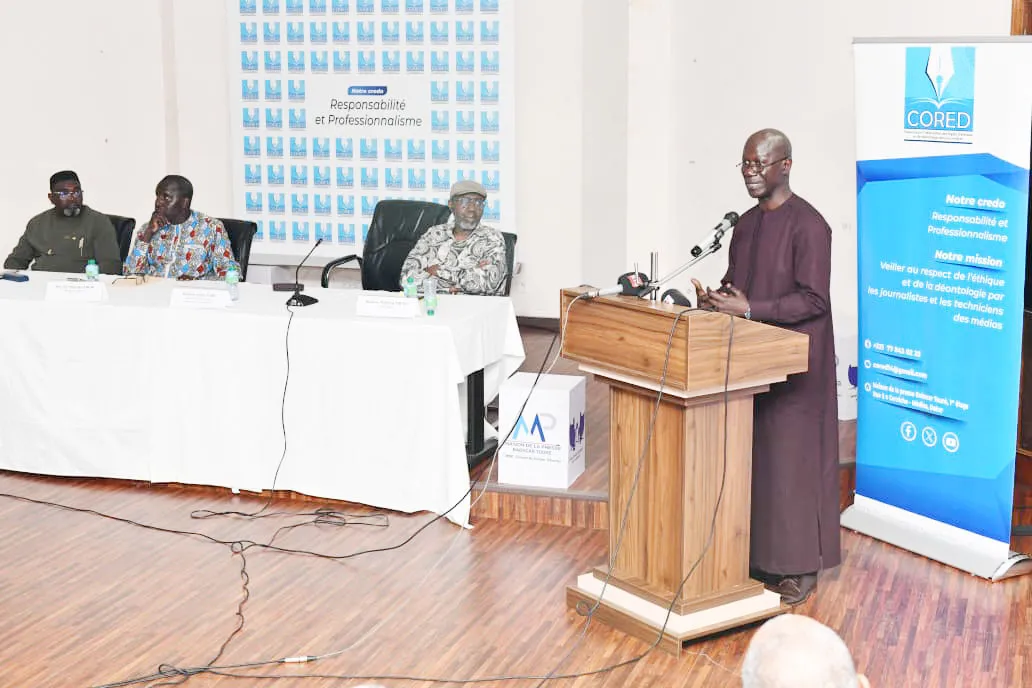
CORED AG: more means for effective media self-regulation
Faced with the growth of the media and digital platforms, the Council for the Observation of the Rules of Ethics and Professional Conduct in the Media believes that strengthening its resources has become a necessity to guarantee effective self-regulation. Cored held its Ordinary General Assembly on Saturday July 4, 2026, at the Babacar Touré Press House.
The members of the outgoing office of the Council for the Observation of the Rules of Ethics and Professional Conduct in the Media (Cored) exercised their mandate in particularly difficult conditions. This is due to a chronic lack of financial resources. For nearly a year and a half, the institution operated without a fixed headquarters, with limited material and financial resources, forcing its members to hold their meetings in different locations. “We operated with the means at hand until the day we were no longer able to continue. Hence the closure of our offices for five months, from the end of June to the end of November 2025, seriously impacting our daily self-regulation mission as well as the process of issuing the National Press Card,” recalled the outgoing president of Cored, Mamadou Thior, on the occasion of the body’s Ordinary General Assembly, held on Saturday July 4, 2026 at the Babacar Touré Press House.
This meeting served as a forum for Council officials to plead in favor of strengthening its financial resources, in order to enable it to fully accomplish its mission. “We cannot enforce iron discipline with makeshift tools. Self-regulation has a cost, and this cost is currently underfunded. The Peers Tribunal and the Cored Directory operate with alarmingly thin resources in the face of the explosion in the number of media, information sites and digital platforms,” lamented the president of the Peers Tribunal, Ibrahima Souleymane Ndiaye. In his eyes, the main challenge lies in strengthening the monitoring system. “How can we validly judge if we cannot see everything? “, he asked, before pleading for “an urgent and massive strengthening of the means of action”, particularly in the area of media surveillance. “Monitoring is Cored’s eyes and ears.
Scientific monitoring
Without an efficient technological and human surveillance system, capable of scanning Senegalese radio, television, written press and cyberspace in real time, our action will remain partly reactive, dependent solely on complaints from citizens,” he maintained.
According to him, to have a “broadest, most exhaustive and fairest” vision of the Senegalese press, the Council must be equipped with a real scientific monitoring unit. “This is the price to pay to anticipate abuses, document shortcomings in an indisputable manner and definitively establish the authority of our decisions,” insisted Mr. Ndiaye. Before adding: “A press that self-regulates poorly is a press that threatens social peace. Giving Cored the means to monitor and judge means guaranteeing citizens a quality public debate. » The outgoing president also stressed that regular media monitoring remains the institution’s weak link. “We started it modestly this year, but the material and financial resources necessary for its optimization have not yet been gathered,” regretted Mamadou Thior.
Speaking, the Minister of Communication and Relations with Institutions, government spokesperson, Bacary Sarr, recalled that the modernization of the media sector constitutes a priority for the public authorities. According to him, this ambition involves both better governance of the sector, the creation of conditions allowing press companies to be economically viable and the improvement of the working conditions of media professionals. “Our ambition is to build, through dialogue and permanent consultation with all players in the sector, a modern, responsible and professional media ecosystem,” declared Mr. Sarr, before reaffirming the availability of his department to support Cored in carrying out its missions.
Aliou DIOUF
