
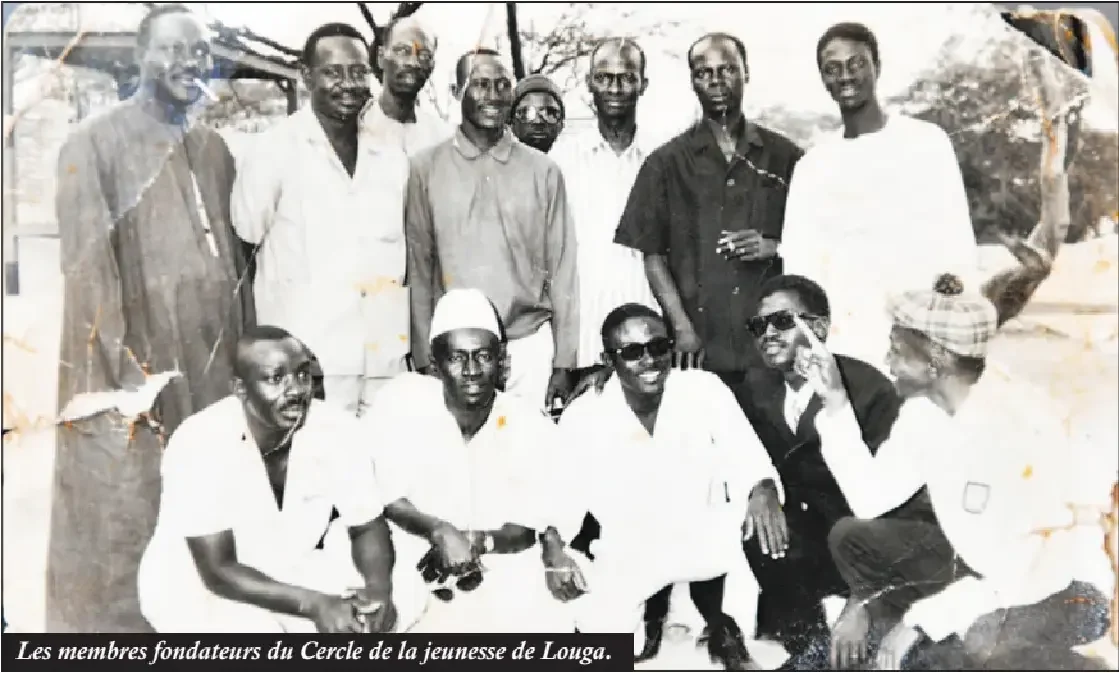
Louga: at the heart of the epic of the Youth Circle
Living memory of a collective genius, the Louga Youth Circle, founded in 1951, made history for having produced large-scale theatrical, musical and folkloric works, crowned by international influence beyond Africa.
Louga, Artillery district. It is here, in his vast and green house, that the president of the Youth Circle receives us, this Thursday, November 27, 2025. Cheikh Zaccaria Niang is “proud and happy” to welcome the “Sun” team. “Make yourself at home,” says the sixty-year-old, warm and friendly. To “complete” him and “help him carry out a good interview”, Cheikh Zaccaria calls on his partner, El Hadji Mor Fall, current general treasurer of the Circle. Then the interview begins.
A beautiful, immersive conversation, rich exchanges and memories. The Louga Youth Circle, says Zaccaria Niang, is first and foremost the idea of a group of friends, all brilliant and passionate, led by an exceptional spirit: Mademba Diop, affectionately called “Mass Diop”. “Mademba is undoubtedly one of the most gifted of his generation. His boundless intelligence impressed everyone. The Louga Youth Circle is first and foremost him,” says Cheikh Zaccaria Niang.
Elhadji Mor adds: “He was ahead of everyone.” This is because the group became aware very early on of the role it was called to play in society. Made up of Mademba and his friends Baba Diallo, Allassane Camara, Birahim Dieng, Demba Dièye, Mbol Seck, Elimane Thiam, Abiboulaye Samb, Kader Dia, Ibou Diagne, Ibrahima Ndiaye, the group quickly distinguished itself with an admirable desire: that of dialoguing with history, of creating a system of thought, a destiny worthy of traditional Senegalese values.
Their favorite field: popular theater intended to raise awareness among populations about social and political facts. The idea and the approach were to bring together all the Lougatois artists around a common project, but also to renew them by identifying the talents of tomorrow. In reality, the Circle encompassed: theater, dance, singing, but also popular education and sport. Not to mention that he also fought for the independence of Senegal, obviously through the prism of culture. Indisputable label of the living arts “The Circle played an extremely important role in Senegal’s accession to independence,” notes Youssou Mbargane Mbaye.
The traditional communicator goes further: “Many are talking today, but what the Circle has done for a free Senegal, few associations have done it,” maintains Dean Youssou Mbargane who received us at the Regional Cultural Center, his “second home”. It must be said that the context was favorable. Louga, a city at the crossroads, saw the birth of a culture, the fruit of a ferment and a gigantic human intermingling. Artists, dancers, troubadours, poets met there at the end of their field work to express their talent. Senegalese values were the main source of inspiration for the Circle.
The advantage was twofold: the message passed quickly and a beautiful communion was created between the Circle and the populations. “The pieces were always drawn from ritual, rites and beliefs, popular traditions and rural activities,” emphasizes Youssou Mbargane. “Everything was taken from Senegalese realities,” confirms Zaccaria Niang, who adds: “In the pieces, the group put a lot of emphasis on ethics, respect for one’s word, courage and humility. Better still, the lyrical element was not dissociated from the dramatic element. “.
Another particularity at the base of the cultural reputation of the Circle: traditional dance. “It was a pleasure to see the Circle on stage. The spectators were amazed. “The dances were a message from the heart and the mind that the body expresses,” Youssou Mbargane likes to say. Obviously, success was not long in coming. First in Senegal and Africa (Gambia, Mauritania, Mali, Guinea, etc.), then on the prestigious stages of Europe and the Americas (France, England, Finland, Mexico, etc.).
Rarely has a local “Third World” group seduced the world so much. From 1951, the year of its creation, to 1970, the date on which it was declared “out of competition”, the Louga Youth Circle was unbeatable, winning several prizes: 1957: cup of the Aof Youth Council 1960 and 1962: cups of the President of the Council Mamadou Dia; 1964: President Senghor’s cup; 1966: participation in the World Festival of Youth Centers in Narbonne (France).
In 1962, the Cercle and Star Jazz de Saint-Louis represented Senegal at the Youth and Students Festival in Helsinki, Finland. “The Circle won all the prizes in the competitions. No group had the level of Lougatois,” specifies Babacar Sarr, president of Fesfop. And in 1970, what had to happen happened: the Circle was declared “out of competition”, a victim of its creative genius. But before that, he had finished being what everyone recognizes today: an indisputable label and a formidable talent machine.
Abdoulaye DIALLO
