
Living together disrupted by irregular emigration January 13, 2026
Located on the coastal part of Mbour, the Téfess district, stronghold of the Lébous, has become, over time, a real melting pot. With a well-organized social life around the sea, the locality founded towards the end of the 19th century tries to preserve its traditions, despite the wind of modernity blowing through the city. Today, Téfess suffers the consequences of irregular migration which drains it of its youthful substance.
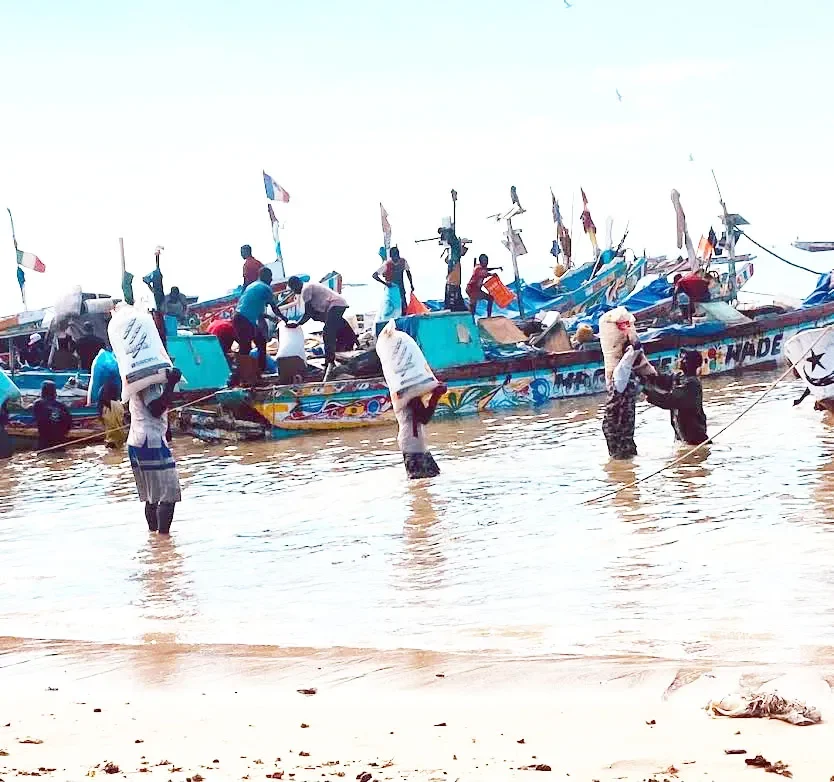
MBOUR – Its dusty streets flooded with rubble lead to the sea. In the surrounding area, fishing nets are spread out to dry in the sun. In this morning the carts transport people, goods and luggage.
A stone’s throw from the din of the city of Mbour, Téfess reveals itself as a maritime district, most of whose activities revolve around the deep blue. Every morning, dozens of canoes throw themselves into the sea in search of fish products. Here, the fishermen, heirs of several generations of men of the sea, tame the ocean from which they draw their means of subsistence.
On this seafront of Mbour, an entire economy is being built. Ice factories, gas stations, canoe makers, carters, street vendors and simple onlookers form the elements of the decor.
In this traditional bastion, each house tells a story and each street carries hundreds of memories that recall the glorious past of this fishing community. Here, we don’t need to go back in time to know the close links between Téfess and the sea.
“My grandfather was the first to arrive here with his canoe in 1898. It was after him that the community grew. At the time, there were the Seereer who occupied the arable land. Two centuries later, Mbour has become a large city where all ethnic groups meet and coexist in perfect harmony,” remembers Jaraaf Alioune Badara Ndoye.
For this octogenarian, Téfess had its heyday with an abundance of fish. At the time, fishing was a real source of income that supported the entire community. But, with the population boom and the arrival of foreign boats, the sea is emptying of its resources.
A social hierarchy still alive
As the day progresses, Téfess changes face. Toddlers returning from school blend into the decor. On the shore, canoes returning from fishing raise hope. This lively and intense atmosphere recalls the fervor of this district nestled along the coast.
In this Lébous stronghold founded around the 1880s, certain social values still stand the test of time. Kinship ties are jealously guarded and good neighborly relationships are evident in discussions. Some decisions are even taken following popular consultations between different family leaders.
And it is around the Ndéye-djirew (legal entity and Minister of the Interior) that social life is organized. On a daily basis, the manager in charge of social security must report to his post (Kourel Gui) to inquire about the situation in the neighborhood. No other member of the community can comment on a subject of general interest without the prior authorization of the traditional chief.
This model of governance based on seniority aims to foster a peaceful climate and promote solidarity and peace.
“Everyone is welcome here. Resources belong to everyone. We welcome, with open arms, all the communities who come here to work on the sea,” says Baye Dame Gning, Ndeye-djirew from the Lébou community of Mbour.
Like other Lébou strongholds in the country, the inhabitants of Téfess perpetuate an ancestral heritage. They know each other, help each other and share the happy moments and the heavy trials of life often caused by the phenomenon of irregular migration.
Dreams turned towards Europe
A working tool often passed down from father to child, the canoe, the emblematic symbol of Téfess, has long accompanied the evolution of this coastal community. With the scarcity of resources, the canoe became a means of transport to reach the Spanish coasts.
In recent years, the Téfess district has been strongly affected by the phenomenon of irregular migration. Several dozen young people looking for a new start ultimately perished in the depths of the Atlantic. Although it provides life, the sea has also taken human lives. Many young people from the neighborhood paid with their lives trying to reach the Canary Islands.
Despite these bad episodes, the inhabitants of Téfess are not giving up. “Today, fishing equipment is expensive and resources are scarce. Catches have seen a significant drop and this has had a considerable impact on stakeholders. Certainly the State is making efforts, but even more is needed to secure the young people who take the canoes,” said Baye Dame Gning.
He believes that the authorities can help young people to settle down by adopting an employment policy. But in the meantime, people live in hope of a more secure future.
