
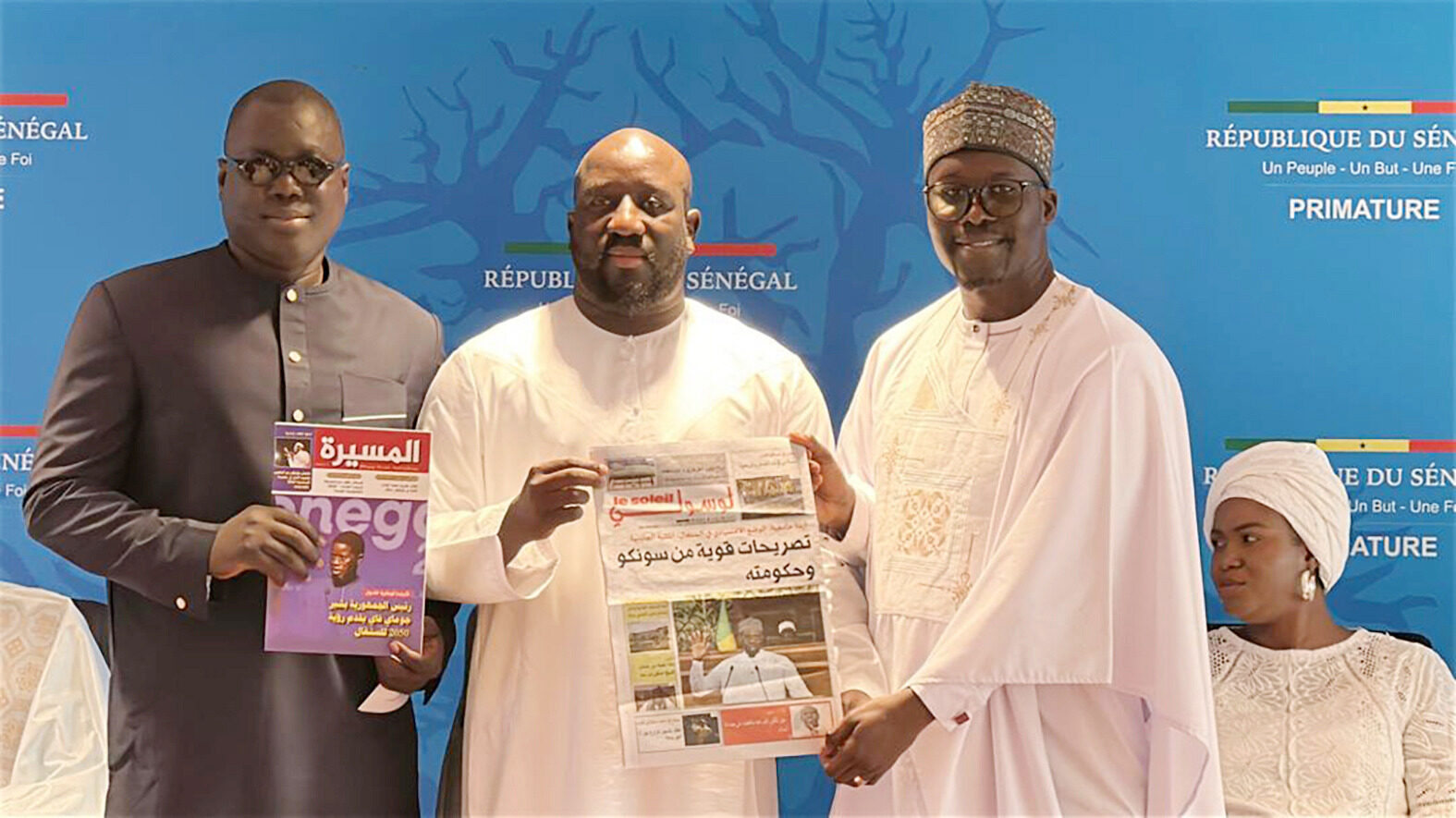
Launch of “Al Missirah” presentation of the weekly “Sun”: Arabic at the center of institutional communication
The Ministry of Communication, Telecommunications and Digital Affairs launched this Friday its institutional newspaper in Arabic, “Al Massirah”. This new title affirms Arabic as a lever for linguistic inclusion in public communication.
Through a ceremony held at the Administrative Building on February 27, the Ministry of Communication, Telecommunications and Digital Affairs launched the Arabic Language Inclusion Day and the new institutional newspaper in Arabic, “Al Massirah” (The Journey). This inaugural meeting was also marked by the supervisory authority’s commitment to strengthening the Arabic version of the daily newspaper “Le Soleil”, weekly (every Thursday), launched on March 12, 2025.
These publications go in the direction of affirming the Arabic language as a vector of government communication, informational inclusion and international cooperation. The objective is mainly to reduce inequalities in access to information for Arabic speakers, to involve Arabic-speaking public media as instruments of cohesion, as well as to establish relevant diplomatic and media bridges with the Arab world. It would be more accurate to speak of a relaunch concerning “Al Massirah”. The title existed from the first governments of Senegal, in the early 1960s with Léopold Sedar Senghor and Mamadou Dia, to carry the voice of the Executive in Arabic.
According to Habibou Dia, the government perpetuates the tradition of consideration of this “language of history, science, commerce and religion”. The Director of Communication said that we cannot despise Arabic, which was taught in our universities (Pire, Timbuktu, etc.) before colonization and which continues to punctuate Islamic teaching in our predominantly Muslim country. According to him, we cannot hide this language even less in this context where the Head of State and the Prime Minister value the dissemination of government communication in languages, and at a time when our country supports the Palestinian cause and occupies a place of choice in the OIC. Also, he added, press releases from the Council of Ministers are systematically translated into Arabic. “Al Massirah”, which is based on “Le Soleil”, therefore returns to its time.
Arab “The Sun”, strategic choice
The general director of Sspp Le Soleil, presenting the Arabic version of “Le Soleil”, immediately clarified that it is not a religious newspaper. The ambition for this weekly title is in line with the missions of “Le Soleil”, which are to popularize government actions and to affirm public service involving the consideration of all social strata.
“It is important to include the reflections of Arabic-speaking intellectuals in the public space. 28% of the population in Senegal regularly speak and read Arabic, alongside their mother tongue. Again, in 4 regions, Arabic is the most used language.
“The Sun” Arabic version is not just another product, it is a strategic, geopolitical and cultural choice, a way to attract partners from Arab countries,” explained Lamine Niang. He urged Arabic speakers to take ownership of “Le Soleil”, the Arabic version which is distributed throughout Senegal, and partners to financially support its production.
Mor Loum, speaking for Arabic speakers and coordinating the translation of the Arabic “Sun”, shared the satisfaction of his peers who “have the feeling of being associated with the construction of the country and the awakening of consciences”.
Alioune Sall, Minister of Communication, Telecommunications and Digital Affairs, chaired the ceremony, with Marie Rose Faye, Minister Spokesperson for the Government. The minister welcomed this “democratic imperative”, which is in line with the National Transformation Agenda which does not intend to leave any layer behind, and in the dynamics of the New Technological Deal.
Access to digital infrastructure, the minister believes, must be accompanied by equitable access to content and information.
“Digital inclusion must be linguistic. Your approach contributes to our territorial equity policy. Areas where Arab-Islamic education is strongly established and modernized, dedicated universities and Arabic-speaking cultural centers must access, in their spoken language, public information and opportunities offered by the State. It is a question of justice and the effectiveness of the Government’s action,” admitted Minister Alioune Sall.
Mamadou Oumar KAMARA- Djamil THIAM (Video)
