
“It is not an obligation for the wife to replace the husband with family responsibilities” January 27, 2026
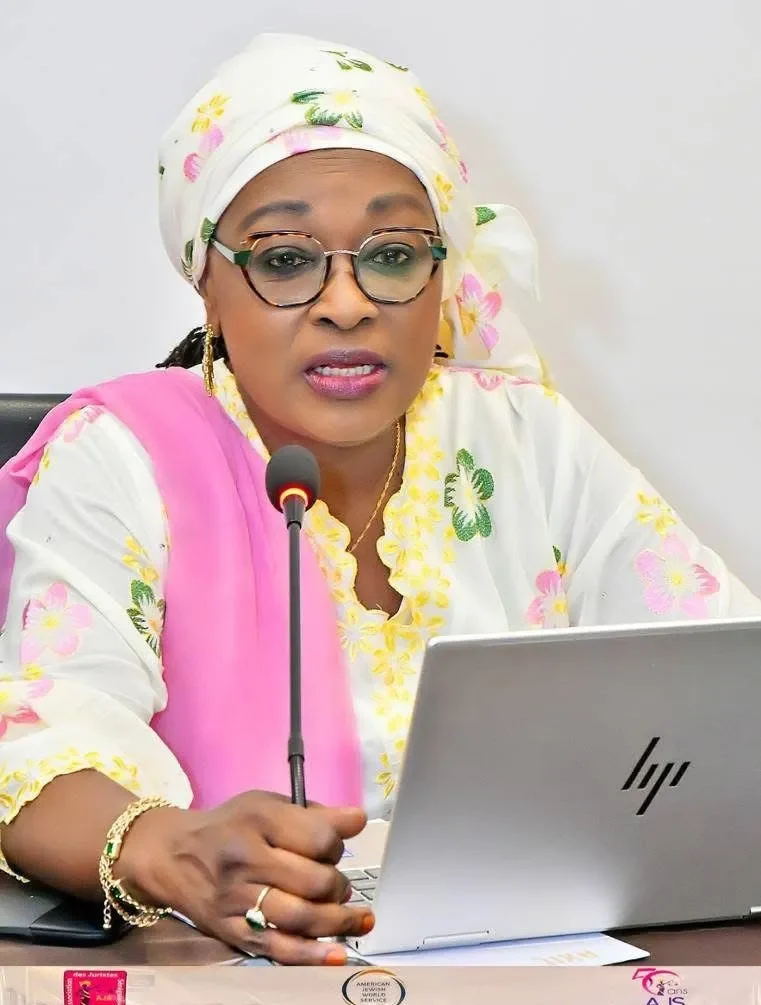
Aminata Fall Niang, president of the Association of Senegalese Jurists (Ajs) emphasizes, in this interview, that the Family Code does not require the woman to replace the husband for household expenses. The jurist lifts the veil on the asymmetry between social practices and the legal framework, and pleads for reforms enshrining marital co-responsibility and the recognition of women’s work, particularly unpaid work.
Does the legislation in Senegal require women to contribute to household expenses?
The rule laid down by the Family Code is based on a hierarchical conception of marital relations. Thus, the husband is the head of the family (article 152). In this capacity, he chooses the marital home (article 153) and primarily ensures the maintenance of his wife and children (article 375).
For women, the general obligation to contribute financially to household expenses, in the same way as men, remains accessory under the current provisions of the Family Code. If she is in a position to do so, for her it will be an option based on marital solidarity or on an agreement of will. In other words, a woman cannot be legally forced to take the place of her husband for the financial obligations incumbent upon him as long as he is able to provide for them.
In specific cases, and taking into consideration the best interests of the children, a judicial decision could nevertheless impose specific obligations.
In any case, Senegal recognizes women’s right to individual property, but also mostly has the regime of separation of property as a common law regime. This means that each spouse remains legally the owner of their property, unless proven otherwise. Thus, the woman can freely enter into contracts, dispose of her property and income, participate in family management and refuse to have responsibilities imposed on her that are normally the responsibility of the husband.
It is important to remember that the woman can take legal action if the husband seriously fails to fulfill his maintenance obligation or takes, as head of the family, decisions contrary to the interest of the household, or even dangerous for it. However, this referral often remains difficult for the wife, due in particular to ignorance of the law, legal delays, lack of resources or even family pressures.
However, economic reality shows that more and more women today assume a part that is no longer incidental, but a determining part of household expenses to ensure the proper functioning of the home. Unfortunately, this new family configuration is not expressly recognized by law.
There is thus an asymmetry between the evolution of social norms and the current legal system, marked by the absence of normative recognition of the contribution of women to the household, including in households de facto headed by single women.
For comparison, the Personal and Family Code of Burkina Faso imposes a proportional contribution to household expenses on both spouses, according to their respective economic capacities. As for Morocco, it recognizes the economic contribution of the woman to the enrichment of the couple and allows a distribution of assets based on the actual contribution.
Read also: Family responsibilities: Women on the front line
Does the law protect the wife against the informal obligation to bear expenses which normally fall to the husband?
As indicated previously, no legal provision obliges the wife to assume household expenses if the husband has the means. Any economic coercion exercised on a married woman can, depending on the circumstances, constitute economic violence, a category today recognized in several international conventions.
In practice, however, many women are almost forced by socio-economic realities to assume burdens that they are not legally required to bear, in order to support their families, without recognition or legal protection.
Does women’s financial contribution create rights for them?
We must not forget that women have always carried out most of the unpaid care work: raising children, caring for the elderly or sick, managing the household and domestic tasks. This work, although essential, has obvious economic value, but remains ignored by the law.
According to United Nations instruments, it constitutes a major contribution to the national economy, although it is neither counted in GDP nor legally recognized. The Maputo Protocol requires States to economically recognize domestic work and to develop public policies aimed at reducing the burden, particularly through crèches or social services.
In the absence of legal consideration of unpaid work, women remain economically useful, but legally invisible.
While waiting for this recognition, a woman can, in principle, have her financial contribution to the household recognized, particularly in the event of divorce. When it participated in the construction of a building or financed the acquisition of movable property, it can claim rights to this heritage, provided it provides proof.
However, this proof is often difficult to establish, because many women invest in the household without formalizing their contributions through written documents. Thus, a woman can financially support her household for years without benefiting from real or proportionate legal protection.
Does “paternal power” limit women’s economic autonomy?
You are referring here to articles 277 et seq. of the Family Code, which enshrine the notion of paternal power, inherited from a patriarchal conception of the family. This affirms the legal and symbolic preeminence of the father in decisions concerning the home, including in certain major economic orientations.
This leads to a weakening of the legal role of the mother and a marginalization of her economic contribution. In other words, the woman participates, but does not decide; she contributes, but does not control, the financial, educational and property choices concerning her children.
This is why the Ajs pleads for the establishment of parental authority, implying joint and permanent responsibility of both parents.
What reforms are necessary to adapt the Family Code to current realities?
Through several studies, the Ajs has identified provisions of the Family Code which deserve to be revised, both for their discriminatory nature against women and for their inadequacy with current social realities and international conventions ratified by Senegal.
It appears necessary to establish true marital co-responsibility in the governance of the home, in particular by replacing the notion of paternal power with that of parental authority. This development would establish a joint responsibility of both parents with regard to the children.
Far from any desire to destabilize the family, these reforms would, on the contrary, aim to make it more equitable, legally coherent and better adapted to contemporary realities.
It would also be appropriate to adapt the rules for managing household assets by explicitly recognizing the economic contribution of women and legally integrating unpaid care work into the assessment of property rights.
Comments collected by Souleymane WANE
