
Irregular emigration: Modou, the price of a life
Irregular emigration remains one of the paths most taken by part of Senegalese youth in search of a future. Every year, canoes leave the Atlantic shores, loaded with hopes and fragile lives, for uncertain crossings where the dream of elsewhere often confronts the violence of the sea.
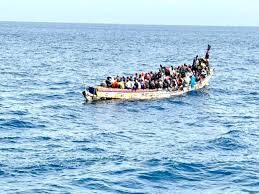
One Thursday, at the beginning of the afternoon, precisely at nap time, Yoff vibrates to the rhythm of laughter and waves. The calm sea and fairly clear sky offer a magnificent view. Young people aged between 15-18 play football by the sea, while others a little older chat over tea near the canoes whose different colors and sizes catch the eye from afar. These canoes which once roamed the sea in search of fish have now become a means for young people to go into the unknown. In this journey, the luckiest arrive safely while others are turned away and the less fortunate lose their lives.
Modou is part of the second batch. Aged 25, fishing is her only source of income. Sitting on one of the benches set up by the sea, his gaze fixed sometimes on the waves, sometimes on his phone, with a little smile, he pretends to be fine. But his eyes say otherwise. With much hesitation, he retraces this adventure which until then remains engraved in his memory.
“At one point, I was just waiting for death. I was convinced of it because people were dying like flies in the canoe,” he confides.
Barça or Barsak
He pauses for a few seconds to control his emotions before continuing his story. “We were at the mercy of the waves without water or food. Worse, we no longer knew which way to take and the salt was attacking our skin,” he says, blinking.
Behind the choice to go in search of a better life lies a sometimes sickening reason. “I have seen young people my age succeed just by trying the adventure of emigration. In less than three years, they built a house and took a wife. I wanted to follow the same path, convinced that I would find success there. In addition, all my brothers went through the dugouts to go outside. I told myself that I could do it too,” he confides.
And added: “Fishermen are always in contact with the water. This is what perhaps saved me, otherwise I was going to lose my life like others with whom I was in the dugout. To avoid arousing suspicion, we take a small canoe until we reach a fairly distant area. There, the big emigration canoe awaits us. Everything is coordinated discreetly. » he adds.
The difficulties hidden behind this journey into the unknown very often exceed what we can imagine.
“We got lost. We no longer had any reference points. My family had no idea what I was going through. I left without warning, like my brothers,” he explains with a darkened face.
Patrols from Spain arrived in time to help them. “The canoe was almost empty. There were just a few souls left, glimmers of hope. At the start, there were a hundred of us, only around twenty clung to life. They gave us sweaters, water, food. Then we called our families to reassure them,” he remembers.
Modou is thus brought back to his native country. Back to square one. Despite this painful experience, the young man remains determined to try the adventure again. “What my country doesn’t give me, I will look for elsewhere, barsa or barsak,” he said with conviction.
5,000 candidates intercepted in 2024
The drama he relates is part of a lasting migratory dynamic on the Senegalese coasts. According to statistics published by the security services and relayed by the National Agency for Statistics and Demography (ANSD), more than 5,000 candidates for irregular emigration were intercepted in 2024 during attempts to leave by sea.
In this perspective, the maritime routes linking West Africa to the Canary Islands remain among the busiest: nearly 47,000 people landed there in 2024, making this route one of the most active and perilous for irregular migration to Europe.
Official figures struggle to reflect the real extent of the phenomenon, with many disappearances occurring on the high seas without formal reporting. They nevertheless reflect a constant dynamic of departures in canoes, often overloaded and insufficiently equipped, at the cost of recurring human losses.
A survivor among so many absentees, Modou remains one of the visible faces of a largely invisible tragedy. His story, born from a shore and returning to it, illuminates in words what the statistics state in numbers: an irregular emigration which continues to carry, every year, entire destinies towards the uncertain horizon of the ocean.
Fatou NDIAYE
