
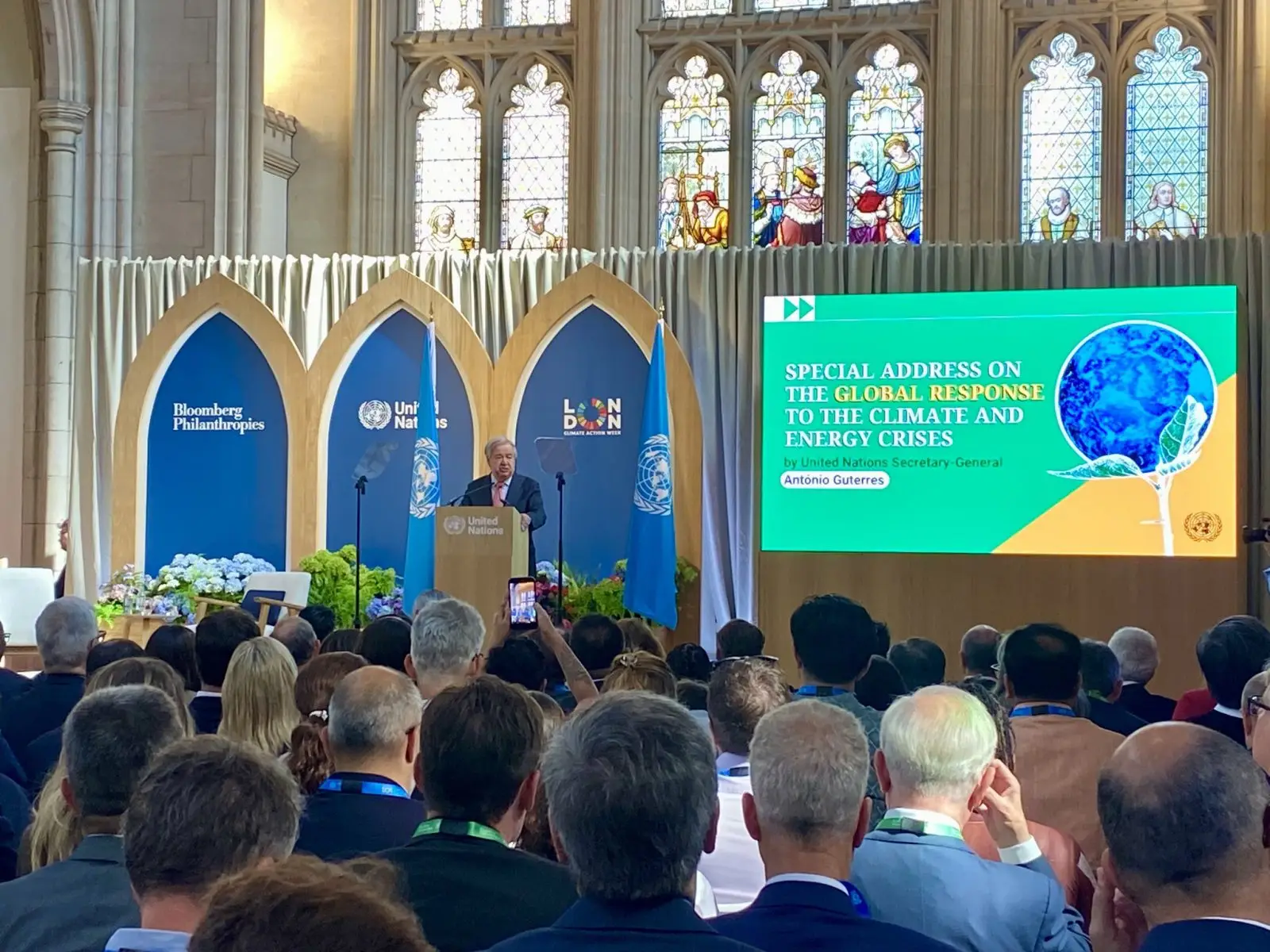
Climate and energy crises: UN Secretary-General calls for rapid and just transition to renewable energy
The Secretary-General of the United Nations, António Guterres, delivered a special address this Tuesday, June 23, 2026 as part of London Climate Action Week, warning of what he called “a tale of two crises”: a climate crisis that brings the planet closer to irreversible tipping points, and an energy crisis that reveals the vulnerability of a model dependent on hydrocarbons.
These two crises, he said, have the same origin: fossil fuels. They also call for the same response: a rapid and just transition to clean energy, accompanied by a massive strengthening of adaptation, resilience and climate justice for populations and countries already suffering the effects of climate change.
The Secretary-General stressed that, unlike all previous energy crises, the world today has a clear and clean path out.
Renewable energy has become the cheapest, fastest to deploy and most easily scalable source of new electricity across most of the world. He recalled that, since 2010, the cost of solar energy has fallen by almost 90%, that of onshore wind by more than 70%, and that of battery storage by 95%.
He insisted that energy independence cannot be based on dependence on fossil fuels, and that renewable energy is the cornerstone of true energy security.
Electrification of transportation, buildings and industry, he said, is among the fastest ways to reduce emissions and dependence on imported fossil fuels.
To successfully complete this transition, the Secretary-General presented seven steps. These include the need to strictly limit any excess of the 1.5 degree Celsius threshold; accelerate the transition from fossil fuels to clean energy; reduce methane emissions; to respond to the environmental footprint of artificial intelligence; to ensure a just transition; to strengthen adaptation; to mobilize financing on the necessary scale; to remove structural obstacles to clean energy, in particular obsolete electricity networks; and to protect science and the integrity of information.
Two major announcements
The Secretary-General launched a Global Call for Action on methane, a gas responsible for about a third of global warming and nearly 80 times more potent than carbon dioxide. This initiative targets three sectors: waste, agriculture and, above all, coal, oil and gas, where rapid reductions can produce short-term climate effects.
He also proposed an Artificial Intelligence Environmental Transparency Initiative, calling on all major AI companies to measure and publicly report the full environmental footprint of their systems, including their carbon, water and land use impacts, and to commit to powering all their data centers with renewable energy by 2030.
A key message for Africa
The Secretary-General has highlighted a major challenge and opportunity for Africa. The continent is home to 60% of the world’s best solar resources, 30% of critical minerals and a fifth of humanity, but receives only 2% of global investment in clean energy, while more than 600 million Africans still lack access to electricity. He described this situation as unfair and a missed opportunity for Africa and the world.
He also called for climate financing at the level, speed and equity required, in particular by materializing the $300 billion promised to developing countries and by concrete measures aimed at mobilizing $1.3 trillion per year by 2035.
Finally, the Secretary-General stressed the need to protect science and truth in the face of misinformation, recalling the launch by the United Nations of the Global Initiative for Information Integrity on Climate Change. He stressed the need to protect scientific independence, ensure the safety of human rights defenders and journalists covering climate and the environment, and ensure everyone’s access to reliable, credible, science-based information.
“Facts matter. Science matters. “Integrity of information matters,” he said.
The Secretary-General will convene leaders in September to advance this work ahead of the United Nations Climate Conference, COP31, in Türkiye.
