
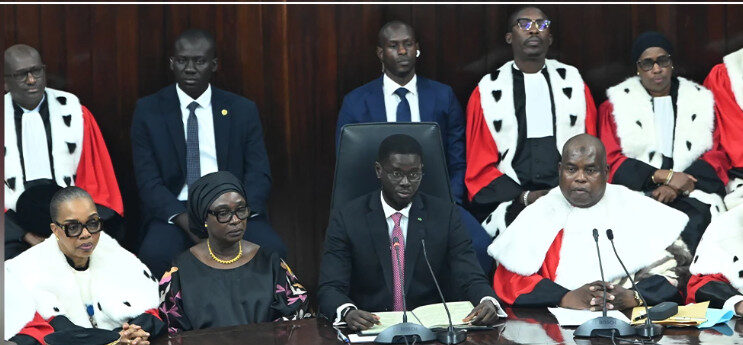
Back to school: President Bassirou Diomaye Faye calls for a digital overhaul of justice
The President of the Republic, Bassirou Diomaye Faye, pleaded Thursday for a profound overhaul of the Senegalese judicial system, centered on digital transformation, on the occasion of the solemn re-entry of the Courts and Tribunals.
Presiding over this ceremony for the second time since his accession to the supreme office, the Head of State stressed that the modernization of justice is “neither an option nor a slogan”, but a “moral, institutional and democratic requirement”, in view of the expectations of the populations and the sacrifices made for the third democratic alternation.
Placed under the theme “The judge facing the challenges of digital technology”, this judicial start-up was an opportunity for President Faye to highlight the issues linked to the growth of information technologies and artificial intelligence, and their impacts on the office of the judge. He insisted on the need to reconcile technological innovation and fundamental principles of justice, in particular independence, impartiality, dignity and secrecy of deliberations.
The Head of State recognized the risks linked to cybercrime, cyberattacks and the manipulation of judicial data, calling for strengthening the training of magistrates, the culture of digital security and ethical and professional standards.
Several structuring projects were mentioned, including the e-Justice platform, for the dematerialization of civil and criminal procedures, e-Services, to facilitate users’ access to legal documents online, as well as the digitalization of criminal records, prison management and juvenile justice. The president also cited the JustAlerte platform, intended to prevent the loss of files and excessively prolonged detentions.
Bassirou Diomaye Faye called for generalizing the pilot experiments already carried out in certain jurisdictions, notably in Dakar, Thiès, Kaolack and Pikine-Guédiawaye, and for accelerating the master plan for the use of digital technology in justice, ensuring that suitable infrastructure, secure connectivity and efficient equipment are available.
Guarantor of the independence of justice and president of the Superior Council of the Judiciary, the Head of State assured that he would take the necessary measures to enable judges to render their decisions within a reasonable time, with complete independence and impartiality. He announced that the digital transition will require legislative reforms, including the introduction of electronic signatures, electronic subpoenas and summons, as well as remote hearings.
“Digital technology and artificial intelligence must not threaten justice, but be its guarantors and protectors,” he insisted, reaffirming the ambition to build sovereign, secure and inclusive digital justice.
President Bassirou Diomaye Faye then officially declared the 2026 judicial year open, sending his best wishes to all those involved in justice and their families.
Salla GUEYE
