
The challenge of adaptation for traders February 27, 2026
In Kaolack, where the thermometer rises easily in the middle of the day, sellers and drivers are learning to deal with these high temperatures while observing the fast.
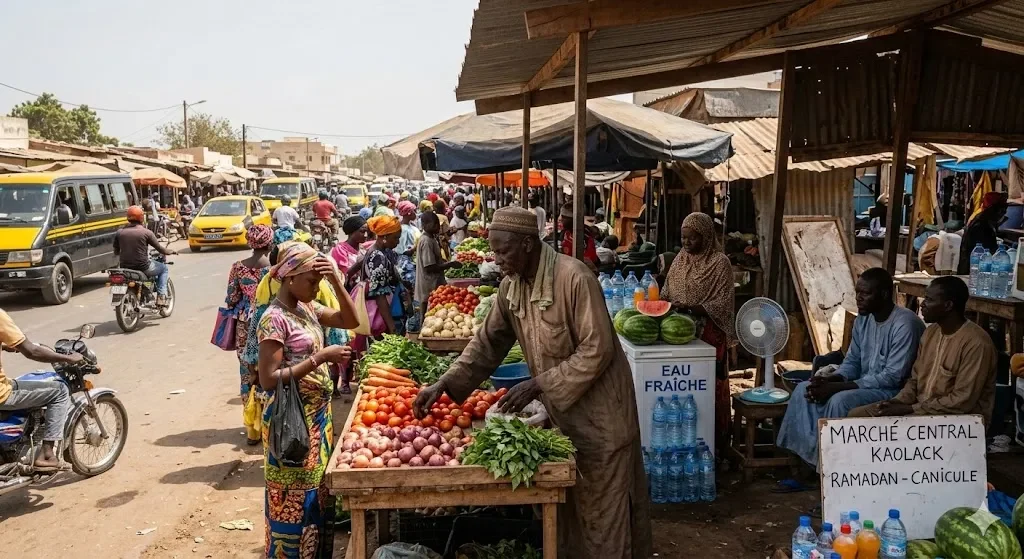
KAOLACK — At the central market, the atmosphere becomes more subdued at the start of the afternoon this Monday, February 23, 2026. Under the sheds and makeshift tarpaulins, traders organize themselves as best they can: homemade fans, bottles of water kept in the shade for breaking the fast, shortened breaks. Everyone develops their own strategy to hold out until sunset.
“The first days of the month are always difficult, especially with this heat. But you gradually get used to it,” confides a vegetable seller, his face covered in sweat. Like many of his colleagues, he arrives earlier in the morning to take advantage of the freshness and reduce his activities during the hottest hours.
“Women mainly come in the morning to do their shopping. This allows them to come home and rest before starting to prepare the evening meal. That’s why we come here very early,” he adds.
For fruit and juice sellers, the heat represents both a constraint and an opportunity. “Customers are looking for more watermelon or juice for the break. Demand increases as the day progresses. So you have to put up with the fatigue,” explains a shopkeeper located not far from the main avenue.
In fabric and miscellaneous goods stores, the curtains are sometimes left half closed to limit the entry of heat. “Ramadan has just started and people are not thinking about fabrics yet. Our work is not too complicated at the moment,” says Mor Ndao, seller at the Kaolack market.
Between constraint and opportunity
At the Kahone garage, on the outskirts of Kaolack, Modou, taxi driver, waits. It only needs two passengers to finally be able to start, but the wait seems endless. “With this oppressive heat, people rarely go out. You can go for hours without a single customer. It’s frustrating, but I remain hopeful: better days will come,” confides this father philosophically.
In the capital of Saloum, “Jakarta” motorcycle taxis dominate the asphalt. Improvised stations spring up at every crossroads. During this Ramadan period, many users are abandoning taxis, often stuck in traffic jams, in favor of these two-wheelers.
“The motorcycle allows you to move around with agility. It sneaks everywhere and takes shortcuts inaccessible to cars,” explains a city center trader.
Despite the rigor of fasting and working conditions, solidarity unites sellers and transporters. “Ramadan is a time of mutual aid. We look out for each other,” says a driver from “Jakarta” while waiting for his next race.
As the breaking of the fast (Ndogou) approaches, the city comes alive again. Customers rush for the latest purchases. It’s rush hour for sellers of dates, sugar, milk and bread, essential ingredients of the f’tour.
At this moment, exhaustion fades in the face of collective effervescence. A trying day comes to an end for these courageous workers, carried by faith and hope.
