
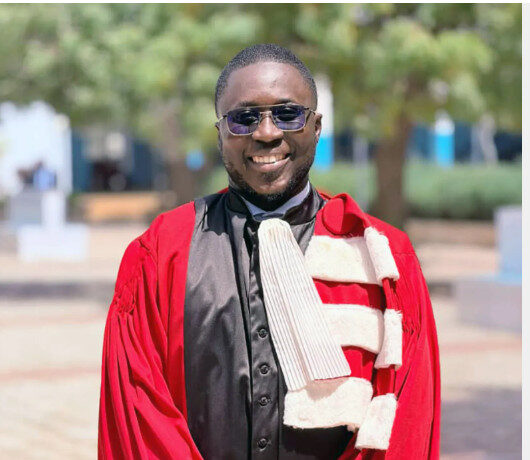
“Faced with IMF conditionalities, recourse to China offers Senegal valuable room for maneuver” February 28, 2026
Doctor in Political Science from Cheikh Anta Diop University in Dakar, Amadou Wagne focused his thesis on Senegalese-Chinese relations between 2006-2024. With the advent of the new power, he believes that relations between the two countries have kept the same approach with structural stability.
“Questioning the limits of China’s multifaceted policy of influence in Africa through the prism of sovereignist resistance. Diagnosis of the “big gap” strategy of Senegalese diplomacy (2006-2024)”: this is the subject of the Doctoral Thesis in Political Science defended by Amadou Wagne on February 21, 2026. Registered at the Faculty of Legal and Political Sciences since 2015, he turned, after a common core, towards political science for, he says, “the transversality and openness of the methods” of this discipline. In 2021, after obtaining his Master 2, he enrolled, the following year, in a Doctorate under the supervision of Professor Alioune Badara Diop. And after three years of investigations and research, he completed the writing in 2025. “I chose to question this asymmetrical dialogue between the Middle Kingdom and the land of Teranga not out of a taste for calculation, but out of a thirst for lucidity,” says Dr. Wagne.
According to him, academic discourse had fallen silent. “We were offered preconceived narratives: either Africa was passive prey, or it was the enchanted receptacle of a new oriental miracle. But, the truth is rarely so simple; it is more bitter and more beautiful. To flush it out, I had to go down into the dust of Thiaroye, Diamniadio, Madina Yoro Foula, on the lands of Fatick and then in China, in Guanzhou, collect 224 testimonies as so many proofs of life,” he explains. The researcher thinks that the Senegalese “big gap” strategy is, in itself, a work of Sisyphus.
“It is the desperate and magnificent effort of a Nation which tries to hold together two contrary worlds: the West of old habits and China of dazzling promises. I wanted to diagnose this acrobatics! How can we advocate the “rooting and openness” dear to Senghor when the debt burden reaches 100% of GDP? There is a metaphysical tension there,” questions Amadou Wagne.
Structural stability
While working on this subject, he also wanted his Thesis “not to be a plea, but a scanner”. “Why China? Because it is the mirror of our own shortcomings. Why Senegal? Because it is the laboratory of this “democratic exception” which tries not to sink into illiberalism for a few kilometers of highway,” he tries to answer. The temporal sequence of Dr. Wagner’s research covers the period 2006, just after the resumption of Senegalese-Chinese diplomatic relations, and 2026. A period with three different regimes at the head of the country. But, for him, there are no changes in approach from these three regimes. “Contrary to expectations of a possible diplomatic recomposition, linked to the political alternation of 2024, the examination of the recent dynamics of the Sino-Senegalese partnership reveals a remarkable structural stability. The new Senegalese authorities, far from marking a break, have not only preserved, but actively consolidated relations with Beijing,” he describes.
Avoiding deindustrialization
According to him, from the first months of his mandate, the new head of state, Bassirou Diomaye Faye, accompanied by several members of his government and senior administration directors, has increased his trips to China. These visits, maintains Amadou Wagne, are of unprecedented intensity. “Only Mauritania was the subject of comparable attention and these visits pursue a clear objective: to reaffirm the solidity of bilateral ties and call for a “change of outlook” on the Sino-African relationship,” he analyzes.
Dr Wagner goes further by emphasizing that one of the most robust sources of this continuity lies in the role played by Beijing as a safety net when negotiations with large Western financial institutions encounter difficulties. “Faced with the conditionalities of the IMF or the slowness of the World Bank, recourse to China offers Senegal valuable room for maneuver,” he explains. Senegal’s economic and commercial partner, trade with China is today unbalanced. This is why Amadou Wagne talks about the imperative to transform resources on site to create added value instead of remaining a simple reservoir of raw materials. “The strong Chinese demand for peanuts has suffocated local oil mills like Sonacos, because they cannot compete with Chinese purchase prices. The State must protect these industries to avoid deindustrialization by substitution,” he advises. On another level, he believes that Senegal must stop systematically favoring foreign companies in calls for tenders for major projects in its Development Plan. “We must impose compulsory subcontracting clauses with Senegalese companies to encourage the transfer of skills and technologies. Take inspiration from models like that of Nigeria, which imposes 30% local participation in major infrastructure projects,” indicates the researcher. He adds that debt to China is often linked to “turnkey” contracts where the money goes back to Chinese companies, creating a cycle of dependence. “The State must review agreements deemed unfair to ensure fairer sharing of benefits. The current opacity of Chinese loans makes it difficult to assess their real impact; more transparent management is necessary to avoid the debt trap,” says Dr. Wagner.
By Oumar NDIAYE
