
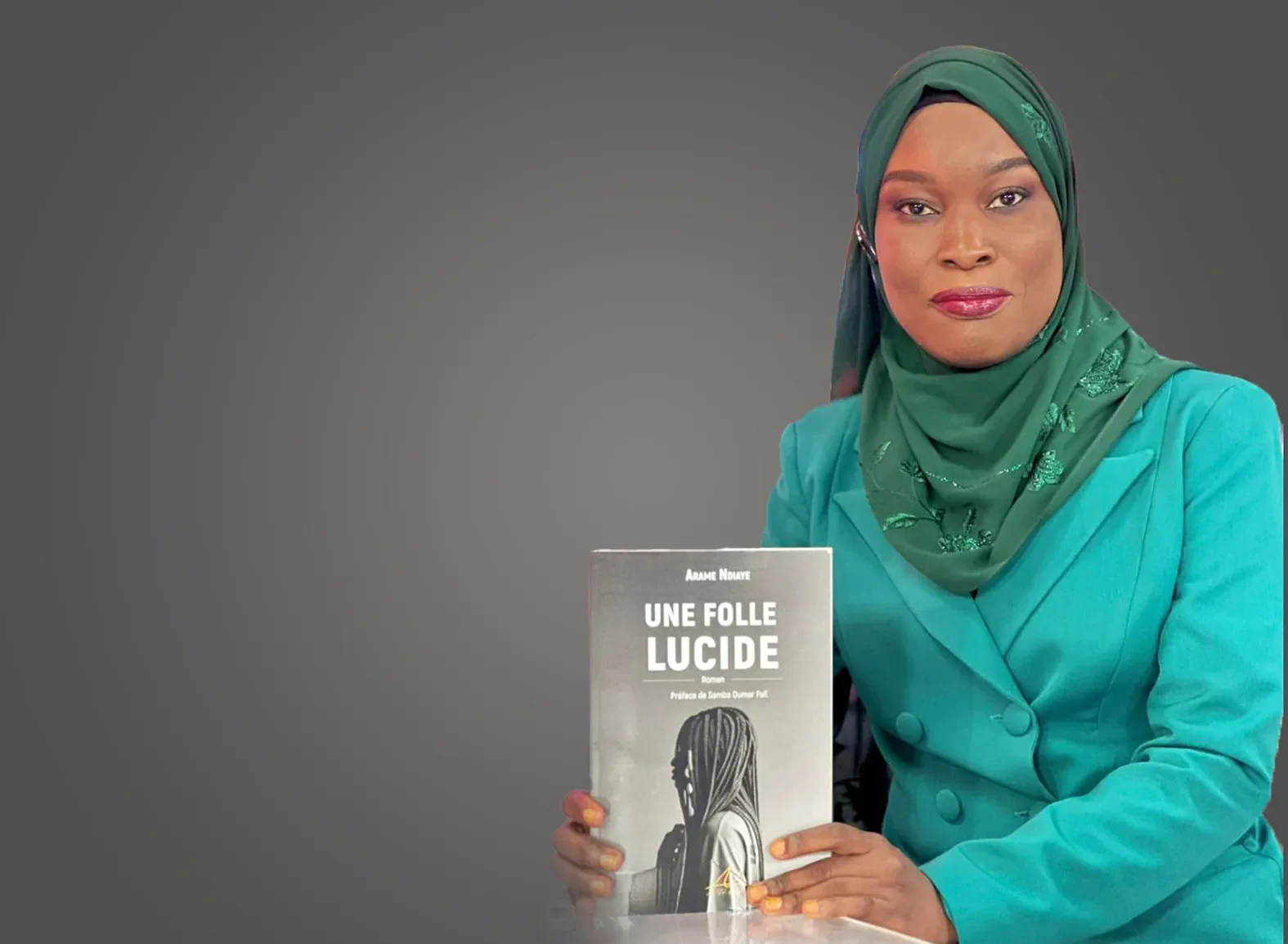
Novel “A lucid madwoman” by Arame Ndiaye: a mirror novel
Can you be both crazy and lucid? With “A lucid madwoman”, Arame Ndiaye, journalist for the national daily “Le Soleil”, explores this fragile border through the journey of Marième Soda Diop, a woman injured by violence, betrayal and social exclusion. Between intermittent lucidity and inner disorder, the novel questions the female condition, marginalization and the capacity of writing to make a word heard that society prefers to silence.
In “A lucid madwoman”, Arame Ndiaye, journalist at “Soleil”, invites the reader on a journey to the heart of the blurred limits between reason and delirium, lucidity and madness. From the title, the antinomy that structures it calls out: being “mad” and “lucid” at the same time, a paradox that runs through literature from Shakespeare and Cervantes to Dostoyevsky and Zola.
By summoning these legacies, Arame joins a line of writers who explore human fragility through mental illness, but she does so with an acute awareness of modernity, which would amount to saying that madness is no longer a divine punishment nor a manifestation of a possession, but a psychological and social trajectory.
The novel sets the scene on Marième Soda Diop, orphaned and vulnerable, whose journey recalls the classic tragic heroines, from Camille Claudel to Esther in Colette’s “La Maison de Claudine”: figures marked by family violence, they become the mirror of injustices and social cruelties.
Soda is also a lucid character, capable of critical reflection, and it is this oscillation between control and unleashing of his emotions which structures the story and creates sustained psychological suspense. This narrative technique, which alternates passages of clear consciousness and moments of delirium, recalls Virginia Woolf’s interior monologues in “Mrs Dalloway” or “To the Lighthouse”, where subjectivity is in reality a landscape.
Stylistically, the author favors a refined, direct style, but rich in dramatic tension. The punctuation and sometimes choppy sentences reflect the character’s inner disorder, creating a rhythm that reproduces psychological instability. The digressions and introspections recall the techniques of the classic psychological novel, but with modern freedom.
The writing embraces the confusion and flow of consciousness of its heroine, giving the madness a sensory and intellectual materiality. From a technical point of view, the novel excels in the management of temporality. Traumatic memories are superimposed on the present, causing a disorienting effect that reflects Soda’s experience.
This fragmentary construction of time, similar to that used by Proust or Woolf, allows the reader to feel the instability of the mind and to perceive moments of lucidity like islands in the flow of fog. The style, through its apparent sobriety, is in reality worked to create permanent tension.
The use of anaphora, repetition and hyperbole accentuates the emotional force of certain scenes, while the introspective passages, of remarkable clarity, reveal a mastery of language and narration.
A modern tragedy without catharsis
The novel also explores the moral and social dimension of madness. But rather than passing judgment, Arame strives to show how lucidity and delirium coexist, how an individual’s subjectivity can be shaped by history, family context and society.
The violence suffered by Soda is the engine of an underground reflection on the human condition: on the mechanisms of domination, the manifestations of cruelty and greed, and on the possibilities of resilience. The passages where Soda analyzes her situation, where she perceives the evil that surrounds her while maintaining moments of control, testify to a fine psychological construction and an ability to translate inner turmoil through literature.
The central character, Soda, is an orphan faced with intimate and social violence: the disappearance of her mother at birth, the assassination of her father by her own aunt and the betrayal of family figures who are supposed to be protective. These ordeals shape a tormented psyche, in which lucidity and moments of loss of control alternate.
This constant back and forth between clarity and delirium recalls, in the literary tradition, the explorations of madness by authors like Dostoyevsky in “The Demons” or “Crime and Punishment”, Balzac in “The Skin of Sorrow” or even Zola in the way in which he places psychological pathologies in determining social contexts.
Also read: Mental health: Arame Ndiaye launches a literary cry with the publication of A lucid madwoman
However, Arame Ndiaye places his story in an African and Senegalese contemporaneity, where madness, social malice and resilience meet in a specific universe, nourished by cultural and historical realities. “A Lucid Madwoman” can also be read as a modern tragedy, but a tragedy profoundly shifted from the classical model.
There is no transcendent fatality, no clearly identifiable original fault, no purifying resolution. Evil is not brought by the gods or a higher law. In reality, it is diffuse, human, banal and above all inscribed in ordinary relationships. Violence arises from within the very fabric of society.
The character of Soda does not follow a tragic destiny in the Aristotelian sense. She does not fall from a high position, she does not commit hubris, nor does she bring about her own downfall. Its trajectory is that of progressive collapse. On a narrative level, this absence of catharsis is essential. The novel does not seek to relieve the reader with a clear resolution.
Even when prospects for care or recovery appear, they do not take the form of total appeasement. The regained lucidity does not erase the trauma, it coexists with it. The text refuses reassuring closure and allows an instability to persist which extends the character’s experience beyond the reading. This tragic structure without a purifying outcome corresponds to a profoundly modern vision of existence.
The time of the novel is a non-heroic time, a time of survival rather than of overcoming. In “A lucid madwoman”, Arame Ndiaye never explicitly claims a feminist stance. However, the novel is fully part of feminist writing in the literary sense of the term, that is to say, writing which questions the very conditions of female speech, the relations of domination inscribed in bodies and silences, and the forms of social disqualification which weigh on women.
The choice to entrust the narration to a woman perceived as crazy is in itself a strong literary gesture. Historically, female madness has often served to neutralize women’s words, to make them suspect, irrational, and therefore negligible. By giving Marième Soda Diop the first person in the story, Arame Ndiaye reverses this logic. Thus, the marginalized female voice remains the center of the text, the very place where meaning is developed. Madness does not cancel speech, but it makes it possible in a different way.
A feminist writing of experience
This feminist writing is based on constant attention to the body. Soda’s body is crossed by fear, fatigue, desire for others, constant threat, etc. It is a body exposed, monitored, coveted, sometimes violated and rarely protected.
The feminine thus appears as an experience of structural vulnerability, and not as an essence. In terms of writing, this feminist posture manifests itself through an aesthetic of non-heroism. The novel also works on the question of credibility. Who believes a woman called crazy? Who listens to a woman without status? The text does not pose these questions theoretically, but places them in the very material of the story.
The reader is constantly confronted with a voice whose reliability is uncertain, but whose emotional sincerity is undeniable. This tension requires us to rethink the usual criteria of truth and narrative authority. “A lucid madwoman” remains a beautiful book, as we suspect from the frontispiece.
By Amadou KÉBÉ
