
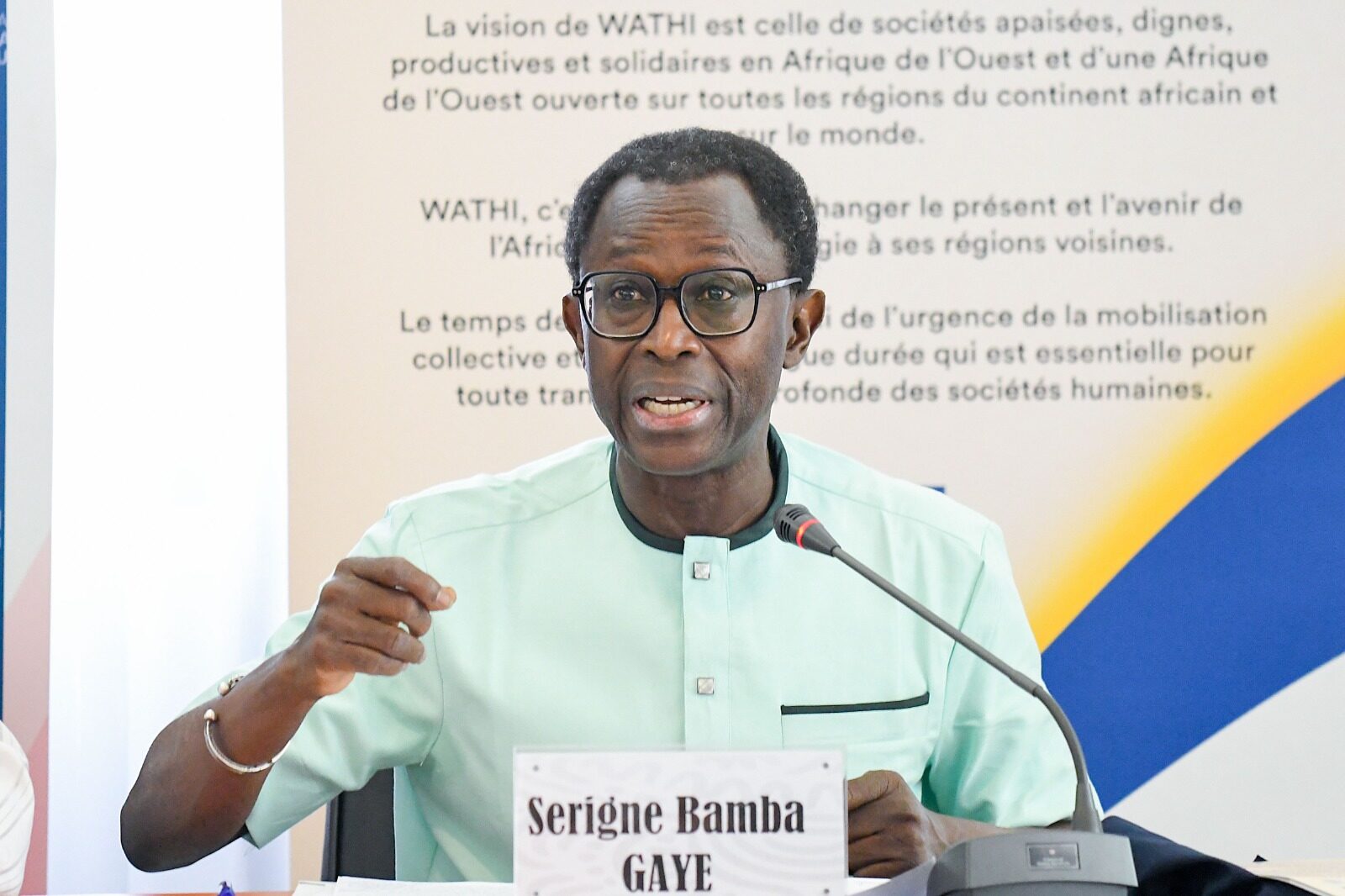
Dr Serigne Bamba Gaye, lecturer at CHEDS: “This Peace Council appears to be a parallel approach which goes beyond the UN framework”
Independent international expert and lecturer at the Center for Advanced Defense and Security Studies (Cheds) in International Relations, Dr Serigne Bamba Gaye believes, in this interview, that Donald Trump’s “Peace Council” is a competitor to the United Nations.
How do you see this new idea from the American president to create a “Peace Council”?
The creation of this “Peace Council” by President Donald Trump is in line with the strategy he has been pursuing for several months. Upon his arrival at the White House, he sought to free himself from the rules of international law and to call into question multilateralism, in particular the United Nations which, with its charter, is the tool for maintaining peace and international security. The establishment of this body appears to be a parallel approach, which goes beyond the UN framework to enable Donald Trump to act unilaterally on the major issues shaking the international scene. Furthermore, this “Peace Council” was announced as part of the resolution of the conflict between Israel and the Palestinians around Gaza. But, when we read its latest version, we realize that Gaza is practically absent there today. The “Peace Council” has given itself the prerogative of being able to bring peace to the world, wherever there is a crisis. It is no longer an body linked to the question of Gaza, to the tensions between the United States and the Palestinians, but has the prerogative of acting everywhere in the world to be able to bring peace and to be an international instrument which, let us say it very clearly, is in the process of competing with the United Nations in its prerogatives as defined by its charter, in particular article 103 which provides that it is the sole institution responsible for maintaining peace and security at the international level.
We see European, especially French, reluctance regarding this Council. Don’t you sense divergences in the transatlantic relationship between the United States and Europe?
Some countries like France and Spain believe that leaving the multilateral and UN framework constitutes an adventure or a risk that they do not want to take. Creating an organization that pursues the same objectives as the United Nations in matters of peace and international security amounts to calling into question the primacy of the UN institution in this area as defined by its charter. This is truly the situation that Trump is exposing (the world) to with this “Peace Council” comprising countries which also have a foot in the UN. It is a very difficult balance and poses a problem of diplomatic coherence. A country that wants to be diplomatically coherent cannot take this risk at the cost of being accused of being a gravedigger of the international system as embodied by the United Nations which promotes multilateralism on the international level. This resistance from France and other European countries shows that they do not agree on the strategy announced by Donald Trump and which consists, on the one hand, of creating the “Peace Council” and, on the other, sidelining the UN. Indeed, in this Council, the United Nations are sidelined. This constitutes a precedent since the end of the Second World War. In the resolution of the major conflicts that have shaken the world since 1945, the United Nations is involved to some extent in their resolution.
With Ukraine, NATO, Greenland, disagreements are increasing between the transatlantic partners that are the United States and Europe. How do you see this relationship going forward?
It is obvious that Western Europe and the United States do not have the same reading on these crises, in particular that of Ukraine. Same for the Middle East. Trump has acted cavalierly regarding these conflicts. He truly wants to appear as someone who imposes his vision of international relations and who defends the exclusive interests of the United States. Obviously, Europe believes that on these questions, especially on the Ukrainian one, the American posture, which consists of sparing the Russians and embodying a way out of the crisis by highlighting the question of raw materials and that Ukraine must make territorial concessions to Russia, is not the best and it does not agree. The fact also that the United States has annexationist claims on Greenland, which belongs to a NATO member country, Denmark, shows that they are no longer in the perspective of a strategic alliance with Europe. The Europeans thus feel abandoned, weakened and are trying, today, to have strategic autonomy.
But, the latter is built over time. In terms of defense, Europe is very weak because for several decades it relied on the American umbrella, in particular NATO. Today, Trump’s strategy consists of telling the Europeans: “Take care of your defense and we will intervene ad minimum in the event of a crisis because we believe that you have long benefited from NATO.” Europe today has its back against the wall and must try to have strategic autonomy on a military level; which will take years. However, the crisis in Ukraine and elsewhere in the world shows that Europe is not a military power. Europe is very weakened in the event of a major crisis and this truly constitutes a turning point in transatlantic relations. So, the solidarity and strategic alliance between the United States and Europe are crumbling before our eyes, showing that a new page is being turned in the relations between these two parties.
Interview conducted by Oumar NDIAYE
