
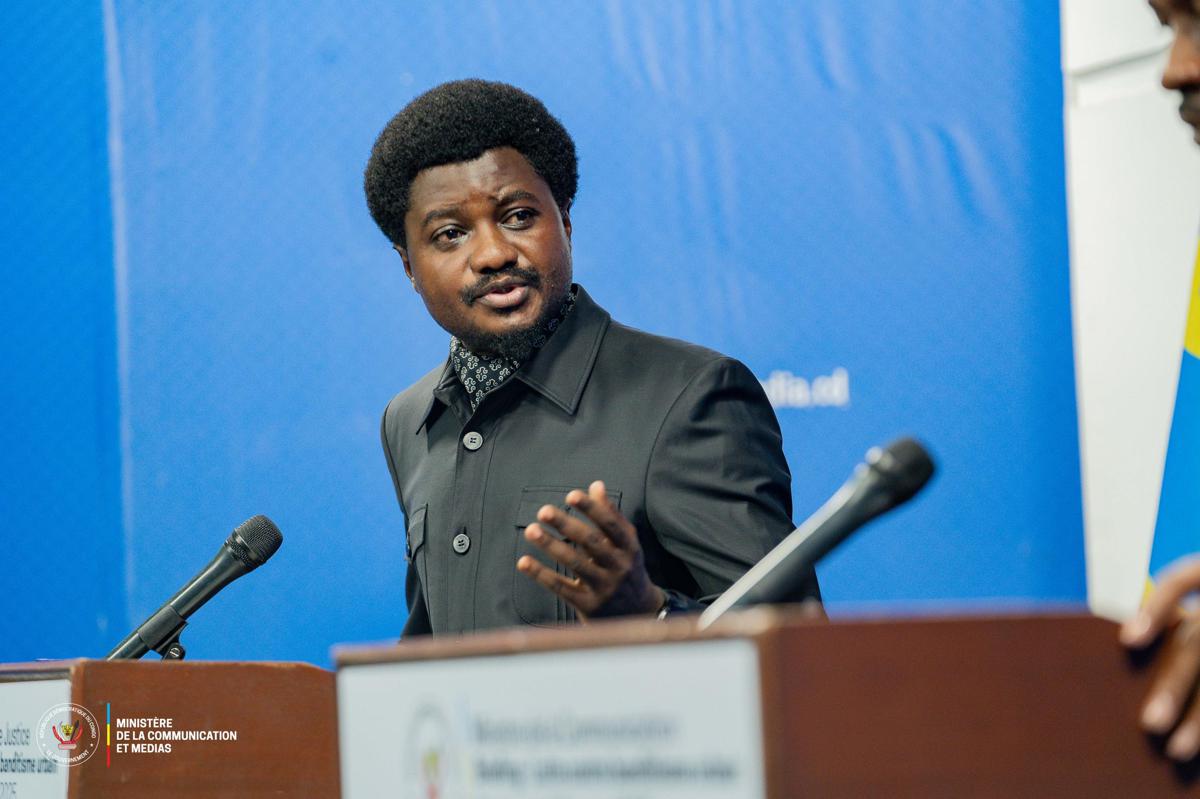
DRC: The National Assembly authorizes judicial education against Constant Mutamba
On Thursday, May 29, 2025, the deputies adopted a resolution authorizing the opening of a judicial investigation against Constant Mutamba. This decision follows a request from the Attorney General at the Court of Cassation, Firmin Mvonde, who asked for the lifting of the Minister of Justice’s immunity.
Mutamba is targeted by accusations of embezzlement of funds linked to the construction of a prison in Kisangani. According to the parliamentary report, he is suspected of having diverted about 19 million USD (out of a total of 39 million) intended for this project. The Special Commission ad hoc heard the minister and the prosecutor, then recommended that the plenum to lift immunity so that justice can instruct the facts.
Aged 37, Constant Mutamba is one of the youngest members of the government. Born April 24, 1988 in Luputa (Lomami Province), he was a lawyer training at the Kinshasa bar and worked as an agent in mines and careers. President of the DyPro political regrouping, he presented himself as a candidate for the presidential election of 2023 under this banner. In June 2024, President Félix Tshisekedi appointed him Minister of State, Keeper of the Seals, to justice. Mutamba had made itself known by its martial positions against corruption and even by targeted surveys against dignitaries of the old regime.
The immunity lifting was voted by 17 votes for, 2 against and 2 abstentions (out of 21 deputies present). The rapporteur of the parliamentary committee underlined the severity of the facts, evoking in his report “contradictions” and “gray areas” preventing the manifestation of the truth. Within the parliament, certain deputies (notably Willy Mishiki and Fontaine Mangala) had already arrested Mutamba in May 2025 to demand clarification on the supposed disbursement of funds and the award of the market in Zion.
In the east of the country, several organizations of the Kisangani civil society denounce “the opacity” of the project and demand the publication of contracts to lift any suspicion. The central government, by the voice of Prime Minister Judith Suminwa, had frozen the litigious market while waiting for internal arbitration. In addition, the African Association for the Defense of Human Rights has called for caution. According to this NGO, Mutamba “must be prosecuted if he has diverted”, but he must also be supported if the accusations are only political maneuvers.
Kisangani’s prison project
The disputed project in Kisangani (Tshopo province) aimed to build a new modern prison. Its total cost was estimated at approximately 39 million USD, funded by the FRIVAO (victims’ compensation funds). The contract was granted without call for tenders to the company Zion Construction SARL (created in March 2024). According to the prosecutor, “an initial transfer of $ 19 million was made on a bank account opened the day before” of payment, an unusual scheme believing that normal procedures have been bypassed. Faced with an uproar, the Prime Minister’s office asked to stay on the current market and required the transmission of all documents in the file. The Ministry of Finance, for its part, said that “no disbursement” had been recorded at this stage, thus contradicting the existence of effective payment for this prison.
In the DRC, the in -practice ministers benefit from factual immunity which prohibits any judicial act without agreement of the Parliament. The Constitution and the organic laws provide that the Court of Cassation is competent to judge the offenses of members of the government, with the exception of the Prime Minister, provided that the National Assembly has authorized prosecution. Thus, the decision taken on May 29 by the lower chamber (an absolute majority vote) is a necessary condition to instruct Mutamba.
According to Congolese law, “the decision to prosecute as well as the indictment of members of the government (…) are voted by an absolute majority of the members making up the National Assembly”. As long as these conditions have not been met, the Minister retains his status and cannot be heard by justice. With the lifting of immunity now obtained, Mutamba remains formally presumed innocent, but it is now borne at the same lawsuits as an ordinary citizen in the event of indicted.
The Democratic Republic of Congo is regularly among countries perceived as very corrupt. Many observers note that “corruption cases involving senior officials are frequent, but rarely prosecuted”. This culture of impunity nourishes the skepticism of the population. In this context, the Mutamba file is followed as a barometer and its conclusion could be a “decisive test” for the independence of Congolese justice.
