
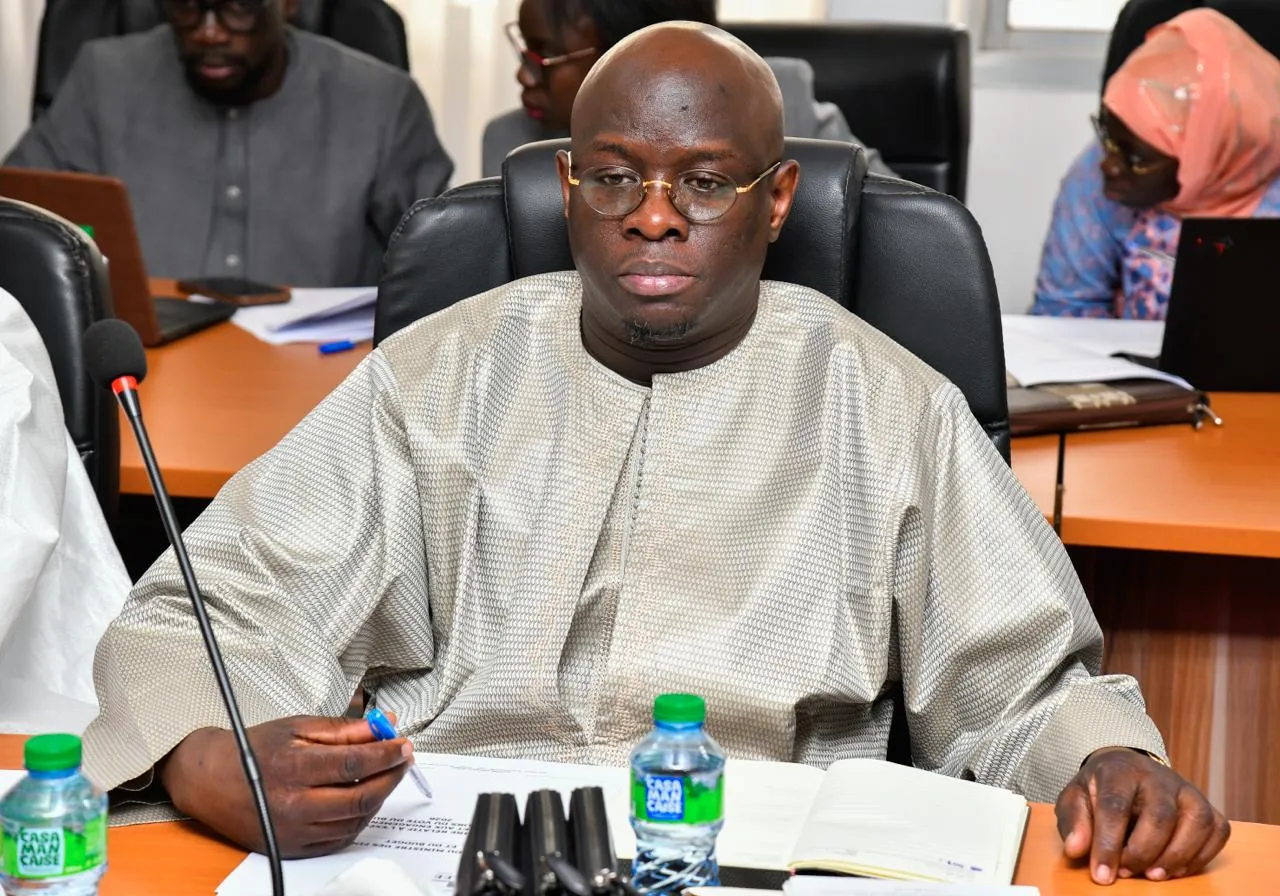
Public finances: general budget revenue reached 4,477.1 billion FCfa, according to Cheikh Diba
Closing the series of hearings of ministers before deputies on Friday, May 15, the Minister of Finance and Budget, Cheikh Diba, took stock of the past year.
“The budgetary year took place in a generally favorable economic environment, with national growth of 6.7% driven by the exploitation of hydrocarbons and the vigor of agriculture.” From the outset, Cheikh Diba set the scene for a flattering year 2025 for Senegalese public finances.
Faced with deputies, Friday May 15, the Minister of Finance and Budget delivered the key figures. General budget revenue reached 4,477.1 billion FCfa, or 98.8% of the target revised in the amending finance law. Better still, they increased by 11.8% compared to 2024.
“Revenues were driven by the rise in corporate tax for oil companies, the good performance of corporate tax and the dynamism of Irvm-Ircm,” detailed Cheikh Diba. Non-tax revenues also far exceeded expectations, reaching 111.1% of forecasts, driven by dividends and domain income. The only remaining shadow on the picture: donations which cap at 60.2% completion, penalized by “late disbursements”.
Also read: Economic situation: performances which confirm resilience
On the expenditure side, rigor was required. Executed to the tune of 5,864.6 billion FCfa, they remained below 93.9% of forecasts. This caused a budget deficit reduced to 1,387.5 billion FCfa, or 6.44% of GDP (gross domestic product), a clear improvement compared to an initial target of 7.82%.
“This result reflects the combination of a satisfactory mobilization of revenue forecasts and a controlled execution of expenditure,” welcomed the minister who even highlighted a cash surplus of 4.5 billion FCfa, “a sign of controlled cash management in 2025”.
He also placed emphasis on the clearance of payment arrears, for a total settled amount of 474 billion FCfa, i.e. an achievement rate of 94.6%. The efforts were particularly noticeable in the energy sector where 145.6 billion were paid with an execution rate of 99.7%.
The specter of Hormuz
According to Sheikh Diba, the budget execution for the first quarter of 2026 is marked by the “systemic energy shock” caused by events in the Middle East.
At the end of March, informed the Minister of Finance and Budget, general budget revenues stood at 1,139.5 billion FCfa, i.e. an execution rate of only 19.2% of the initial finance law. At the same time, expenditure reached 1,482.7 billion, widening a provisional deficit of 343.2 billion.
The structure of spending reveals the urgency of the moment. Current transfers have exploded, driven by an anticipated disbursement of 165.5 billion FCfa for the benefit of the Energy Sector Support Fund (Fse). A massive injection intended to “secure Senelec’s fuel supply”, in a context of soaring prices. On the other hand, investments from internal resources were reduced to the bare minimum, capping at 11.1% of the annual target.
“This situation of a level of expenditure authorization significantly lower than the mobilized revenues reflects deliberately prudent and rigorous management,” he declared, referring to “the high uncertainty on the evolution of hydrocarbon prices and, by extension, on the trajectories of oil revenues and subsidy costs to the energy sector”.
A posture that is starting to bear fruit. “Towards the end of April, cumulative revenues (1,558 billion FCFA) rose above expenditures authorized from internal resources (1,103.2 billion), offering breathing space to the State treasury.
Pathé NIANG
