
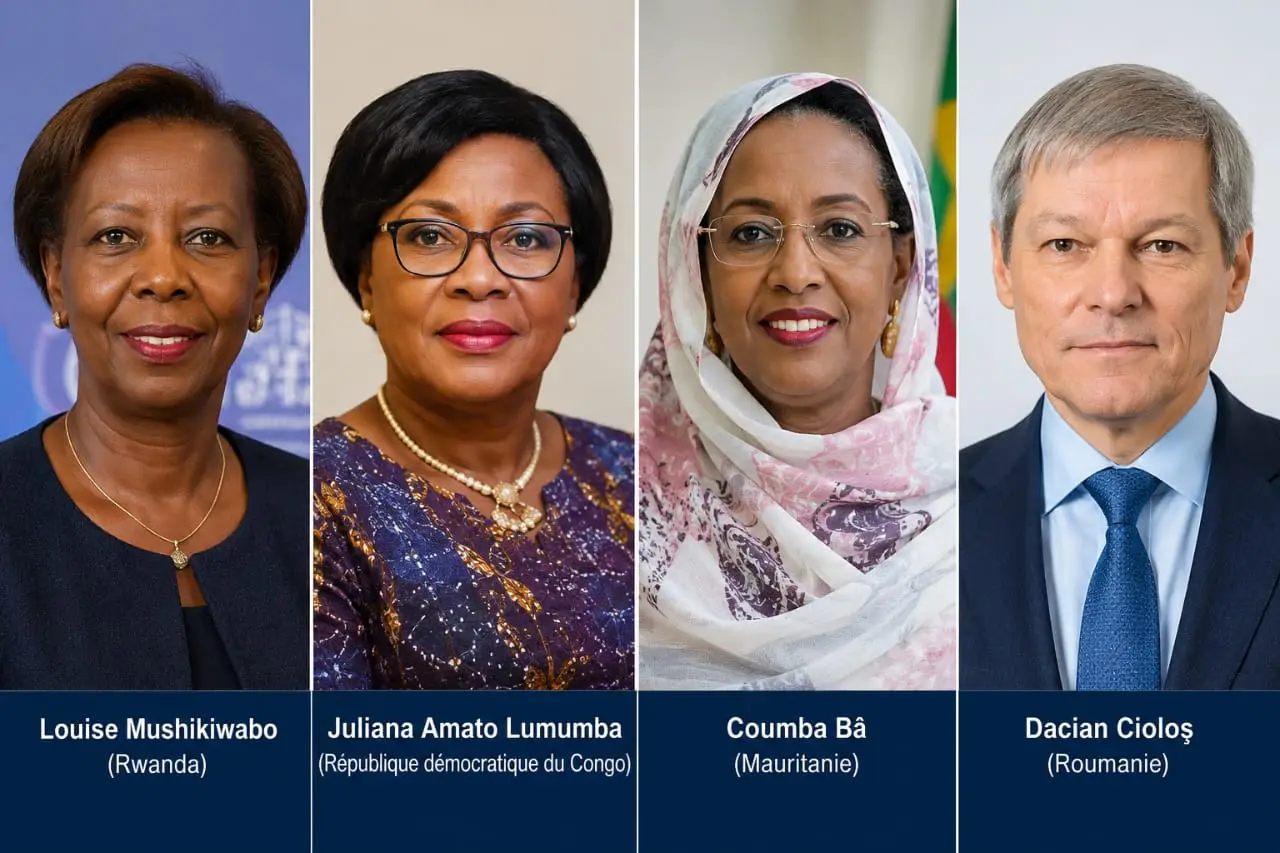
Hearing of candidates for the position of Secretary General of the OIF: a first for the Francophonie
On Tuesday June 30, 2026, the International Organization of La Francophonie (Oif) took an unprecedented step forward. For the first time in its 56 years of existence, the foreign ministers of its member states and governments formally interviewed the four candidates for its leadership. A major innovation, the hearings having even been broadcast on a delayed basis on the Oif YouTube channel.
Ms. Coumba Bâ, Mr. Dacian Cioloș, Ms. Juliana Amato Lumumba and Ms. Louise Mushikiwabo presented themselves, in turn, in Paris, as part of an Extraordinary Ministerial Conference (Cmf). This procedure, underlines a press release from the Oif, “is the result of an institutional reform adopted in 2022”.
It foreshadows, continues the international organization, “the formal election of the next Secretary General for the period 2027-2030 during the 20th Francophonie Summit, in Phnom Penh, on November 16, 2026”. An opportunity for each candidate to outline the future vision and present the axes of their mission once elected.
Also read: Francophonie: Cheikh Niang participates in a historic ministerial session in Paris
Thus, the Romanian Dacian Cioloș, former Prime Minister, after welcoming diversity – a strength within the Oif – recalled that French influenced his professional career. His vision, he said, is based on sharing, because as President Senghor maintained, “the Francophonie is an integral humanism”.
Africa, he continued, will have its place in its management, because it is at the heart of the creation of the Francophonie, has the most speakers, its population is the youngest and has a strong potential for economic growth. He wants to review the priorities of the Oif in order to adapt it to global changes dominated by the economy and new technologies, notably artificial intelligence.
Also, education, the economy, youth, women, financing, governance, employment, multiculturalism will be at the heart of his vision. As for the Congolese, Ms. Juliana Amato Lumumba, daughter of the first murdered Prime Minister of the current DRC, Patrice Lumumba, she counts on experience, responsibility and conviction. According to her, her story nourishes her conviction that “dialogue, peace and dignity are the only lasting foundations of the future”.
Her vision, she said, is simple and strong: a Francophonie focused on the people, that is to say, whose impact is seen in daily life. According to her, education, professional training, digital innovation, academic mobility, must become “transversal, structuring and visible priorities”.
She promised to create a French-speaking intercultural Biennale which will revolve around a summit of French-speaking cultures, a global market for cultural and creative industries, a universal exhibition of French-speaking arts, a major exhibition of digital and technological innovations, a festival of culinary arts and a carnival of popular music and traditions.
While the Rwandan, Ms. Louise Mushikiwabo – candidate after 2 mandates, beyond her record which she considers known to all –, hopes to continue to serve and above all to make the Francophonie, a “space more influential, more united, better governed and aligned with the challenges of its time for the benefit of the well-being of its populations”.
Recalling her “rigorous” management of budgetary resources, she noted that the violence of global shocks gives rise to multiple challenges. Also, the Oif must be well equipped in order to meet the expectations of its populations. In short, an adaptation is necessary to remain within what constitutes the foundation of the organization: universalism.
By Daouda MANÉ
