
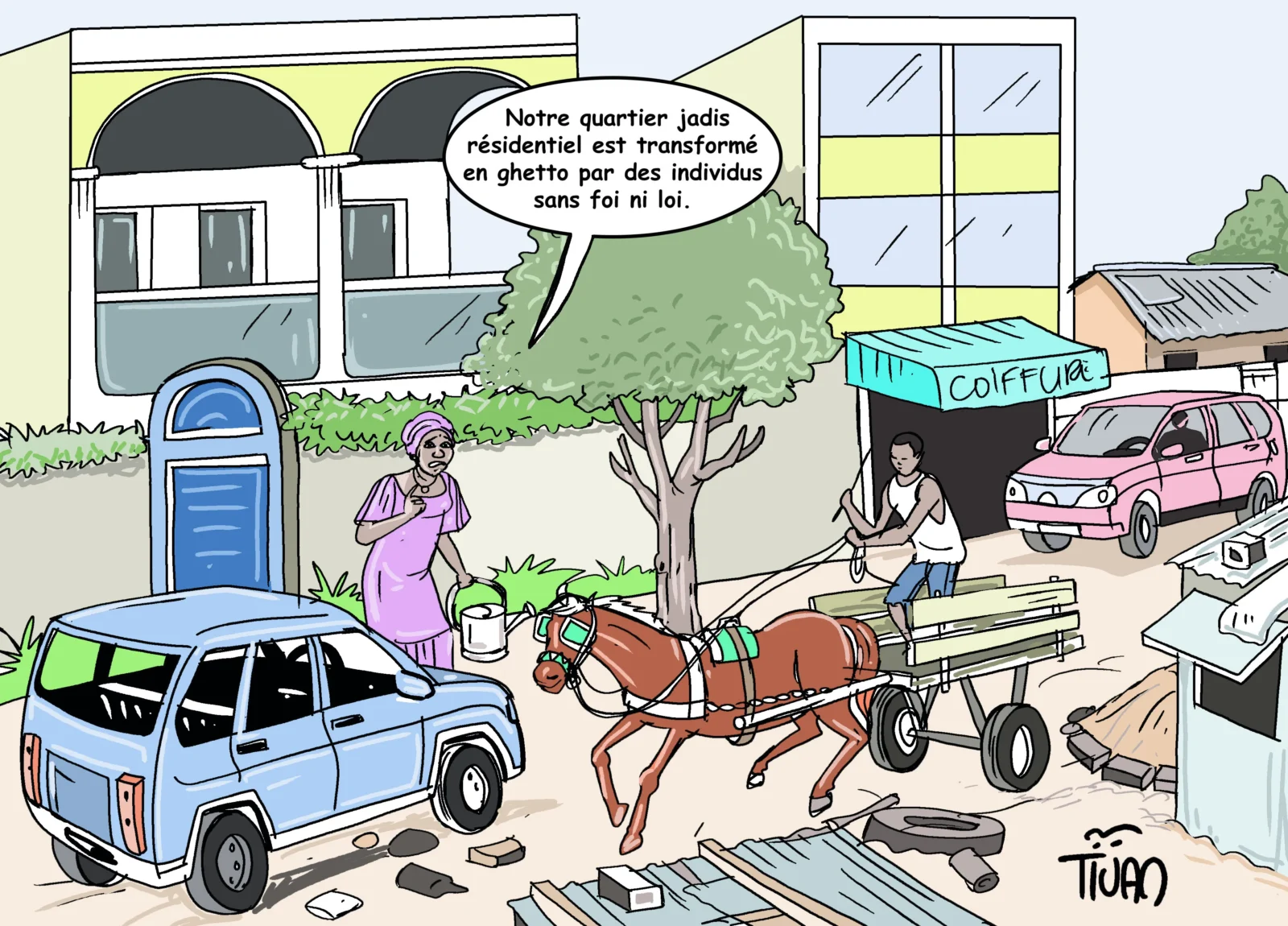
Urban metamorphosis: Nord-Foire, the end of a quiet haven
Once peaceful and well-ordered, the Nord-Foire district of Dakar has undergone a brutal transformation in recent years. Anarchic urbanization, insecurity and noise have disrupted its image as a residential city. The inhabitants oscillate between nostalgia and dismay.
It’s 7 o’clock. The shy sun clings to the wrought iron balconies, makes the windows sparkle and caresses the walls of the opulent villas. A light breeze carries the smell of hot sand, mixed with the more pungent smell of garbage piled up on street corners. However, this morning sweetness hardly lasts. The chirping of birds, perched on a rickety roof, is soon drowned out by the roar of the engines.
Horns blare, hammers sound, a thick cloud of dust rises with each passing car. Between the sidewalks invaded by improvised stands and the vehicles parked in disarray, passers-by slip through with velvet steps, guided by the whistling of a bread seller. Nord-Foire, once calm, seems to be losing the tranquility that gave it its charm in the rhythm of daily life. In front of her house, middle-aged Fatou Ndoye waters her plants using a makeshift bucket. She casts a furtive glance at the late revelers leaving a nearby nightclub, adjacent to her barbed wire-topped home. “Before, we lived in our haven, without skirmishes. The streets were clean and children played without fear. Today, we no longer recognize our neighborhood,” she complains, a scarf carelessly thrown around her neck. Disorder sets in, patience crumbles According to this mother, who has lived in Nord-Foire for more than a decade, the neighborhood, once peaceful and orderly, is now undermined by many evils: noise, congestion, incivility and this dull impression of abandonment. She remembers a time when we greeted our neighbors by their first names, when each house seemed to watch over the other.
“It was a real family neighborhood. We breathed tranquility,” she murmurs. Then his tone hardened. She points to the sidewalk blocked by a sheet metal kiosk and a pile of rubble left by an unfinished construction site. Cars parked sideways cut the road, forcing passers-by to walk on the roadway. “Look at that!” We can’t even walk anymore without going down the road,” Fatou sighs, while a taxi zooms past, raising a cloud of dust that makes her take a step back. 10 a.m., the neighborhood becomes more lively. As the sun rises, the noise grows louder. In the middle of this tumult, Alioune Camara, 45, shirt carefully ironed despite the heat, carefully closes the gate of his house.
According to him, disorder has become second nature. “Nord-Foire grew too quickly, without anyone paying attention,” he says without flinching, walking around an abandoned pile of sand. Then, in a disillusioned tone, he adds: “Everyone does what they want. We build without permits, we occupy the sidewalks, we connect the electricity anyhow. It became a mess. » Around him, life goes on. However, Alioune seems elsewhere, caught up in the memory of a more peaceful Nord-Foire. He looks up at the sky, now veiled in dust, and concludes with irony: “This neighborhood used to be charming. You could hear the silence. Today, even the wind is noisy. » However, the disorder of the day gives way, when night comes, to another worry, that of insecurity. In certain areas, groups of young people have organized themselves to keep watch. They don’t have great resources, just torches and whistles. They rely on solidarity to preserve security in places. “We go around the block, we watch the cars, the dark alleys,” says Cheikh Ndiaye, 27, his eyes attentive under the flickering light of a street lamp. “We are not police officers, but we want people to sleep peacefully,” he reassures.
Insecurity, new companion of the nights He casts a circular glance at the surroundings, where the shadows move furtively. “The neighborhood has changed, yes, but we have to keep control. Otherwise, it’s over,” he added in a deep voice. The echoes of footsteps mingle with the crackle of tired light bulbs. The hot air seems to hold the neighborhood’s breath, suspended between vigilance and resignation. Over the years, residents have barricaded themselves. The walls grew, the gates became “armoured”, surveillance cameras flourished. The need for protection has gradually replaced conviviality. In front of a wealthy house, Mamadou Sow, a retiree, observes the street through an iron gate. His voice trembles with a mixture of nostalgia and weariness.
“Before, we had tea outside, children played in the street, neighbors visited each other. Now we live locked up. Everyone behind their own wall,” he confides. However, despite this silent transformation, some refuse to accept the loss of the link. The night sets in, heavy and hot. In the shadows of the villas, the lamps light up one by one, drawing a checkerboard of flickering lights. Figures pass furtively, a dog barks in the distance. On the steps of her house, Fatou Ndoye sits, a loincloth on her knees. His gaze is lost in the darkness. She is one of the few who still believe in the renaissance of the neighborhood. “Even if he’s changed, I won’t leave.” I want to believe that one morning, Nord-Foire will wake up as before,” she whispers. The offshore wind stirs up a little dust and causes a gate to slam in the distance. Nord-Foire falls asleep, eyes open, torn between memory and survival.
By Pathé NIANG
