
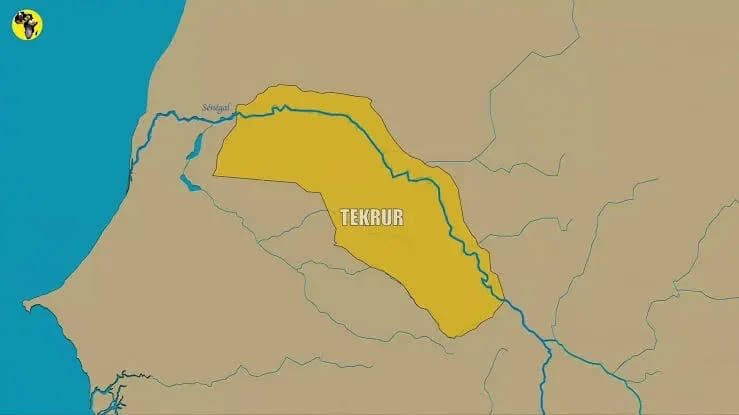
Tékrour: the kingdom forged in iron and history
In the heart of West Africa, long before modern borders appeared on the maps, a kingdom stood along the Senegal River. A kingdom which was not only a political space, but a real economic, cultural and religious force. This kingdom is Tékrour (or Takrūr), one of the first structured states in the region, the one which laid the foundations of a thousand-year-old Senegalese history.
Tékrour is not a simple name in the stories of the past. It is a living reality, a medieval state whose growth is part of the great trans-Saharan trade. From the 7th century, the Dia-Ogo dynasty founded a state whose economic activity was based on metallurgy. Iron, this metal which transforms tools, weapons, but also destinies, becomes the basis of a nascent civilization. In a context where West Africa is structured around trade, Tékrour positions itself as a central actor, between the Empire of Ghana and the trans-Saharan trade routes.
The first populations that make up this state are the Serer, the Wolof and the Fulani. It is a plural kingdom, where languages and cultures intersect, mingle and strengthen each other. This diversity does not weaken the kingdom, it nourishes it. It makes it a living crossroads, a land of exchanges and meetings.
At the end of the 10th century, the Soninké Manna dynasty succeeded the first lineage, and it was under his reign that the kingdom entered a new era. In 1035, King War Jabi converted to Islam, marking a major turning point. This conversion is not limited to a simple religious change: it profoundly transforms society, upsets the balance and causes tensions. The Serers, attached to their traditions, suffered persecution which pushed them into a mass exodus, a painful and founding episode in their history.
Tékrour then became one of the first kingdoms in Senegambia to adopt Islam. It opens a new page in West African history, where religion becomes a vector of power, diplomacy and trade. But the kingdom is not reduced to this spiritual transformation alone. It also asserts itself as a major economic center. At the height of its influence, in the 12th century, it controlled essential trade routes, the gold mines of Galam, the salt mines of Awlil, and became a crossroads where gold, salt, cereals and fabrics circulated with intensity.
However, the history of Tékrour is not only a story of power. It is also that of the fragility of medieval states in the face of the forces around them. In the 13th century, the kingdom entered a phase of decline, hit by the rise of the Djolof Empire, then by the expansion of the Mali Empire. The last territories of Tékrour were gradually absorbed, and the capital was conquered in 1286. The kingdom lost its independence, but not its heritage. A new military aristocracy, subservient to Mali, settles in and marks the end of an era.
In the 14th century, a new dynasty, the Tondjons, appeared. It symbolizes a warlike state, now integrated into the dynamics of Mali. The independence of Tékrour is fading, but its cultural and political influence remains. In the 16th century, the kingdom of Fouta-Toro was formed and is often considered the cultural and traditional heir of Tékrour. Thus, even in the shadow of history, Tékrour continues to live, carried by the memory of the people and the strength of its traditions.
Tékrour is also an example of the complexities of medieval Africa. The sources are rare, fragmentary, sometimes contradictory. Arab writings sometimes confuse Tékrour with the Mali Empire, and oral tradition, written late, offers stories that do not always coincide with the chronologies. However, despite these challenges, the essential remains: Tékrour is a historical reality, a kingdom which left its mark on the region, forged in iron, gold and faith.
For “Sundays of History”, Tékrour is much more than a chapter. It is a gateway to an ancient, rich, structured Africa, where history is told through dynasties, exchanges, beliefs and migrations. It is the story of a kingdom which laid the foundations of a Senegal of yesterday and today.
