
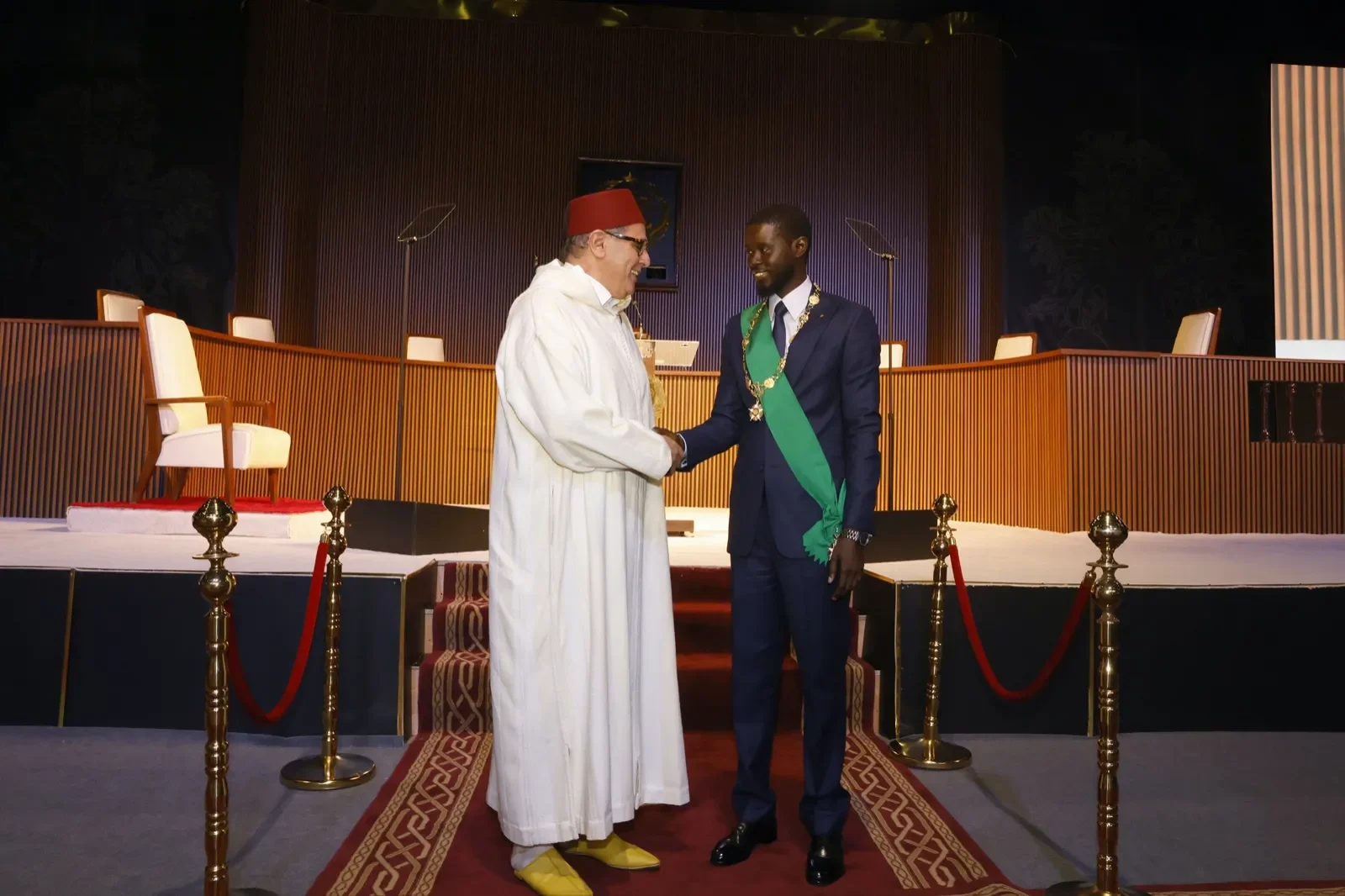
Senegal-Morocco: A legendary friendship with solid foundations
The relationship between Senegal and Morocco dates back well before independence, with commercial and diplomatic exchanges established since the colonial periods. These historical ties allowed a fluid transition to post-independence cooperation marked by the adoption of the 1964 establishment convention. The friendship between Senegal and Morocco was consolidated thanks to the close personal and diplomatic relationship between two great African leaders: President Léopold Sédar Senghor and King Hassan II. From the first years of independence, these two emblematic figures have forged strong links based on mutual respect and the common vision of a united and prosperous African continent..
If there are two countries in Africa whose populations rejoice in the excellence of their cooperation, they are Senegal and Morocco. Their different geographic location, with Senegal in West Africa and Morocco in the northwest, has never been an obstacle to the development of exemplary friendship and fraternity, in Africa and in the world.
Several symbols illustrate the vitality of the Senegalese-Moroccan relationship. In Dakar, you just need to admire the capital’s grand mosque to perceive the Moroccan presence through a unique architecture adopted by the Senegalese for a very long time. Moreover, several other places of worship or palaces in the country have called on Moroccan architects for their decoration.
The Moroccan presence in Senegal is also manifested through the famous Mohamed VI street in Dakar, where Moroccan traders settled well before independence. Knowing the quality of Moroccan craftsmanship, the Senegalese are snapping up rugs, carpets, slippers or djellabas available on site.
In the field of education, Senegalese and Moroccan students travel between Dakar and Rabat thanks to exchanges between the different universities. For several decades, Moroccan students have attended the Faculty of Medicine at Cheikh Anta Diop University in Dakar, renowned for the quality of its teaching and its rigor. Today, there are around 1,300 pursuing their higher studies at the universities of Dakar, Ziguinchor, Saint-Louis, Thiès and Bambey.
“Life in Senegal, and more precisely in Dakar, is very similar to where I come from, and the people are welcoming and open-minded,” says Mohsine Ait Oukhabbar, Moroccan student in DES (Diploma of Specialized Studies) in radiology, 4th year, at the University of Dakar.
Conversely, thousands of Senegalese live in Morocco, particularly in large cities such as Rabat and Casablanca. According to Senegal’s ambassador to Morocco, Seynabou Dial, many Senegalese consider Morocco their “second country”.
This proximity between the two countries finds its foundations in religion, in particular with Tijaniyya, a Sufi Islam practiced on both sides. Every year, thousands of Senegalese pay their respects to the tomb of Cheikh Ahmed Tidiane Chérif in Fez.
In addition, the Cherifian sovereign regularly sends emissaries to religious ceremonies in Tivaouane, Touba, Kaolack, etc. “The common religious model between the two countries, based on moderate Islam and the Maliki legal school, constitutes one of the pillars of this relationship,” recalls Bakary Sambe, director of the Timbuktu Institute.
“A sincere fraternity,
solidarity…”
Better yet, this “old love story” between the two countries is also based on a legal foundation initiated by President Senghor and King Hassan II through an establishment convention signed on March 27, 1964. This document made the relationship between the two countries an exemplary model of South-South cooperation. During the celebration of the 60th anniversary of this convention, last February, the Moroccan ambassador to Senegal, Hassan Naciri, praised this initiative as a “living symbol of a sincere, united and unwavering fraternity, but above all of a common destiny”. This agreement allowed nationals of the two countries to benefit fully from this cooperation, in particular thanks to “freedom of movement of goods and capital” in both directions.
“Senegalese nationals in Morocco or Moroccans in Senegal cannot suffer any discrimination, limitation or obstacle in matters of public procurement in either country,” explains Moroccan-Senegalese lawyer Khaled Abou El Houda. Concretely, this agreement facilitated “the opening of businesses, industrial, commercial, agricultural, artisanal businesses, etc.,”. Today, this founding text has given a boost to relations between Dakar and Rabat, by boosting exchanges and strengthening the convergence of views between the two States. On the economic front, trade between the two countries has experienced spectacular growth, from $6 million in 1999 to $320 million in 2023. More than 60 legal and commercial agreements have been signed, covering areas as varied as transport, rail and energy.
Politically, Dakar and Rabat are in sync on several international issues. This is why Senegal has always considered the Sahara as a province of southern Morocco. “The southern provinces are experiencing colossal transformations recognized worldwide. The Dakhla hub, with its port, is a model for the continent,” underlines Bakary Sambe.
It is no coincidence that Dakhla was chosen, in April 2021, by Senegal to open a consulate, marking its support for the territorial integrity of the Kingdom. “This region constitutes a link between Morocco and African countries,” explains the director of the Timbuktu Institute. This friendship, established well before independence, continues to be consolidated by the leaders of the two countries, to the great happiness of Senegalese and Moroccan nationals.
Today, the relationship between Senegal and Morocco is characterized by sincere solidarity and a common destiny. This “old love story”, nourished by generations of cooperation, is a model for other African countries.
The successive governments of the two nations have been able to strengthen this friendship by making it even more solid on the political, economic, cultural and religious levels. The Moroccan presence in Senegal and, conversely, Dakar’s constant support for Moroccan positions in the world testify to a friendship which continues to consolidate. Citizens of both countries, whether they live in Morocco or Senegal, are witnesses and beneficiaries of this exceptional relationship, and this is how the friendship between Senegal and Morocco continues and flourishes. The story of this exemplary cooperation is a model of African friendship which, beyond geographical and cultural differences, demonstrates that human and spiritual bonds can be stronger than anything.
Located in the heart of Dakar, the Grand Mosque embodies the harmonious union of Andalusian art, Arab architecture and local know-how. Erected by Morocco in 1964, and inaugurated by the late Hassan II and the late Léopold Sédar Senghor, it is distinguished by its majestic beauty, its slender minaret, and its rich Moroccan spiritual and cultural heritage.
This imposing building has become emblematic of the city of Dakar and fascinates as much by its aesthetics as by its importance in the social and religious life of the country. A colorful carpet stretches out like an island of softness, inviting meditation. On the ceiling, artistic crystal chandeliers sit alongside oriental lamps in beige and white tones, suspended elegantly. Finely gilded arabesques adorn the walls, giving them warmth and radiance.
This sublime place embodies a true masterpiece of Moroccan Andalusian art, meticulously created by artisans specially from Morocco. The decor, sumptuous and refined, offers a perfect balance between tradition and modernity, between classicism and creativity. We discover an atmosphere that is sometimes refined, sometimes rich in colors, always enhanced by a luminous design which lights up joyfully at nightfall. Every detail contributes to making this building a sacred, living and welcoming space, a true showcase of a thousand and one mosaics.
The Great Mosque of Dakar is much more than a place of worship: it is an architectural marvel, emblematic of the spiritual and cultural identity of Senegal. Located in the city center, on the Allée Pape Guèye Fall, it proudly dominates the urban landscape of the capital. Its main minaret, 67 meters high, rises majestically towards the sky, like a silent call to peace and faith. If the architecture bears the signature of Moroccan experts with French managers, the building’s lightning rod was welded by a Senegalese technician, Momar Ndiaye, a strong symbol of local participation in this historic collective work. Ranked among the largest religious buildings in Dakar, the mosque also houses the Islamic Institute of Dakar, founded in 1974. Placed under the supervision of the Ministry of National Education, this public establishment constitutes a teaching and research center devoted to Islam. It houses within it a precious library, that of the Saudi prince Nayef Ben Abdelaziz Al Saud, inaugurated on October 9, 2004, which contains works of great value, true treasures of religious and cultural knowledge. The mosque is not just a place of worship. It also plays a key role in the social and spiritual life of the country. Indeed, it is here that the solemn prayers of the President of the Republic of Senegal are performed, highlighting the importance of this building in the political and religious landscape of the country.
In 2024, the Grand Mosque celebrated its 60th anniversary. This celebration was marked by special events, including an international conference on the values of peace and living together, in the presence of personalities from Senegal, Morocco and other African countries. This occasion also made it possible to highlight the deep and historical relations between Senegal and Morocco, a partnership symbolized by this mosque.
In parallel with this anniversary, a rehabilitation agreement was signed in 2023 to ensure the preservation and modernization of the mosque. This rehabilitation project, carried out in collaboration with the Mohammed VI Foundation of African Ulemas, aims to strengthen the management of the building while continuing to share Moroccan expertise in the field of religious training. It testifies to Morocco’s continued commitment to Senegal’s religious heritage. Thus, the Great Mosque of Dakar, beyond its architectural splendor, remains a true symbol of spiritual and cultural cooperation between Morocco and Senegal, and an essential place for the Muslim community.
Maguette NDONG
