
Sale of rosaries, juice, dates: The grace period
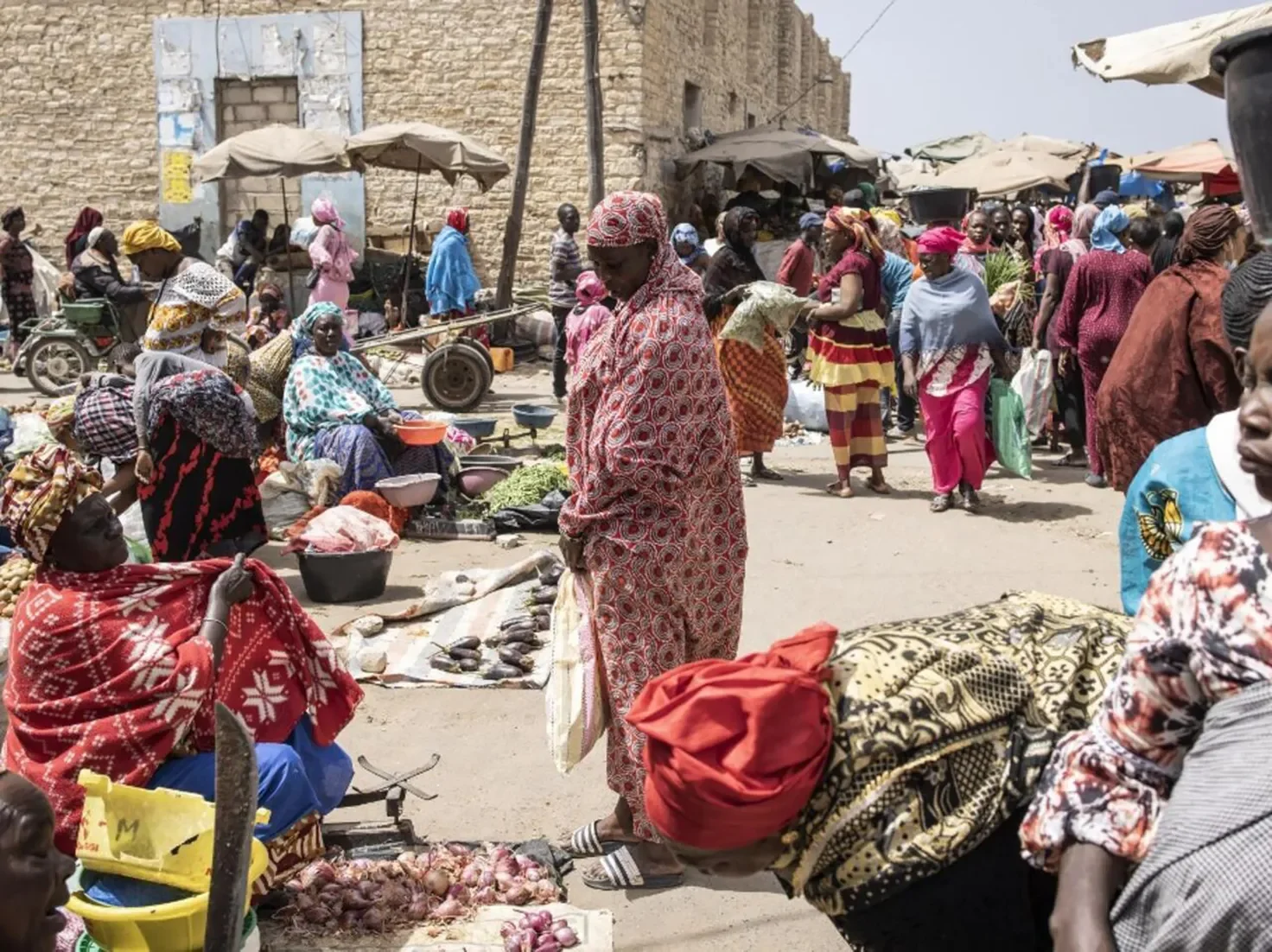
As the sun sets in Dakar, the streets of Grand Yoff transform into a theater of intense exchanges. Rosaries, artisanal juices, dates, toothpicks and prayer mats: behind these everyday products lies a local economy that is certainly fragile, but strategic and boosted by seasonal demand and the quest for additional income.
It’s 5:10 p.m. in Dakar. The sun, already low on the horizon, diffuses an ocher light which envelopes the city in a languid warmth. In the sandy streets of Grand Yoff, shadows lengthen on the facades with peeling paint and chipped tiles, while at the stalls, parasols are already being folded to better see the clock ticking.
It is at this uncertain hour, between dog and wolf, where Dakar changes skin. The yellow and black taxis, the famous fast coaches with bodies sprayed with religious maxims, honk their horns with nervous insistence. The carts, pulled by skinny horses, weave through emerging traffic jams. Passers-by, blue or black plastic bags dangling from their fingertips, hurry as if they were running after the sunset. Not far from a pharmacy in Grand Yoff, near the corner of a busy passageway scented with the aromatic scent of coffee, a seller, his eyes bulging, certainly accentuated by hunger, has set up his shop on the sly. It is a metal construction on several levels on which rosaries hang. A radio placed on the ground broadcasts religious sounds which accompany the bargaining and languid footsteps of the customers.
The owner, Alpha, toothpick in hand, says his business has seen a resurgence. According to him, customers are more active during this period. “Before the start of the month of Ramadan, I could stay three days, even a week, without receiving a single customer. But now, at least, I welcome two clients during the day. The prices of rosaries are negotiated between 2,000 FCfa and 5,000 FCfa,” he says.
Electronic rosaries in vogue
However, specifies the merchant, customers, especially young people, are more fond of electronic rosaries. These sell for between 2,000 and 3,000 FCfa depending on the quality. According to Alpha, this attitude can be explained by several reasons. “I think electronic rosaries are much more manageable. We can use them in all spaces: in the car and even on a motorcycle,” he quips. In his words emerges a discreet adaptation to modern uses where spirituality marries urban mobility.
A little further away, sitting on an overturned crate, Aïda Ndiaye, mother, tries, with mechanical gestures, to attract the attention of potential customers. She is active in the sale of natural juices. On a worm-eaten table leaning on stones, she displays bottles filled with juices very popular during this period and whose manufacturing secret she candidly keeps.
Like Alpha, its turnover has increased substantially, notwithstanding, she says, the complicated economic situation that has been plaguing the country for some time. “Even if times are tough for many households, juices like bissap are selling like hotcakes. People consume it right after breaking the fast. It is very popular and the prices are affordable. I sell the bottle for only 1,000 FCfa. I can easily sell 10,” explains the saleswoman. However, it faces increased competition. Some prefer to buy other juices made with chemicals. “It’s cheaper, but you have to think about health,” she insists. Aïda hopes, in the days to come, to double, or even triple, her turnover. “That’s all I want.” There is nothing better for a seller than to come home with your pockets full of notes,” she adds with a broad smile. His optimism contrasts with the harshness of the setting.
In ordinary times, the date is just one product among others purchased by connoisseurs or nostalgic people. However, during Ramadan, it becomes central, almost symbolic. “We all break the fast with the date,” slips the trader. In front of a brown and golden mound, Cheikh Diop, a seller for more than a decade, is busy putting his products into bags. He explains that he has a particular method allowing him to sell dates quite easily, especially during this period. “As you can see, there are various bags of different sizes. I have prepared them in this way to allow anyone to buy them. There are even bags for 100 FCfa,” says Cheikh.
The cult of solidarity
According to this merchant, the month of Ramadan is a time of clemency and leniency. It is therefore essential to think about people with modest incomes. “There are people breaking their fast in the street. These people do not need a huge amount of dates. A sachet at 100 FCfa can solve their problem,” he says. Cheikh Diop specifies that it is also during this period that he replenishes his coffers. “Currently, dates are sold by the kilo. It is negotiated between 1,000 FCfa and 9,000 FCfa depending on the varieties and quality,” he informs. In the middle of a discussion, a customer arrives. Her name is Fatou, glasses balanced on a flat nose. Fatou came to get dates for the whole month. She plans to buy two kilograms, enough to last 30 days. “I have a budget of 2,500 FCFA and I don’t plan to spend a single cent more,” she whispers playfully to the seller. According to him, the prices remain affordable.
Between two rickety stalls, a loose man with an overflowing tray is hailed by a small group of sellers installed in a makeshift tent. Amadou is a seller of toothpicks, a very common product during this period. “People use them to clean teeth and dispel bad breath. This is my second round of the day and I’m doing pretty well. I am being questioned from all sides,” he says. At each stop, a few pieces discreetly change hands. Finally, as the call to prayer approaches, other figures settle down on the side of the road: the sellers of prayer mats. The colorful scrolls, with geometric patterns and printed arabesques, are carefully aligned. Prices vary depending on thickness and finish: 5,000 FCfa for simple models, 6,000 FCfa for more padded versions and 10,000 FCfa for imported mats, which are wider and better decorated.
Mamadou, one of them, says sales intensify as the last 10 nights of the month approach. “Many want to renew their mats to pray better. Some also buy as a gift,” he confides, while unrolling an emerald green model. Here again, transactions are carried out in whispers, in an atmosphere mixed with fervor and calculation.
By Pathé NIANG
