
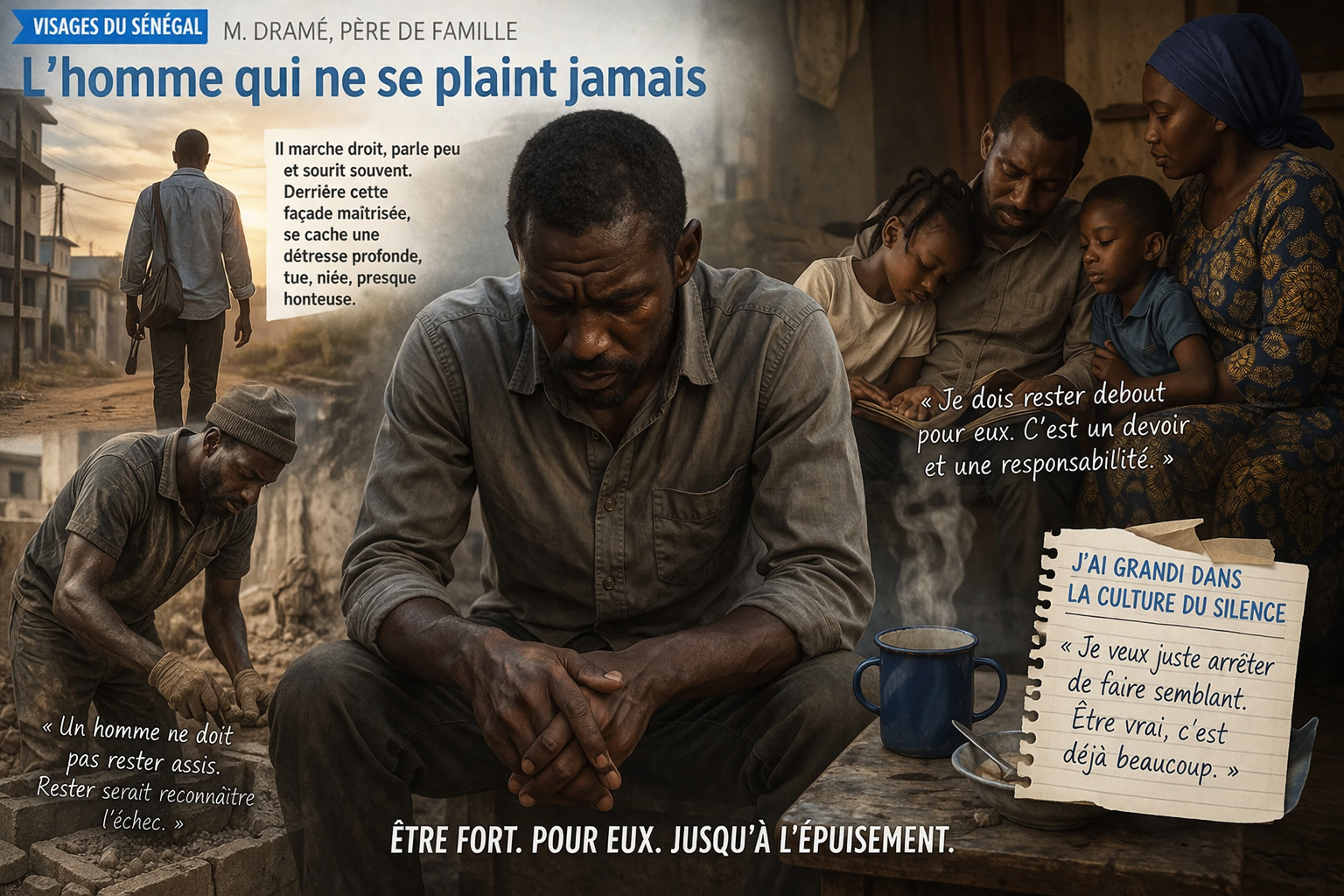
Mr. Dramé, father: The man who never complains (3/4) April 11, 2026
He walks straight, speaks little and smiles often. In his neighborhood in Keur Mbaye Fall, Mr. Dramé, 42, is perceived as a serious, discreet, respectable man. Husband, father of three children, he corresponds in every way to the expected image of the head of the family. However, behind this controlled facade hides a deep distress, silenced, denied, almost shameful. His story tells that of men summoned to be strong. Until exhaustion.
Dramé is a man we barely notice. Forty-two years old, average height, silhouette refined by years of fatigue more than by age. His shoulders are slightly hunched, not out of weakness, but as if his body had long since absorbed the weight of responsibilities. His face is closed without being hard. The features are marked, the eyes often dark circles, showing a chronic lack of sleep. However, he takes care of his appearance with an almost obstinate rigor: sober shirts, clean shoes, discreetly trimmed beard. A sartorial dignity as a bulwark against social decline.
Every morning, Mr. Dramé gets up before dawn. At five o’clock, sometimes earlier. The house is still sleeping. He drinks coffee that is too strong, swallowed standing up, without pleasure, adjusts his shirt in front of a cracked mirror, then goes out quietly. This ritual is immutable. Even since he lost his stable job. Laid off three years ago, he has since had odd jobs, irregular days and unanswered expectations. But he refuses to dwell on it. “A man should not sit still,” he said. To stay would be to acknowledge failure. Going out means continuing to play the role: “I’m a stand-up man. »
He speaks little. His sentences are short, measured. And some days, he comes home empty-handed, after looking for work all day. But he never complains. “We often go to the construction site together. Dramé doesn’t talk much, but he’s always there on time. Even when he knows there might be nothing at the end of the day, he works seriously. He never complains. Sometimes you can tell he’s tired, but he grits his teeth. He is a man who holds on, even when things no longer hold around him,” says Moussa Diop, a mason like him.
A good man
In his neighborhood in Keur Mbaye Fall, Mr. Dramé is respected. He is described as calm, composed, responsible. He speaks little, listens a lot. He smiles often, sometimes jokes. He never complains. Amadou, a neighbor: “He is one of those people call a good man. » Seynabou, his wife, corroborates: “He is nice to everyone. He never shouts. He always tries to keep peace in the house. »
But behind this image, another reality emerges. Being a father, for him, is not only loving: it is ensuring, protecting, presenting. Her children are her pride and her greatest worry. He watches them sleep with a tenderness mixed with anguish, as if he fears he is no longer up to the role. “I have to stand up for them. It’s a duty and a responsibility,” he whispers, gently caressing his daughter. Even when everything is falling apart inside.
Read also: “Gòor dafay dëgër”: when masculine strength becomes a social injunction (2/4)
“Even though it is difficult for the family not to be able to provide for all their needs, I, as a wife, feel sorry for my husband and I understand him. Every day I wake up praying to God for a better tomorrow. But my morale is low,” confides Seynabou.
I grew up in the culture of silence
In Senegalese society, virility is a daily performance. You have to succeed, provide, represent. Failure is not only economic: it is moral. Dramé experiences this discrepancy as an intimate fault. “One day, people will look at me as a useless man,” he confides.
He masters the refuge phrases: “It’s going to be okay”, “God is great”, “We’re holding on”. Words that, according to him, keep others upright, but confine him further. Mr. Dramé is not an isolated case. He is one face among others. The ordinary face of massive male suffering, ignored, trivialized.
A distress that camouflages itself, accumulates, then sometimes explodes. For him, when this happens, society speaks of “weakness”. However, “strong man” does not mean dying, he suddenly blurts out, as if surprised by his own audacity. After a long silence, he adds: “I just want to stop pretending. Being true is already a lot. »
By Adama Ndiaye
AI-generated image
