
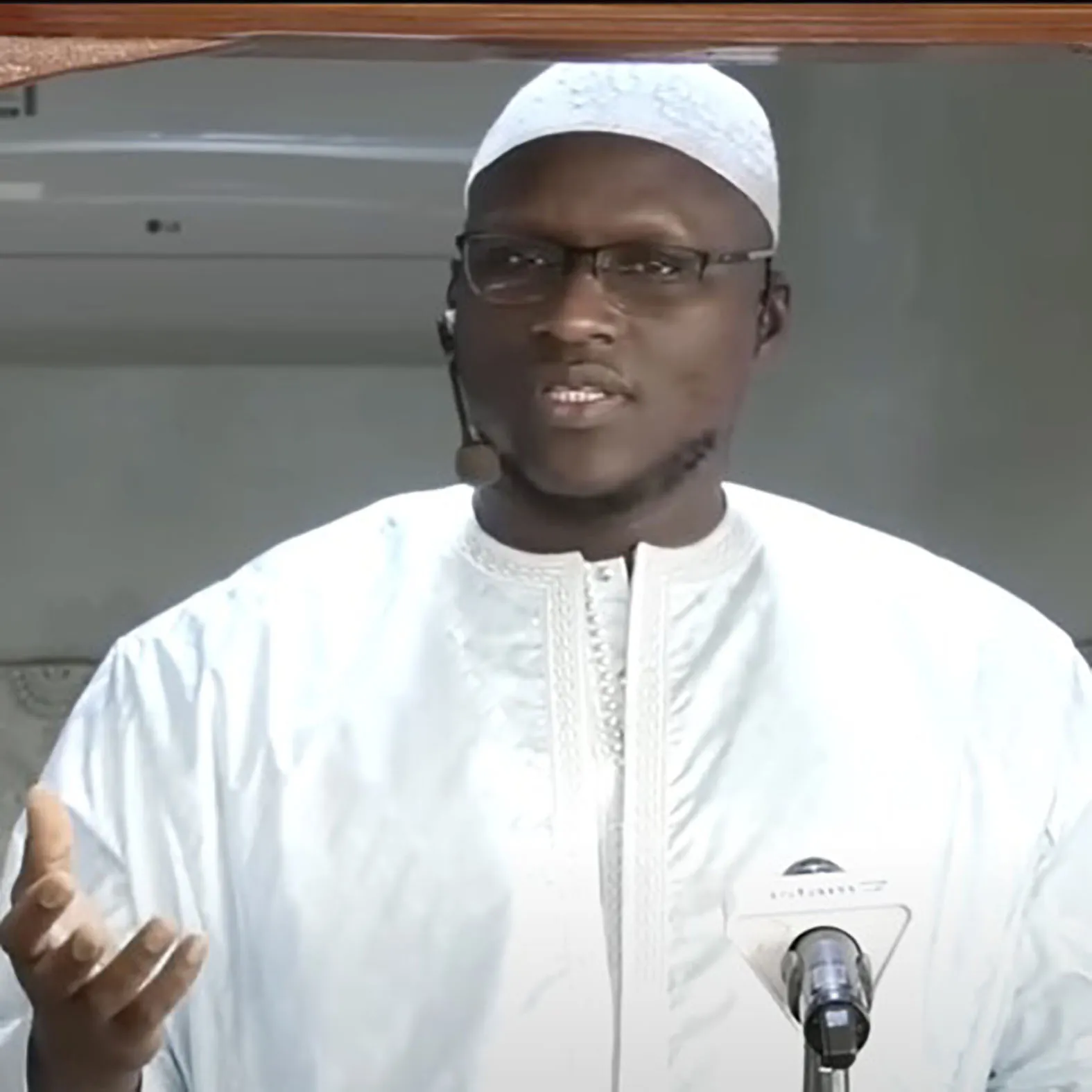
Mor Kébé, Imam: “The Quran is not a business” May 29, 2026
Oustaz Mor Kébé shows rare availability when it comes to addressing this subject which he considers to be one of the most corrosive moral scourges of our time. As soon as the word “false marabouts” is said on the phone, his voice hardens and gains gravity. Mr. Kébé dissects this phenomenon which he accuses of silently ravaging the Senegalese social fabric.
For him, the phenomenon is neither chance nor a simple marginal drift. It is the product of a deeply fractured social, religious and economic environment. In a precise, sometimes sharp delivery of speech, he lists the mechanisms which, according to him, nourish this mystical industry which has become a veritable market for credulity.
“There are several factors that encourage this phenomenon in our society,” he warns, before directing his gaze towards certain misguided teachings given in daaras. According to him, after classical learning of the Koran, some children are initiated into esoteric practices totally foreign to the foundations of Islam.
“We give them mystical books, filled with Arabic writing, which refer more to magic than to religious texts,” he denounces with barely concealed severity.
For the religious, this carefully maintained confusion between sacred and occultism constitutes one of the greatest spiritual impostures of our time. In his analysis, he also points out a social reality that is often ignored: the idleness of many young people when they leave the daaras.
“Many struggle to find work. Having already learned the Koran and other similar practices, some choose to make a living out of it. “It’s a shortcut to easy money,” he regrets.
The spiritual, he says, has gradually transformed into a commercial showcase where human distress becomes a marketable raw material. “It becomes a business,” he insists, before calling for an end to the transmission of this knowledge which he considers dangerous.
But, beyond the initiators, Oustaz Mor Kébé also incriminates the psychological disposition of a part of Senegalese society, which he considers excessively permeable to charlatanism. “The Senegalese believe too much in these things,” he breathes.
According to him, even when they land a job, pass a competitive examination or begin a project, many feel the irrepressible need to consult a marabout to secure their success.
A practice that he considers to be a profound deviation from the relationship with faith: “It is not a prayer. In Islam, we pray to God, not to man. »
The guide then takes care to establish a clear distinction between the true “Salat al-Istikharah” recommended by Islam, this prayer performed to ask God to guide a choice, and the mystical rituals sold by certain pseudo-religious guides.
“Every Muslim can perform Salat al-Istikharah by offering a supererogatory prayer of two rak’ahs and ask God for guidance. It has nothing to do with these occult practices,” he explains. The other poison, he continues, remains religious ignorance.
“Many have never really learned Islam. They do not know how to distinguish religion from the practices that are attached to it,” laments Mr. Kébé. In a society fascinated by symbols, he explains, the simple presence of Arabic scriptures or Koranic verses is often enough to confer an appearance of legitimacy.
“As soon as they see Arabic, they immediately think of the Koran,” he sighs. A naivety which, according to him, takes advantage of clever crooks, capable of disguising occult practices under the guise of religion.
“The Koran is not a business,” he finally decides in a dry sentence. Oustaz Kébé also evokes the media trivialization of the phenomenon: television advertisements, aggressive promotions on social networks, promises of wealth, marriage or healing.
“Faith, in essence, cannot be monetized or conditioned…”
He observes with amazement this public commodification of the sacred. “What is happening today in Senegal is extremely worrying,” he regrets.
For Father Stanislas Diouf, former professor of spiritual theology at the Grand Séminaire de Sébikotane, the border between faith and spiritual commerce is today dangerously blurred in certain religious spaces. A drift that he considers all the more serious as it affects believers who are often weakened, seeking immediate answers to their suffering.
“The word of God cannot become a tool of commerce,” he says. For the man of the Church, the vocation of sacred texts is to accompany human beings in their relationship with God, and not to serve as a lever for financial interests, conditioned promises of healing or the logic of commodification of the sacred.
The Bible, he recalls, remains above all the word of God in the service of the sanctification of man. Any attempt to exploit it for purposes of power or personal enrichment constitutes, according to him, a betrayal of its deep meaning.
The theologian recounts having himself been confronted with certain requests that he considers contrary to the Christian spirit. In particular, he mentions people who came to look for the Paschal candle with the idea of using it for other purposes.
“The light of Christ cannot be used to carry out mystical or other practices,” he insists. For the theologian, the logic is theologically unfounded: “Can we impose something on God? » he asks.
In his eyes, the relationship with the divine cannot be reduced to an implicit contract where an offering would mechanically guarantee healing, success or protection. According to him, such a vision introduces a dangerous drift: that of a transactional faith. Because, he warns, when promises are not fulfilled, some believers fall into spiritual disappointment.
Addressing the question of miracles, Father Stanislas Diouf adopts a position of theological prudence. If he recognizes their central place in the Christian tradition, he recalls that they do not come under any controllable human power.
He is particularly critical of spectacular practices where certain preachers promise instant healings in exchange for acts of faith or financial donations.
For him, these performances reflect a serious confusion between spirituality and performance: “Faith, in substance, can neither be monetized, nor conditioned, nor transformed into an instrument of calculation. »
Adama Ndiaye
