
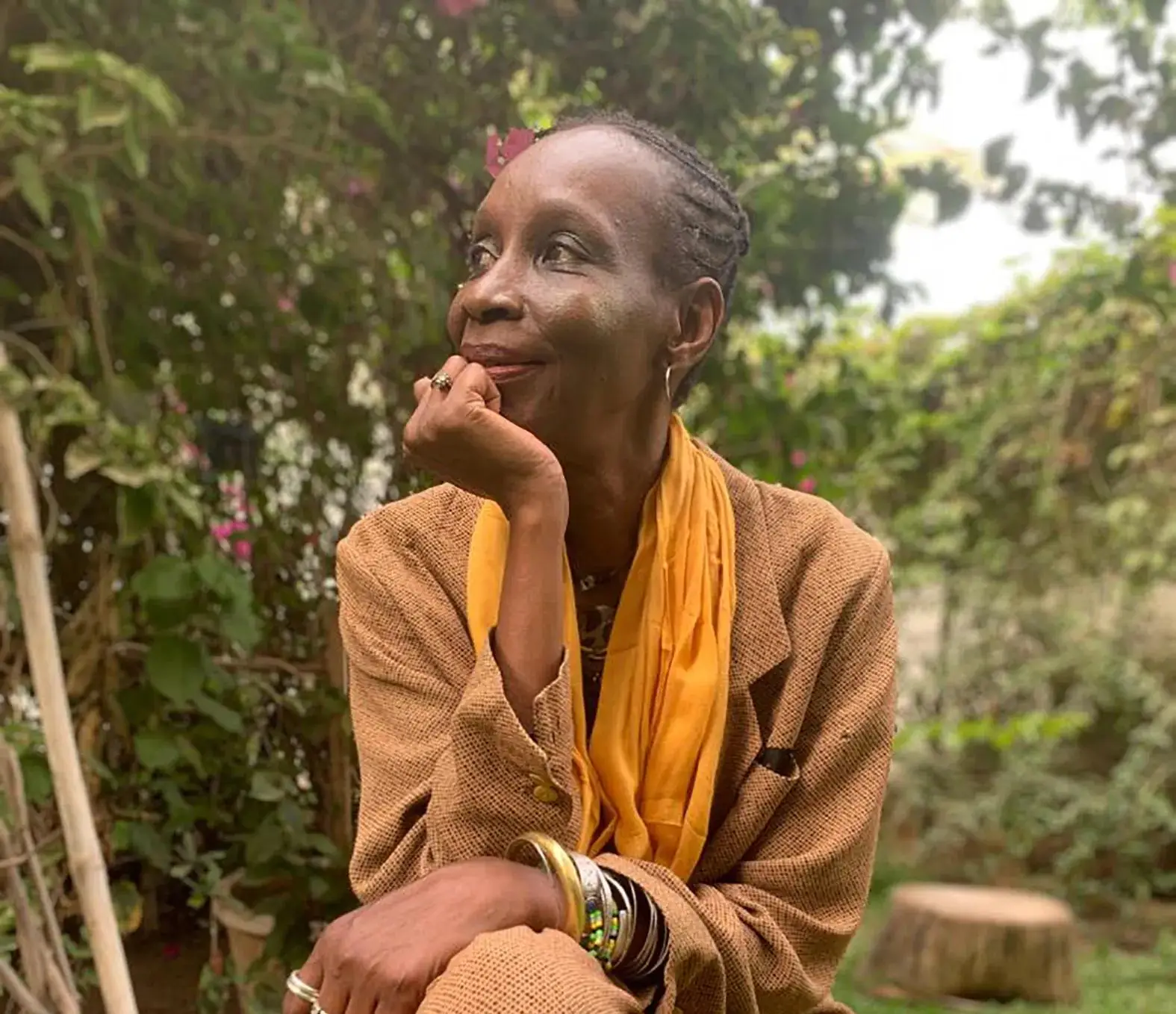
Fania Niang, singer artist: “The Imprint” of a star
She left her mark on the history of the very famous Kaoma group. She lent her voice to Touré Kounda and her silhouette to fashion designers. Fania Niang, because she wanted to sing since childhood, continues to write and sing.
His gestures bear the imprint of modesty. Shyness, perhaps. From his body, not the most robust, a clear voice burst forth. Who has a good build. A concert. Somewhere. Two thousand and eight (so the year the video was published on YouTube). The scene didn’t need a thousand artifices. The singularity of the artist’s voice adorns it. Africans, Europeans, Chinese, the world…the song “Sopi” appeals to everyone. It doesn’t matter if the video which shows Fania Niang dressed a little hippi has lost its pixels! The voice still comes through. Still relevant today, the message. This is Finia Niang who manages her solo career. 1989, summer, and “La Lambada” which dictates the temperature. The global hit from the Kaoma group features its text as well as its sensual clip and… you will see an ebony silhouette born in Koungheul. It is the same person who will later sing “Sopi”, but from the time when she brought her talent to this musical osmosis that is Kaoma. Fania Niang then is also that: a musical career in a group as well as a solo one. Another group? Yes, and not just any one! The one who holds the accordion at the very beginning of the clip discussed above, held the chorus for Touré Kounda. Classy… This artistic spark that sparkles on her sixty-year-old iris, Fania received from her mother. That was a lifetime ago. Paris music theory The girl saw a mother performing steps, in the middle of the crowd, during traditional festivals, and instinctively found a way. Art, that’s it. Then break the guitar that this 12-year-old will buy to try out chords, mother! The spirit of art had already taken possession of his body. She will follow him everywhere. Which will take her to Paris. Paris “the mathematics of music”. Paris music theory. Paris dance. And Paris, modeling. Not the stages, but the workshops and showrooms, where designers draw the shapes and curvatures of dresses on her silhouette. Music theory, dance, modeling…so many experiences! And none of it was lost. You have to see and listen to “Ma robe noire” to be convinced. “My black dress”? Quiet the music and voices, and read about the performance of the “naked woman, black woman” silhouette.
Fania’s clip will illustrate Senghor’s poem well. Because Fania is also that: poetry. Oh, you’ll hear it, instead of saying “syllables”, say “feet”. So it is with her, who versifies, even during a discussion which should only be in prose. You will also be able to hear a “put…” escape from him, immediately overtaken by a “sorry”. The lady keeps her rock’n’roll soul alive! Music theory, dance, modeling, so many possibilities. But, “I refused a lot of things,” confides Fania. “I could have worked with Jean-Paul Goude, been a second Grace Jones. Otherwise, I would be an African Madonna today.” “Education”, “chains” that hold, the words are released!
“La Lambada” may well have been requested by Winie Mandela or by Gorbachev, in the country of one of its artisans, it remains a distant noise. Which we wanted to keep as far away as possible. Music theory, dance, modeling…so many things necessary to find your place in a demanding world of show business. But, from the start, the lady knew what she wanted to do.
“Modeling wasn’t really a job for me. I always dreamed of making music.” “I have always dreamed of making music”… Fania Niang defines herself as a “free electron”. She is also a citizen of the great cities of the world. However, our Ramatu often comes to place his wings and suitcases in the hands of Lady Téranga. At her place. In Almadies. In a house?
In a sanctuary. In a garden house. In an external, green environment that mimics your inner, creative world. What Fania Niang sings, she also materializes in the arrangement of her living space. It’s a question of imprinting. “L’Empreinte” is the title of his latest solo album. Garden house, they said. Botanical album, she made. “Indigo” she sings there. “Niene”, in homage to the Earth, she composed there. “Sopi”…Um, “Sopi”, isn’t it 99? Yes, but, the message of “Sopi” seems to be a cornerstone in the musical edifice of the singer artist. Let us therefore say that “Interlutte”, which is “a cry in the face of current threats, a reflection on collective and internal struggles”, represents an update of the message of “Sopi”, which called for change, a little over two decades ago.
For Michael Soumah, the eight tracks of “L’Empreinte” constitute more than a musical album. “Memory work”, “poetic meditation”, “declaration of love to creation and humanity”, Fanian’s latest creation is a summary of sincerity, strength and depth, inscribed in the sound material. “L’Empreinte”, which was released in November 2025, becomes the fifth album by this free spirit that art has taken all over the world. It comes after “Sopi” (published and distributed by the Sony Music Entertainment label in 1999), Naturel (2004), Silmakha (2008) and Animiste (2014).
She admits, not all her albums have had the same success as those of the beginning of the 21st century. Like that of 2014, whose release coincided with unfortunate terrorist events in Paris. “The title didn’t ring a bell,” she explains. And yet, what she hears from “Animiste” should have helped give depth to the album, even in this context. Everything around us lives: that is its “Animist”.
This must, therefore, be protected and not terrorized! Her Almadies sanctuary exudes this idea of “Paradise” that she wants for the animals she houses there. These trees, with well-anchored roots that stretch towards the sky to give shade to this “Paradise”, are the image of the eco-friendly who planted them. …“A fused music” from Africa for the attention of the world She has been carried very high by her art, but has not yet extricated herself from the spiritual substrate which makes up her being.
She and the trees, her “Paradise” and life, are ultimately only imprints. “An imprint of the one who lives there, from up there, who is infinite. And with a stroke of drawing, which brought us here. We are his works of art. It is us who must be protected more than machines.” To make her “Empreinte”, Fania Niang worked with various musicians, for example Youssou Ndour or the National Orchestra. She retains an impression of fruitful exchanges. Who make you dream. She also believes that with the current dynamic, Africa has all the instruments to compose “fused music that can be listened to around the world”. She does, she believes, she dreams. And one of his biggest dreams “is to have fans who haven’t yet been born.”
By Moussa SECK
