
The premonitory whirlwinds of the third globalization June 21, 2026
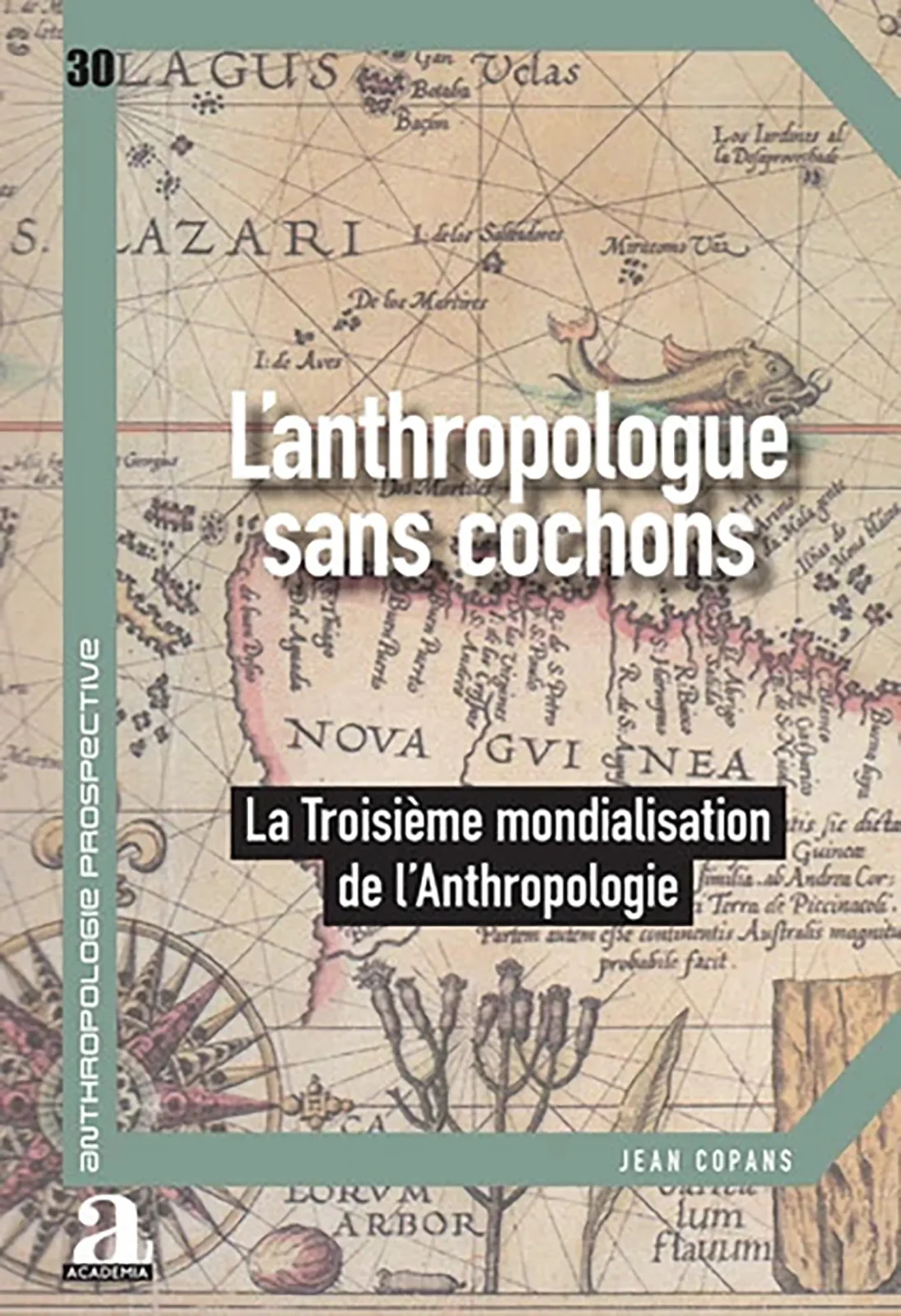
In his work entitled “Anthropologist without pigs” (Academia, 2025, 467 p.), Jean Copans explores the avenues of a third globalization of anthropology. The author also discusses his links with Senegal, a country he knows well since he carried out his first field studies there.
After the era of great discoveries, the Age of Enlightenment and colonization (instrument of voyeurism), a third globalization of anthropology is emerging. In his work entitled “Anthropologist without pigs” published in 2025 by Academia in the “Prospective Anthropology” Collection, the French anthropologist Jean Copans reviews the ideas and disciplinary traditions necessary for him to get there. The book begins and closes with the evocation of the story of John Waiko, “the anthropologist without a pig”, immortalized in the film by Chris Owen (1990).
This return to one of the founding fields of anthropology, the Papuans of New Guinea, is far from trivial. Not only are this region and its cultural area very often considered the birthplace of modern anthropology of the first and second globalizations, but it is also in this crucible, by definition multi-site, he says, that several of the discipline’s innovative thinkers have asserted themselves over the last decades.
Thus, the third globalization could precisely begin with a practice, both exotic and self-reflexive, of a provisional intra-anthropological detour within another cultural and empirical area of the discipline. Which, in the opinion of Jean Copans, would constitute a completely controlled distancing which would add to the obligation not to give in to the ease of an “ethno national” terrain. A reflective journey This work aims to “expose the difficult and contradictory conditions of possible, but above all necessary, management of the third globalization of the discipline of social and cultural anthropology”.
However, recognizes the author, the project of a third globalization of one of the most original, but at the same time the most Western, social sciences of European modernity is not just a simple updating of a most ordinary intellectual project for any society. “This third globalization requires a powerful anthropological commitment, paths and particular procedures whose examination must now be an integral part of the disciplinary corpus itself throughout the world,” he writes. A project that the author describes as utopian. After that of anthropology without borders that he had outlined in 2000 (see chapter 7), this new utopia would be “an explicitly contradictory utopia”. “Indeed, we would then become the practitioners of an anthropology without field driven in spite of itself by a permanent desire to return to empirical field. »
The writing of these texts – the delivery is a collection of articles – began around a quarter of a century ago, but the development began in 2020 in the midst of the Covid-19 pandemic. In fact, it is more of a kind of automobile technical inspection relating to a used vehicle. This collection therefore essentially covers the period of the years 2008-2018, the oldest of the texts, the inspiration for a perspective of a 3rd globalization of anthropology, dating back to 1999 for its writing, that is to say a quarter of a century ago. However, his academic corpus began a third of a century earlier, in 1966, at a time which corresponded, according to Copans, to the golden age of French anthropology which ran from 1955 to the early 1980s.
Existential question
This collection traces both a reflective path, linked to the publication situation (call for tenders, editorial solicitation, educational experience, etc.) and a more systematic and fundamental demonstration which is built over time. In this text, Jean Copans asks an existential question: could social and cultural anthropology disappear? The common thread of his demonstration permanently refers to “the defense of a certain anthropological tradition, multinational by essence and by birth, anchored in an intimate relationship with the interlocutors encountered in the different fields wherever they are and which aims to contribute as much as possible to the complete autonomy of other anthropologies”. The Africanist field remained his field of reference and predilection throughout his career. This is why this collection is also a last trick from the owner.
Over time, the author has become an “necrologist” and a “hommagist” often out of friendship (in the circle of deceased anthropologists), but also out of obligation and finally today as a chronicler of “learned life”.
This return to the elders obviously leads to the cadets, still alive, who quite recently published significant personal recollections. His third category of obituaries focused on the Senegalese colleagues who had accompanied his numerous visits to Senegal (Amady Aly Dieng, Abdoulaye Bara Diop and more recently Momar-Coumba Diop).
Forged by the French editorial context of the 1950s-1970s marked by the tensions of the debates between structuralist anthropologists and Marxists, Jean Copans does not hesitate to get involved in the “disciplinary gear that is both epistemological and political”. Some criticize him for a sometimes excessively polemical tone towards his African colleagues and radical postcolonial Africanists, or even intransigent de-colonialists.
For Copans, the postcolonial academic awakenings that we have been witnessing for almost half a century are of the most varied genres, but each new orientation remains most of the time rooted in a very specific historical and cultural experience and can hardly be applied to the whole of what we today call the Global South.
However, the one we described in 2021 as “The marabout of anthropology” in these same columns (see “Le Soleil” of September 2, 2021) was able to benefit from a kind of Senegalese revenge since the reduced and published version of his doctorate under the title “The marabouts of the peanut” (1980) had experienced a certain success locally, attracting him a sign of recognition from his Senegalese colleagues.
Disciplinary gear His professional retirement in 2005 finally gave him the opportunity to make visible the Senegalese methodological nationalism under construction for more than half a century and the popularization of his preferences for anthropology and African fields. “In a more rigorous way, the last decade has allowed me to contribute to the history of French African studies (highlighted since 1971) by means of an intellectual biography of Georges Balanadier, the inspiration and primary trigger of my own career,” he writes.
But if we ask him coldly which article or work should be carefully put aside until the last moment, he cites without hesitation “The ethnological field investigation” (published in 1998) which, although summary, remains his “eternal personal bedside book”.
Towards an anthropology without Others? His first assessment, which was at once personal, thematic and committed, appeared in 1990 under the title “The long march of African modernity” (1990). The 1990s were devoted to taking stock of research on the working and laboring classes before returning, in the 2000s, to the metamorphoses of the Mouride brotherhood which he had abandoned for two twenty years to temporarily devote himself to studies of the development, analysis and severe criticism of the Afro-centrist-postcolonial globalizing tide which increasingly occupied the center stage. With his Senegalese colleagues and friends, he contributed positively to this debate on postcolonial academic awakenings that has been going on for almost half a century.
Anglo-Saxon register If the anthropologists of the 1950s-1980s had a tendency to take refuge in the cocoon of theoretical development, his conviction is that anthropology must remain a committed discipline. “Contemporary anthropology is subject to a permanent tension between its national, even pluri-national, roots in the Anglo-Saxon register, and a global dynamic which telescopes and contrasts local, national and global fields of empirical investigation on the one hand and disciplinary traditions with proven but disjointed methodological nationalisms on the other hand,” writes Jean Copans.
As we move towards an anthropology of everyone for themselves by themselves without Others, this work undoubtedly constitutes a new horizon for the discipline. The questions raised by the texts contained in this collection will always remain relevant since they can (or must) fulfill the role of a new utopia which should inspire anthropologists.
Seydou KA
