
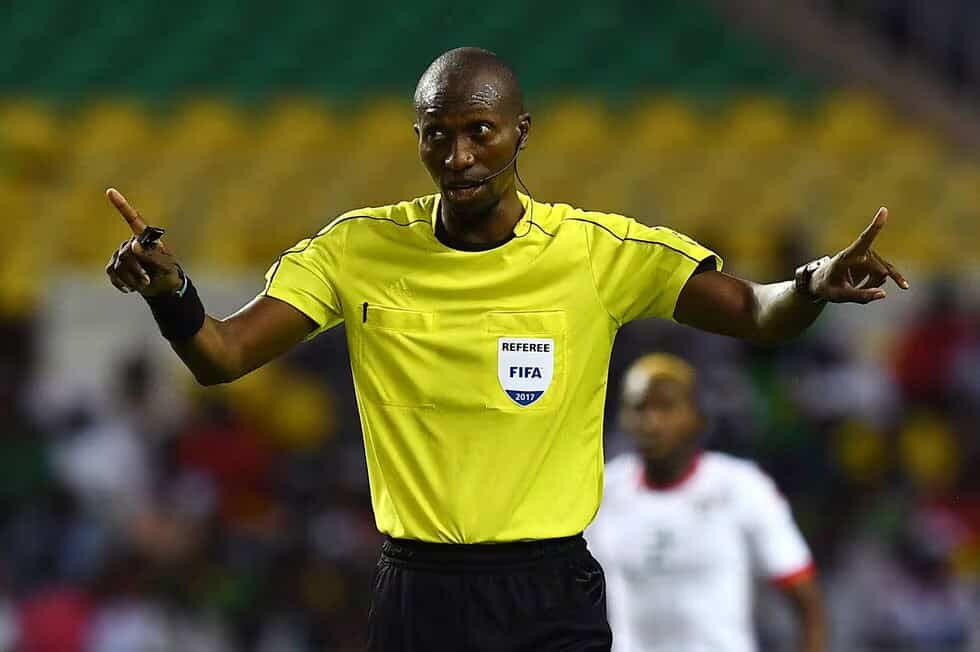
CAF arbitration: the exit of Malang Diedhiou which exposes a system that is running out of steam
The final of the last African Cup of Nations between Morocco and Senegal continues to cause a stir, well beyond the final whistle.
This time, it is neither a frustrated player nor a club manager who speaks, but an authorized, experienced and respected voice from the African refereeing community: Malang Diedhiou. Former FIFA international referee, president of the Central Commission of Referees of Senegal and member of the Executive Committee of the FSF, the former Senegalese whistle broke the silence during a notable intervention on RTS, the Senegalese public channel. And his words left no room for any ambiguity.
Describing the performance of Congolese referee Jean-Jacques Ndala as “scandalous”, the Senegalese Customs colonel, however, did not limit himself to a simple technical judgment. On the contrary, it highlighted a much deeper structural malaise.
“I was part of the referees committee, I know why I left: because I said NO. We cannot accept the interference and interference of certain leaders in the appointment of arbitrators. » This strong testimony confirms what many were already whispering in hushed tones: African arbitration has become a real political battlefield, confiscated by a few influential leaders and largely detached from the principles of competence, performance and meritocracy.
Continuing his analysis, Malang Diedhiou points out an element that is troubling to say the least. Since CHAN, the strategic position of CAF refereeing director has remained vacant, following a dismissal never officially explained. However, this manager’s essential mission was to ensure the monitoring of the referees, the evaluation of their performances and the technical preparation of a CAN in Morocco, expected to benefit from exceptional media exposure.
The consequences of this institutional void were not long in coming. A weakened referees committee, referees with limited international experience and assistants with little experience were appointed to lead major matches, up to the final itself.
This dysfunction could find its origin in a decision with serious consequences, taken just a few months before the CAN. In July 2025, Doué Noumandiez, respected Ivorian referee and then director of refereeing development at CAF, was ousted without a public report, without established fault, and five months before CAN 2025.
In the process, Safari Olivier Kabene, former Congolese assistant referee, is propelled to the head of the Central Commission of Referees, to the detriment of more experienced profiles, such as the Gambian Bakary Gassama or the Egyptian Essam Abdel-Fattah.
A choice all the more intriguing since CAF had, for a time, also considered using European or South American referees in order to guarantee the credibility of this CAN. Why was this option suddenly abandoned after the appointment of Safari Olivier Kabene? The question remains.
Today, more than ever, refereeing appears to be one of the most fragile links in the development of African football. Without independence, without transparency and without protection mechanisms against influences, no competition can sustainably claim excellence. Malang Diedhiou’s speech is therefore not akin to a settling of scores, but rather to a clear and asserted alarm signal on a system in full swing.
Faced with this situation, an urgent, profound reform of African arbitration is necessary. Otherwise, CAF will not only continue to weaken its own competitions, but also to further erode its credibility on the international scene.
By Cheikh Gora DIOP
