
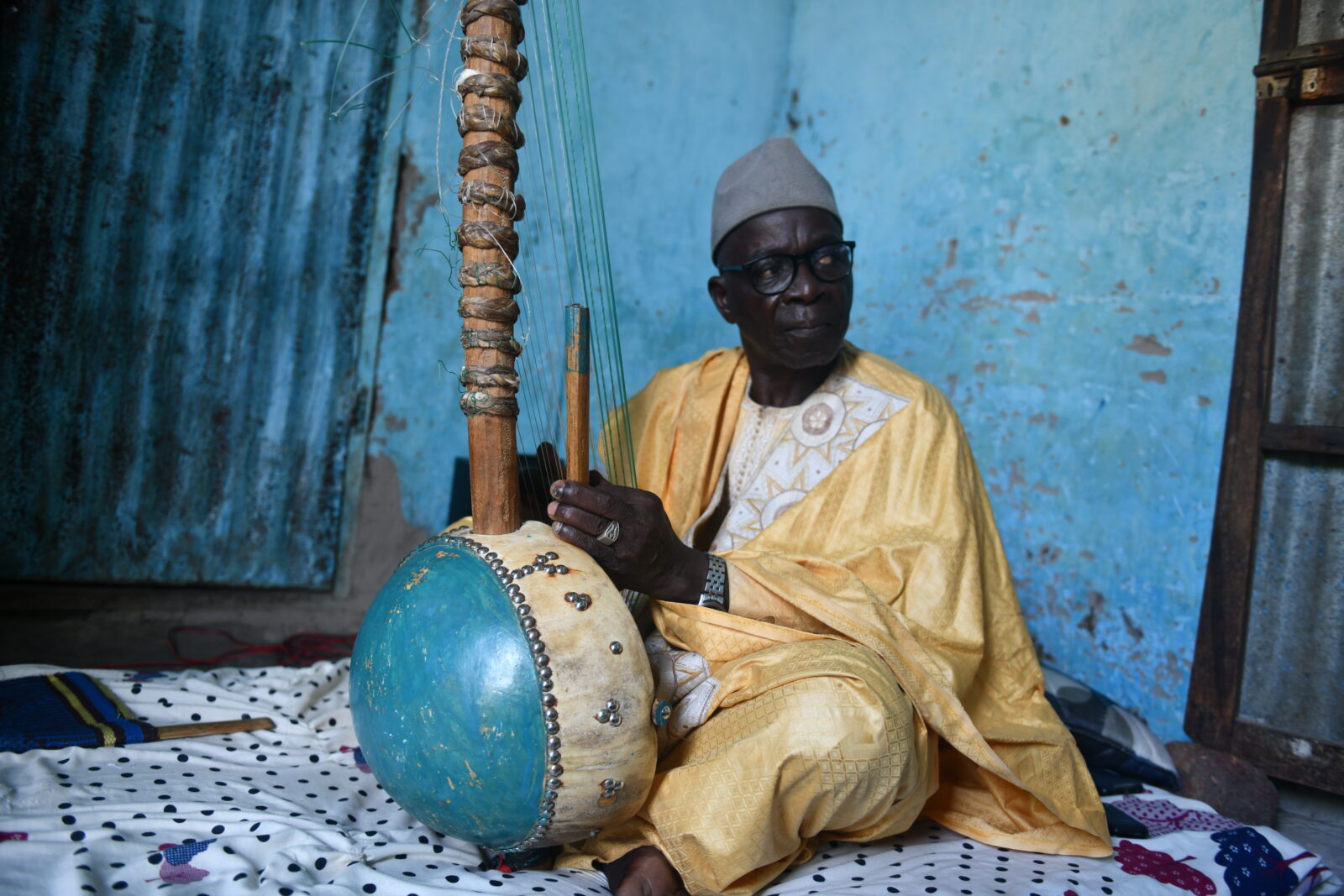
Malang Diébaté: The guardian of the history of the kora in Darsalam (2/2)
In every town, village or house, there are always men or women who hold the knowledge and secrets of the place. In Darsalam, Malang Diébaté plays this role of unifier of the community. He remains the largest Korist in this village.
He is one of those without whom, using the words of Djibril Tamsir Niane in his work “Sundiata or the Mandingo Epic”, the names of the kings would fall into oblivion, because they are the memory of men. Through words, they bring to life the deeds and gestures of kings in front of younger generations. This is the case of Malang Diébaté from the village of Darsalam. At the end of the morning, the sun is still struggling to make its mark.
The wise man of the Diébaté family is on the veranda of his sloping American building. In his late sixties, he is lying on a mat, a radio taped to his side. He listens to beautiful sounds from his parents. Informed of our arrival, he adjusts his hat and puts on his large boubou. After the usual salamalecs, the old Korist calls his daughter in a serious tone and asks the young lady to give him her musical instrument, the kora. His voice still high, Malang Diébaté says enthusiastically that all the griots of Darsalam have inherited this art of strumming the strings of the kora from their parents. “Our job is kora and agriculture.
The kora is not a toy. Our parents played it with three strings that the Mandingos call kontin. It’s different from the many strings used by other artists who are not griots,” the man explains. Explaining that it was his grandfather, Sambou Diébaté, who introduced the kora to Darsalam. He had left Gambia for Darsalam where he finally settled. Regarding the properties of this instrument, our interlocutor confides that it has a mystical dimension that only blood griots know. While regretting that this mystical and mythical dimension tends to disappear with modernity. With its universalization, many people manage to play the kora without being a depository. Making it known that the real kora is the one that has 21 strings.
For the instrument called kontin, it is held on 3 strings. And you have to be from the Diébaté family to know its secrets and be able to play with them. Attached to his kora, all his children became excellent korists. “I have a boy named Fabouly Diébaté who plays the modern kora. He performs in Ziguinchor, Adéane, Goudomp among others,” he explains with pride. For those who predict the disappearance of this instrument with its melodious notes, our interlocutor informs us that the kora will never disappear. In any case, not in this peaceful land of Darsalam where the visitor is submerged in a beautiful atmosphere of strings.
Samba DIAMANKA and Assane SOW (photos)
