
Tomboronkoto: An aquaculture hub to turn the page on gold panning and boost productivity
The village of Bafoundou, located in the commune of Tomboronkoto, is preparing to experience a major transformation. Through the Natural Resources Management Project in Senegal (Senrm), financed by the World Bank to the tune of 100 million dollars (61.3 billion FCFA), a modern aquaculture center is emerging. Objective: strengthen the resilience of local populations especially in the face of gold panning and boost the productivity of fisheries and aquaculture by 2028.
Jointly supported by the Ministry of Fisheries and Maritime Economy and the Ministry of the Environment and Ecological Transition, the project primarily targets people affected by the project (Pap), in particular fishermen, gold miners and especially women. Over an area of 2.5 hectares, the future center will include a fish hatchery, five grow-out modules, a modern catfish processing unit (yass in Wolof), market garden plots over one hectare, an administrative building, training rooms, separate sanitary blocks accessible to people with reduced mobility, as well as a solar field to guarantee energy autonomy.
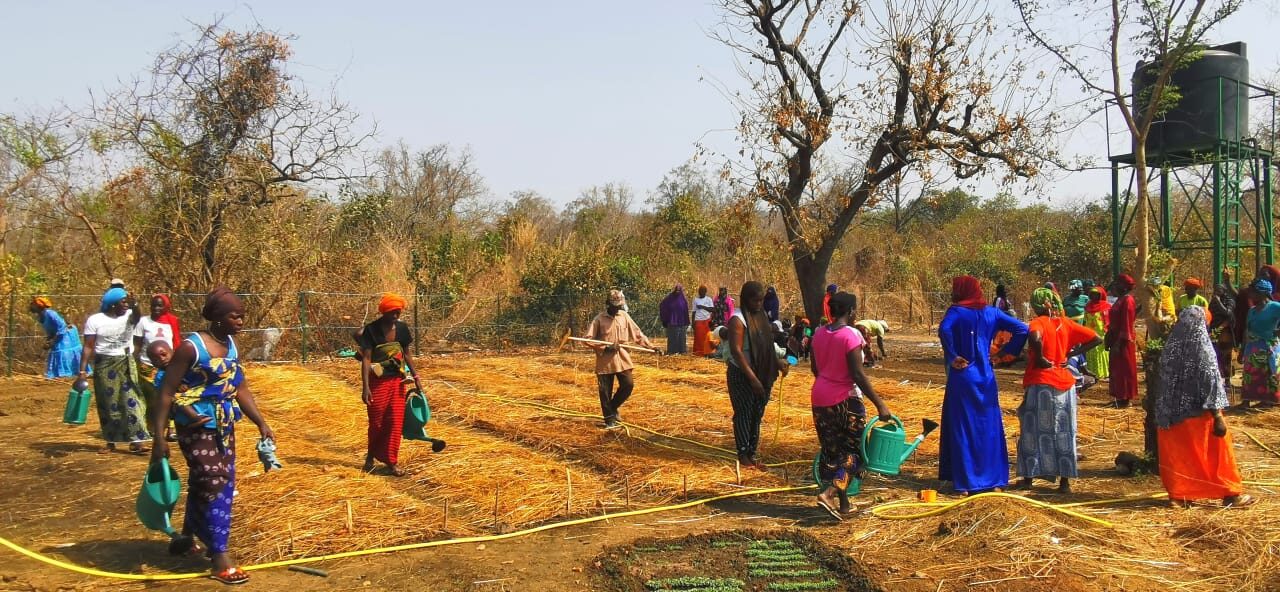
“We came to train the affected people before the complete installation of the pole. It’s about keeping them on their original site while improving their working conditions,” explains Abdoulaye Niane, the project’s aquaculture specialist. While waiting for the infrastructure to be finalized, the beneficiaries have already started market gardening activities. Equipped with equipment estimated at 20 million FCFA, the women cultivate various local crops despite the heat and Ramadan. “They are present from 8 a.m. to 3 p.m. Their commitment shows that they take full ownership of the project,” underlines Abdoulaye Niane.
Women’s empowerment at the heart of the system
The processing unit will be entirely managed by women. Trained in modern smoking and drying techniques, they will be able to diversify their offering between fresh and processed fish, targeting in particular mining and industrial workers in the Kédougou region. “There will be a rest area for women, separate toilet blocks for men and women, and we will take into account the inclusion of people with reduced mobility,” says the specialist. On the energy front, it reveals that autonomy is a key objective, with the installation of a solar field combined with an auxiliary generator, so that the pole is completely energy self-sufficient. “All you see behind us are the women who installed it,” says Abdoulaye Niane, impressed.
For Nessou Keïta, representative of the beneficiaries, this project is a breath of relief. “Gold panning is full of risks. Here we can generate income and take better care of our families,” she maintains.
Same determination from Sane Keïta, president of the group. “We want to abandon gold panning to invest in this more useful and safer project,” she adds. Fansa Signaté agrees: “I will never return to gold panning. » The municipal councilor of the commune of Tomboronkoto, Moussa Traoré, welcomes a long-awaited initiative. He calls for rapid execution so that populations fully benefit from the benefits.
Beyond infrastructure, the Senrm embodies a new perspective of sustainable development: that of creating wealth locally, professionalizing the fishing industry and offering women a credible alternative to gold panning. In Tomboronkoto, aquaculture already appears to be a lever of hope for the communities.
