
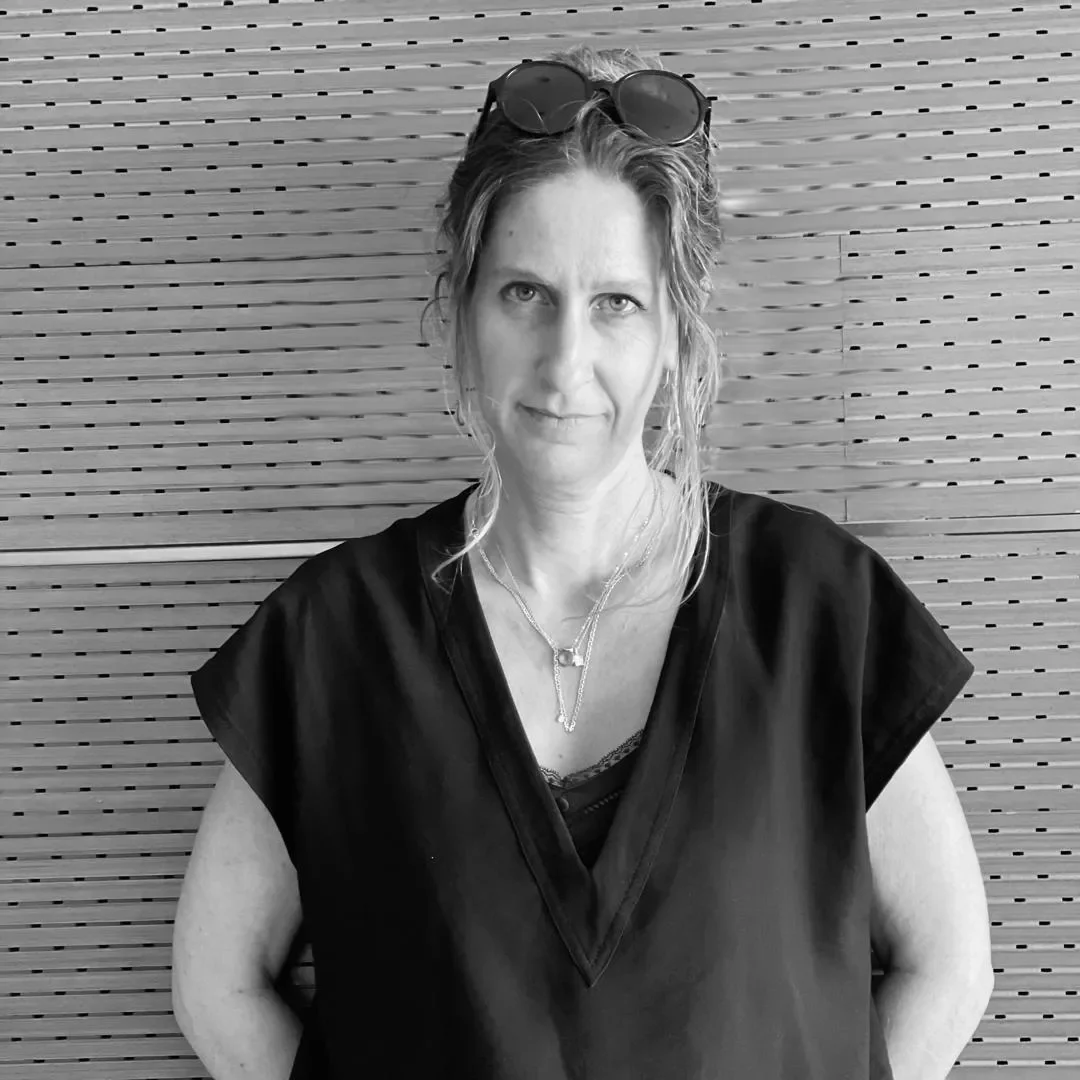
Berengere Brooks, director: “It’s a difficult job that requires a lot of energy”
Based in Senegal, director Berengere Brooks makes theater a space of friction, questioning and freedom. At the head of Brrr Production, she develops demanding, committed creations from Dakar, deeply connected to contemporary social realities. Between stage writing, actor direction and independent production, the Franco-British questions bodies, speech and politics. In this interview, she looks back on her career, her practice of theater in Senegal and her vision of a lively, critical scene resolutely open to the world.
Brrr Production is described as socially engaged theater, but without neglecting art. How do you define this right balance between social message and aesthetic requirements?
It seems to me that it is not because we are committed, or because we deal with social themes, that we must sacrifice the artistic. Theater is an art and a language, and costumes, sets, lights, acting are part of it. A coherence must emanate from the whole and the general aesthetic of the show contributes to this. For me, the show and the social theme dealt with will be much stronger, if all these aspects are taken into account equally. We must not neglect any of these aspects just because we are doing social theater; for me that would be laziness. And it has nothing to do with lack of resources.
You work with local actors, but also international ones: how do you manage to create a solid and coherent troupe in this mixed context?
This has never posed a problem, it’s rather enriching, everyone arrives with different baggage and shares it with others. I generally find that having an actor with whom we have never worked before in a creation always brings new energy, a new breath of life to the work for me and for others.
Awareness theater is often participatory. How do you see its value for non-traditional audiences?
I believe that it is a very simple way to bring non-traditional audiences to the theater, because in these plays, the themes addressed are always linked to issues that spectators experience on a daily basis and then, they have the right to intervene, therefore to interact with the show and to change things in the case of forum theater. They find themselves at the heart of the debate, this breaks the wall between the stage and the spectators, which can be a little intimidating for audiences who are not used to going to the theater.
Your recent creations (Back, Mondial.es, Le Débat) explore strong socio-political subjects. How do you choose the themes you want to address?
I choose themes which relate to the society in which I live and which will therefore be interesting for the actors with whom I work, but also for the public. Since one of the company’s goals is to open debate, it is important that the topics covered concern the local public. It is also important to me that these themes have a connection with a globalized world, undoubtedly because I come from elsewhere, but above all because we live in a world connected by the Internet, social networks, and all of this influences our vision of the society in which we live. Talking today about migration or feminism in Senegal also means discussing how this is treated elsewhere and what are the links between Senegalese society and the outside world on these subjects. Most of the shows are in fact commissions, that is to say that I am asked to produce a play on one of these subjects, certainly because we know that the DNA of the company is to open the debate on socio-political subjects.
In “Back,” the story of the returned migrant speaks of democracy and social expectations. What reactions from the public influenced your thinking?
In this show, the public is asked to vote to support a mayor who wants to pass a law to kill one of the town’s residents and thus gain access to the returned migrant’s fortune. This character is very funny and sympathetic, and ultimately the spectators end up supporting him in his efforts to obtain this money even though we know very well that this man is a corrupt and unscrupulous manipulator. This makes you think about the power of politicians in a democracy. After the show, the spectators also shared with us their emotions regarding the monologues of the migrants who talk about their life in the West and their inability to return, largely because of the shame of not having succeeded. I think these characters really touched the Senegalese public.
With “Mondial.es”, you tackle the word “feminism” which, you said, “hurts” certain audiences. How do you opt for discussion rather than preaching?
I think it is important to take stock of feminism and what it means to understand why some people do not dare to call themselves feminists. In this show, that’s what we do, and we also criticize certain feminisms from elsewhere which do not correspond to what women expect here. This is done with humor, which helps to play down the tensions that certain situations can create and to make everyone react to what gender equality means.
Compared to what you explained in an interview, you often make the actors work without them first knowing the final theme. Why this choice?
It’s important to me that the actor speaks with his body before intellectualizing things. If I tell them that we are going to put on a show on migration, they will come up with their ideas on the subject and will certainly work from these ideas. Whereas if I start with more abstract exercises in silence which will ask them to mobilize only their body, their proposals will be much freer, because they will not be prevented by preconceived ideas on the theme. Through these exercises, I lead them to create images, movements, movements that have a connection with the subject of the piece that they will discover little by little and allow them to perceive, just like me, aspects of the theme addressed that we would not have discovered if we had gone through the text first.
What are the major challenges for professional live theater in Senegal today, in your opinion? And what solutions do you imagine?
The training of actors remains one of the most important challenges, because very few of them have access to real professional training. The whole aspect of administrative management of cultural projects is also a problem, because few structures manage to carry out projects of a sustainable scale, but I see more and more training open for this type of profile, so perhaps competent people will emerge in the sector in the coming years.
That’s what I want. What does it mean to “band together” in Senegal today, in a context of artistic precariousness?
I think that “making a troupe” in Senegal should probably be written “making troops” and it seems very difficult for an actor to be able to make a living from his profession by evolving only within a troupe or a company because of the lack of projects and financing even if at Brrr production, we are lucky to have projects that follow one another all year round, but that does not mean that there is work for everyone all year round. Most of the actors I work with are part of other companies or in films and series. But I don’t think this is specific to Senegal, there are fewer and fewer fixed theater troupes where it is always the same actors who play. You have to see this as an asset, you learn a lot by working with different people in this profession, even if it’s very comfortable to always work with the same people, because we know each other well. Does the lack of equipped rooms influence your artistic choices? It’s a question of constraints, as we know in advance, we work with them and we create accordingly. We have done several shows in recent years with video and it is true that it is always a challenge to show these shows in different places, because they are generally not adapted for that, but we do it anyway by finding solutions each time on site.
Comments collected by Amadou KÉBÉ
