
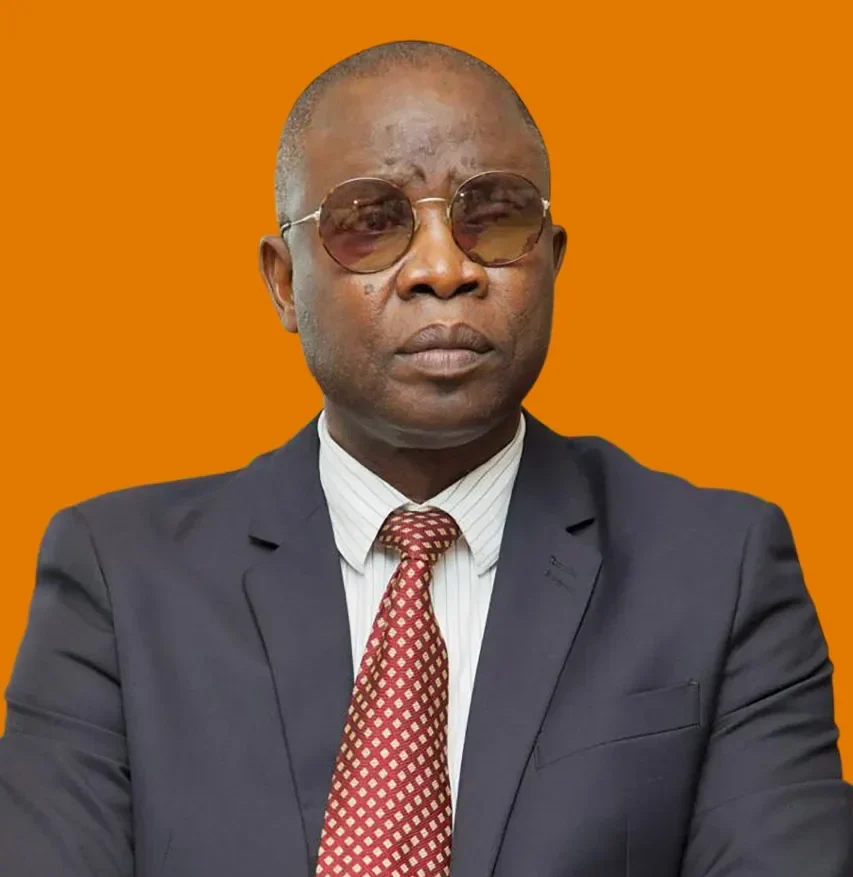
Dr Fall Mbaye: Train rather than drill February 13, 2026
Appointed in July 2024 as head of the National Institute of Oil and Gas (Inpg), Dr Fall Mbaye is not a transition manager. A high-level engineer, he claims neither ego nor verticality. He “respects everyone”. Doctor in electronic engineering, Mr. Mbaye has a rare conviction in a sector dominated by urgency: “without solid human capital, black gold illuminates nothing”. Portrait of a technician turned strategist.
In the Senegalese oil tumult, Dr Fall Mbaye is moving against the tide. While others talk about barrels, he swears by brains. He never talks about a black gold rush. No. He doesn’t like the word. Too rushed. Too noisy. The director general of the National Institute of Oil and Gas (Inpg) prefers long trajectories. Coherent systems. Solid training. In his office, located at Point E, the tone is calm, his speech measured. The man, of average height, never raises his voice, but his speech contrasts sharply with the ambient fervor. “Oil and gas are not an end in themselves. They are levers. What matters are the skills we build around,” he says.
He talks about energy as we talk about the future. Without emphasis, without slogans. Dr Fall Mbaye chooses his words like calibrating an electronic circuit: nothing superfluous, nothing unstable. Since July 2024, the date of his appointment, he has been responsible for a strategic mission: preparing the Senegalese for jobs in a sector which is finally entering production, after years of waiting, debates and promises.
Doctor in electronic engineering, trained in scientific rigor and complex systems, Dr Fall Mbaye has long evolved far from the spotlight, in the international technology industry. A pure engineering journey, shaped by precision, method and long time. “Energy is a demanding field. You can’t improvise as an expert. We need solid scientific bases, ongoing training and a capacity for anticipation,” he insists.
A trajectory shaped by rigor
At the Inpg, created in 2017, he inherits a young but strategic tool: the only officially accredited institution in Senegal to train in oil, gas and mining professions. And for him, the issue goes far beyond the issuance of diplomas. “On a daily basis, his influence is seen less in the speeches than in the method. Organized, direct, demanding on efficiency, the CEO sets a style of work that pulls the teams to the top,” testifies Babacar Kébé, Director of Regulation, Control and Quality.
As Senegal enters the oil-gas era with the Sangomar and Gta gas field projects, Dr Mbaye warns against a dangerous illusion: believing that wealth will come mechanically from hydrocarbons. “A country can produce oil and remain poor if it does not control the value chain. Local content starts with training,” he warns.
Under his leadership, the Inpg is strengthening its licenses, masters, specialized MBAs, but also its certifying technical training intended for field professions: maintenance, offshore safety, instrumentation, industrial mechanics. An assumed orientation towards the concrete. “We don’t just train for diplomas, we train for real employability,” he says with conviction. Local content, a concept that has become central to Senegalese oil governance, is for him neither a political slogan nor an artificial quota: “It does not mean excluding others. It’s making the Senegalese competent, credible and indispensable.”
The Inpg is thus increasing partnerships with universities, research centers and industrial operators, in Senegal and internationally, in order to align curricula with the real needs of the sector. This obsession with competence is not theoretical. It is the product of a demanding personal trajectory.
Born in Mbacké, trained at Limamoulaye high school, Dr Fall Mbaye distinguished himself very early on through academic rigor which led him to the École Polytechnique de Dakar, where he ranked top of his class in electrical engineering. The rest was written in the French Grandes Ecoles, in Toulouse, at L’Enseeiht (National School of Electrotechnics, Electronics, IT, Hydraulics and Telecommunications), where he obtained an engineering diploma in electrotechnics, electricity and automation, again top of his class.
In laboratories as in industry, he learns to think about complex systems, to anticipate breakdowns, to design to last. A culture of engineering that he extends in large European technology companies. His professional career began in 1986, when he served as Director of Technology at Bull Electric in France. Subsequently, he assumed the role of director of project managers at Eurotherm International SSD in Paris, from 1988 to 1990. This experience strengthened his skills in managing large-scale technological projects.
Dr Fall Mbaye then joined the Swiss holding company Ascom, where he worked as director of project managers for nearly 17 years, from 1990 to 2007, in the telecommunications sector.
Thinking about the post-oil world
His mastery of the collective and complex projects naturally leads him towards responsibilities of another caliber within Comet Ag, a Swiss multinational specializing in “What struck me the most was his respect for the staff. He respects everyone, regardless of position and really monitors the working conditions of the agents,” confides Babacar Kébé. Moussa Oulare, Business Unit director at Inpg, corroborates: “The CEO has a culture of responsiveness. It pushes us to never rest on our achievements. He is very available and always listens to his colleagues.”
Passionate about innovation, Mr. Mbaye also earned a certificate in emerging economics from Harvard University, broadening his vision of global business and markets. But even with this broader view of the economy and global markets, Dr Fall Mbaye does not change his compass: understand before acting, structure before exploiting.
Behind the function, the man remains discreet. Not inclined to show off, the general director prefers the long term to the effect of announcement. His words, often technical, sometimes become more philosophical. “The real challenge is not oil. The real challenge is what we will do with it when it is no longer there,” underlines the expert. In international forums, particularly during Msgbc Oil, Gas & Power meetings, he defends a sober but firm vision: Africa must no longer be just a territory of extraction, but a space of knowledge and skills.
At the head of the Inpg, Dr Fall Mbaye embodies this generation of decision-makers who think of energy not as an income, but as a transition. A transition that cannot be decreed, but is built patiently, in classrooms, workshops and laboratories. And if oil promises billions, it is betting on something more lasting: trained intelligence.
By Adama NDIAYE
