
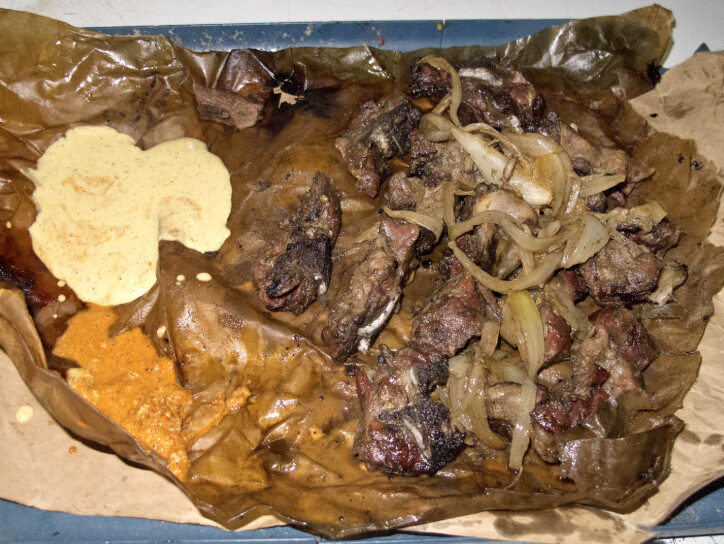
Dibi and cement paper: a question of habit… or of philosophy? February 3, 2026
“Habit is a second nature,” wrote Blaise Pascal, immediately adding that nature can itself become a first habit. Rarely has this thought resonated as much with the times as in the controversy that arose on social networks around the use of cement paper to wrap dibi.
This expertly seasoned and wood-fired meat, traditionally served wrapped in cement paper, actually conceals an insidious danger for public health. This paper, intended for the construction industry, contains industrial inks, glues, waterproofing agents and sometimes even cement residue. Under the combined effect of heat and fat, these substances can migrate to the meat and contaminate the food. Questioned on the issue, some grill owners admit to being aware of this silent risk, long trivialized in the name of tradition.
On social networks, the controversy is growing. On the one hand, those who plead for reason, ready to comply with health recommendations in the name of public health. On the other, defenders of an inherited practice, unrestrainedly invoking the force of habit and the emotional charge attached to it. For them, giving up cement paper would almost be a betrayal: that of a popular ritual, of a childhood memory, of an emotional link with the past. The practice is so deeply anchored in Senegalese usage that the word dibiterie, derived from dibi, found its place in the French dictionary, under the leadership of Léopold Sédar Senghor.
The dibi and the cement paper are thus Proust’s madeleine: one seems inconceivable without the other. Better yet, the question becomes almost existential. Despite the now established proof of the health danger, some demand the continuation of this practice, establishing the habit as an intangible principle, or even as an identity marker.
Behind this culinary controversy lies a deeper opposition: that between loyalty to traditions and the need to protect life. A confrontation between nostalgia and responsibility, where public health imposes itself as the will… even free will.
Moussa DIOP
