
“My works offer a space to escape and breathe” May 26, 2026
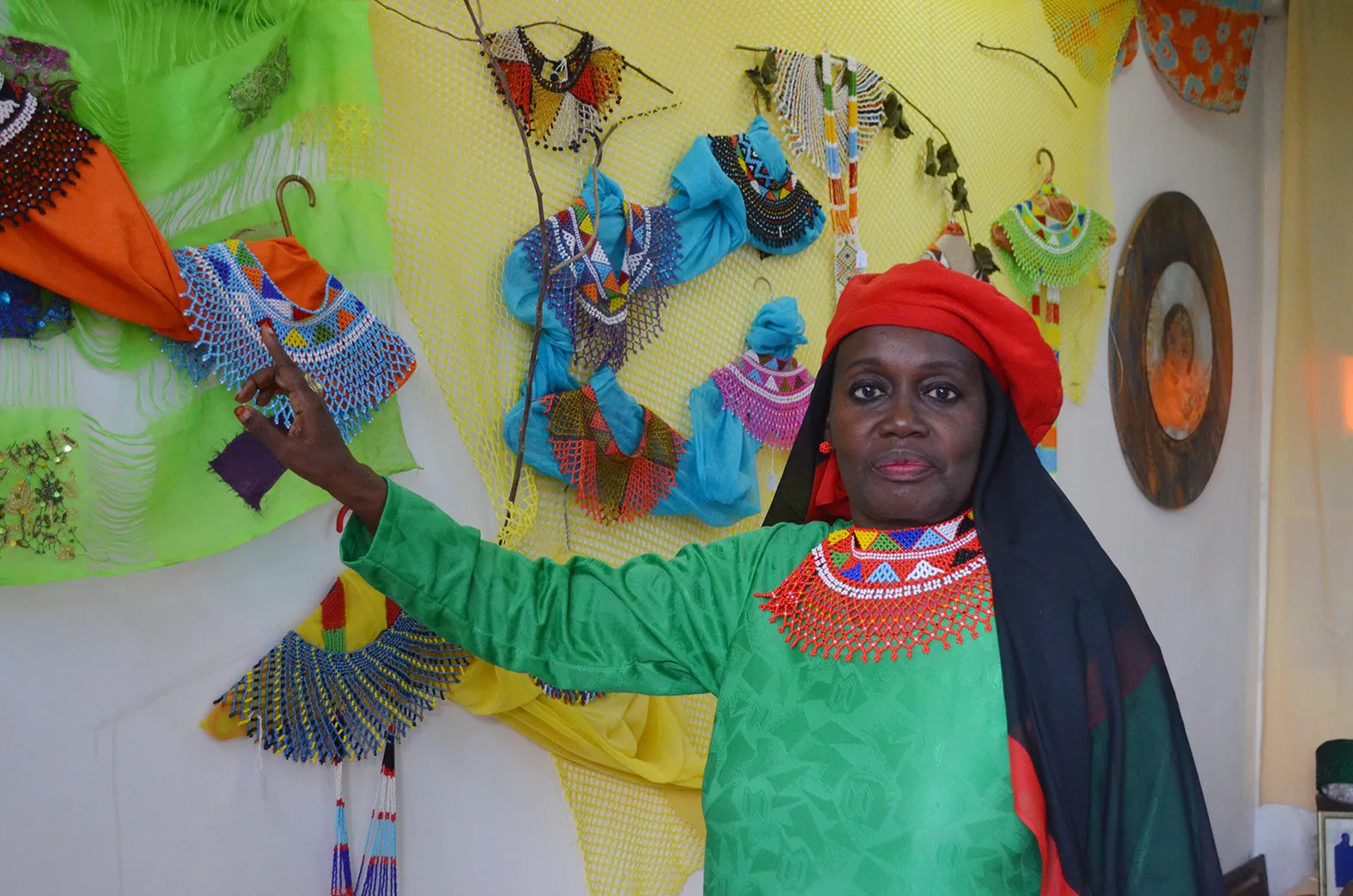
Dear children, I have the aspiration to settle in a half-tone shadow, but I have been dedicated to transmission. I will continue to be this transmitter of light. May she light your paths with gentleness and kindness.” It is with this case of light that Anta Germaine Gaye would like to enter this interview. An immense visual and intellectual artist, through her words the portrait of a sensitive and demanding artist emerges, whose work explores both the intimate and the universal resonances of art.
You were born in Saint-Louis in 1953, a city crossed by history, elegance and cultural mix. What childhood memories continue to inhabit your artistic imagination today?
I would like, to open this statement, to say a prayer in memory of the one who restored my outlook and marked out my path. His name was Abibou Mbaye, a philosopher by nature and by trade. His thoughts have illuminated my steps, his presence continues to inhabit my view of the world. He preceded us on May 7, twenty-nine years ago. Amiin.
I was born in Saint-Louis, Senegal in February 1953. My father was a veterinary doctor and also sat on the General Council. My mother, a teacher, belonged to this generation of women trained at the Rufisque Normal School during the war, under Germaine Le Goff. Very early on, however, my life was built between several spaces. At two years old, after weaning, my parents sent me to live with my maternal grandmother in Dakar. My brother had just been born, my little sister stayed with them, and I grew up with this grandmother who shaped me a lot.
But when I go back to my memories, it is first of all women’s faces that come back to me. My “badiennes” (paternal aunts), my cousins, all these Saint-Louisian relatives who were constantly visiting the house or staying there. Later, during the holidays, I went to visit family in Saint-Louis. And everywhere, I found this same elegance, this same human warmth.
Above all, I remember magnificent women. Modest, lively, funny, witty women. They knew how to welcome, put others at ease, and make people feel important. It was a true art of living. A way of inhabiting the world with dignity and delicacy. It had a profound impact on me and it has remained an intimate reference in my life and in my work.
I even believe that I became Saint-Louisian by love of this city as much as by birth. Saint-Louis seduced me with its rhythm, its way of being, its way of creating beauty in everyday life. You know, the people of the four communes carry multiple heritages. There was so much crossover, so much cultural interpenetration. But despite this, I define myself above all as a Saint-Louisian.
My family world was very vast. There were my parents, my grandparents, cousins, but also relatives from the rural world who stayed with us. My father was very keen that we keep a strong link with our origins and traditions. He often sent my brothers to spend the holidays in the Waalo or in the river valley to learn the Koran, discover other ways of life, and also understand certain human realities.
When my parents left Saint-Louis for Dakar, my father joined the government of President Léopold Sédar Senghor. We lived at Fann Residence. We had an open house, with a “daara” where the neighborhood children came to learn the Koran. Despite the comfort in which we lived, my father absolutely wanted to maintain ties with our river family. These attachments played a huge role in my interior construction.
And then there were the books. I read a lot.
What types of books appealed to you?
Novels mainly, but also many other things. I sometimes read texts that I did not yet fully understand, but which already opened something in me. Books taught me to dream, to look at the world differently, to inhabit words. I also learned to love solitude.
At Fann Residence, life was quite calm. When we went to the Medina to see relatives, it was another world: lively, noisy, overflowing with energy. We didn’t even want to leave. This coexistence between calm and excitement has certainly nourished my inner life.
After my literature studies at the University of Dakar, I understood that I could not be satisfied with a traditional path. Teaching letters was not enough to express everything I carried within me. I felt deeply that I was an artist. Not only in the sense of producing works, but in this particular way of looking at beings, emotions, materials.
When I decided to join the National School of Arts, those around me were very surprised. We found this decision extravagant. But my mother, who worked in student guidance, encouraged me to take the competitive examination for the École Normale Supérieure d’Éducation Artistique. She knew what the security of being a teacher meant. At the time, I agreed almost reluctantly, as if I was making a concession.
Looking back, I understand today how important this decision was. This stability gave me immense freedom. I could create without depending on the market, without trying to produce what necessarily appealed. I could follow my own inner necessity.
Obviously, in my work, there is everything I went through: the women of my childhood, the memory of Saint-Louis, the traditions, the family stories, the readings, the silences too. All of this continues to live on in my works today.
Has literature influenced your artistic work?
What I read mostly influenced my view of the world. Books teach you to look, to feel, to question. At the time, we were nourished by literature that did not necessarily come from our region. Some would speak of acculturation. It never bothered me. My father always said that certain things belong to all of humanity. Beauty is neither black nor white nor red. When music upsets you, you don’t ask who composed it. Either it affects you or it doesn’t.
This is what I have always tried to pass on to my students. I took them to museums, to exhibitions, to the theater. I taught them to put words to what they felt. I told them: if you like a work, it’s important. If it bothers you too, that’s important. What matters is your meeting with her. Not what you are told to think.
My literary training gave me tools to think, analyze, and establish connections between things. She opened my mind. A university education always leaves an inner method. Even when we then take another path.
Which masters or which encounters have particularly marked your career?
First there was this school principal who refused to give in when my father came to ask for me to leave. My father sincerely believed that art was not a serious path. For him, it was a fantasy, an extravagance. This director replied that I had my place in this school, that I had the vocation and the level. I owe him a lot.
There is also Alioune Badiane, who was a true monument of knowledge and who supported me a lot. There is also my pedagogy and art history teacher, Michèle Strobel. She wrote the reference book with photographer Michel Renaudot “La Peinture Souwere au Senegal”. I can also quote Mangion who was my Color teacher, he forged my audacity for color. And then Daniel Corvizi, who taught us sculpture and volume with great human generosity.
I could name many other people, because basically this school has become my family. My classmates were also like brothers and sisters. We grew up together in this common passion.
Since the 1980s, you have participated in major exhibitions, particularly around art against apartheid. What do you remember from this period?
It was an extremely powerful period. A personal revolution too. I was confronted with new worlds, with prestigious artists, with immense debates. It opened incredible horizons for me. I met painters with whom I formed very strong bonds, like Souleymane Keïta. It was he who made me participate in one of my first major exhibitions with already recognized artists.
We also participated in the “Art against Apartheid” exhibition at the Musée Dynamique. President Léopold Sédar Senghor came to visit her. I still have photos from that moment. It was a period of very intense artistic and political ferment. Today, when I look at certain tensions on the African continent, I sometimes wonder what has become of this Pan-African dream. At the time, we really thought we were building something common. Today, I sometimes feel like we are walking on our heads.
How did you experience your first confrontations with the public?
When I left school, with a classmate, we put together an exhibition around our research work. He worked on “Boukout” in Casamance. I was working on the appearance of Muslim women in the four communes. I relied on memories, on photographs, on shapes, colors, silhouettes that had inhabited my memory since childhood. All these women I had admired in Saint-Louis.
This exhibition was a great success. She spoke to people. It awakened a collective memory, a nostalgia too. And from that moment on, I continued to exhibit, to work, to produce. I believe that deep down, what motivated me was very simple: I was doing something that I loved deeply, and this work met others. There was human interaction. That’s what carried me.
Comments collected by Amadou KÉBÉ
