
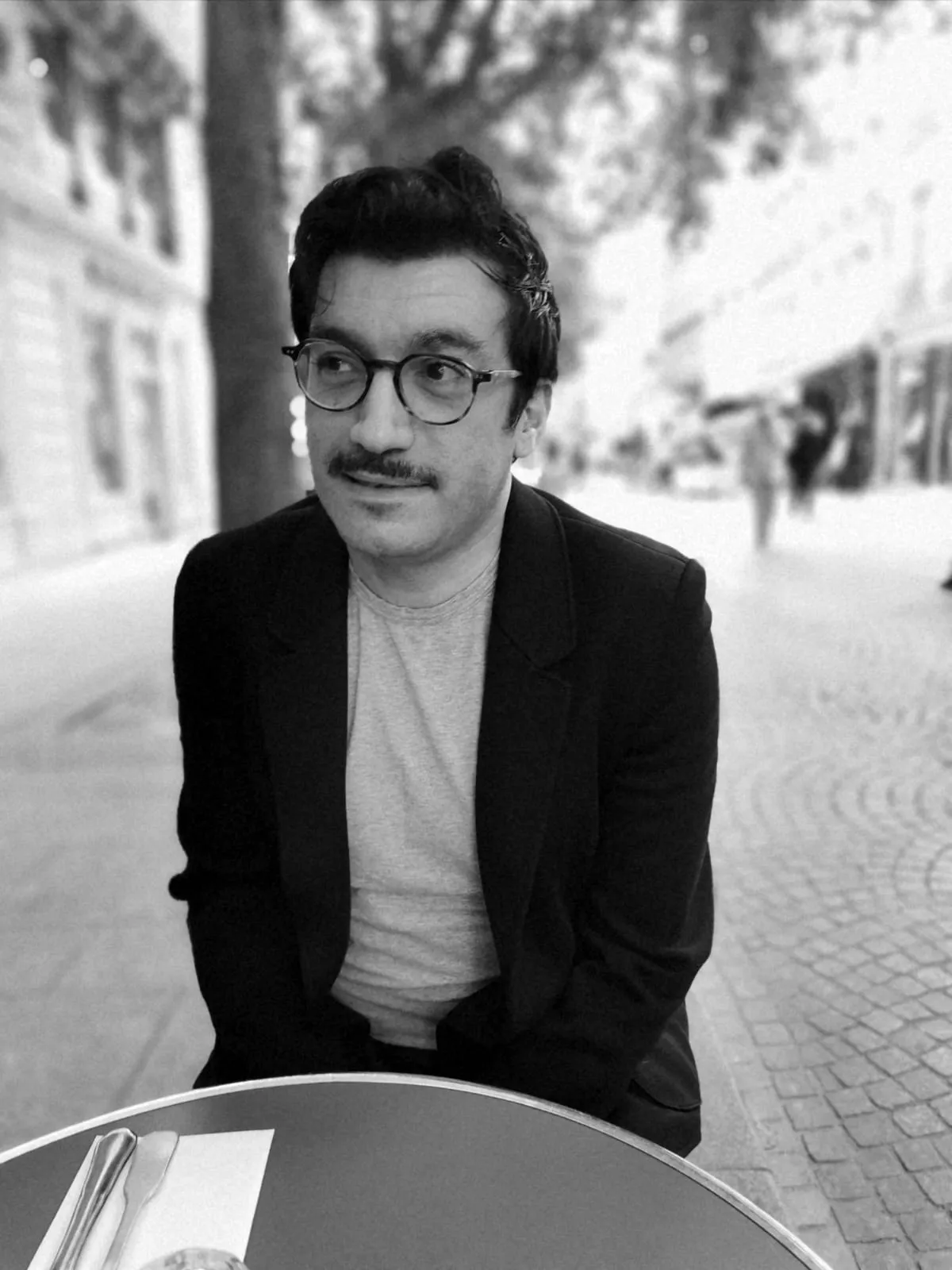
Morad Montazami: “The aesthetics of fragility will be the common thread of the 16th Dakar Biennale” May 27, 2026
Art historian, publisher and exhibition curator, Morad Montazami is the artistic director of the 16th Biennale of Contemporary African Art in Dakar (November 19 – December 19, 2026). He recently stayed in Dakar. In this interview, Mr. Montazami outlines the general concept “(Anti)fragility: arts of repair and strategies of backlash”.
What motivated Morad Montazami to apply for artistic direction of the 16th Biennale of Contemporary African Art in Dakar?
Dak’Art is a historic biennial. She is over 30 years old. The Dakar Biennale has longevity. I heard about it. I visited it. I am an admirer of the former artistic directors. She was always one of my references. I first specialized in modern and contemporary art from the Arab and Mediterranean worlds with a stronger anchor in North Africa. I did a lot of projects in Morocco and Egypt. Algeria and Tunisia, too, have always intrigued me. I developed an activity as a publisher with Zamân’Books and as a curator via the Zamân’Books and Curating platform. Through this anchorage in North Africa, I gradually questioned this border. I had the desire and opportunities to work with artists from the African continent. Through artistic meetings, researchers, other curators from Africa – due to globalization, there is more mobility – notably during the 1-54 Contemporary Art Fair in Morocco which also takes place in London, I gradually opened myself up to the rest of the continent for such a political issue. I believe that the North Africa-sub-Saharan Africa border can sometimes have something limiting, colonial about it. Basically, it was colonization that built this border. For questions of political commitment, through the great African authors that I have read in recent years -Souleymane Bachir Diagne, Felwine Sarr, Valentin Mudimbe -, a lot of African intellectuals have opened my mind and given this impetus to be able to expand my activities and my research.
Is it a trigger?
For me, it is a natural, political path in relation to an engagement in the history of postcolonial art. It is all these nuances, commitments, questions that gradually led to opportunities for me; I was given opportunities to work with African artists, to go beyond this expertise on contemporary Arab art. Finally, the candidacy for artistic direction of the 16th Dakar Biennale came to me. I felt very invested. I said to myself “I must apply to put myself at the service of creators on the African continent”. Not being African – I am Franco-Iranian – could have been a weak point. Fortunately, the Biennale wanted to express a form of openness to the world, particularly with the Global South.
The general concept “(Anti), fragility: arts of repair…” caught the attention of the Dakar Biennale Steering Committee. What are the main points?
The “(Anti), fragility…”, which I reappropriated from a technical field in which this concept was invented through several thinkers, authors who have nothing to do with art in the first place. They are in technology, transport, physics. We can think of the automobile industry with the crash test to study how to strengthen a car. A more prosaic, more human example is the child. He has to fall to learn to walk. In a way, he is forced to hurt himself in order to become an adult. Based on this idea, I found it interesting to move this concept – relating to physiology – into the field of art knowing that the main idea is that a thing or a system, a body can be fragile by suffering a shock and “break”. Secondly, it can resist due to its robustness by absorbing the shock. We have a third option, the “anti” fragile in which it is neither breaking nor resisting, it is strengthening. Paradoxically. This means being able to withstand a shock, but above all to reverse the load of this shock as if a situation of danger, crisis, trauma was going to give us an opportunity to find new strength, a second wind. I called it the backlash strategy. This can be in several directions: organizing solidarity, reinventing forms of cohabitation, coexistence, co-creation. The idea is to invent alternative systems of compensation in all fields: legal, historical, technical, why not artistic. I don’t want to give too closed a definition. My wish is that artists appropriate this concept, give their interpretation through their works. This concept will have relevance in relation to the ecological and financial crisis.
How do you intend to develop this idea?
For the moment, the three axes are emerging firstly around the “Powers of the fragile”. Hence the “(Anti)-fragile”. Fragility as aesthetic potential, poetic potentiality. How do we consider an injury, a flaw not as a flaw, but as an opening. This idea of the “Powers of the fragile” can be summarized by this metaphorical concept of the beautiful scar which has its beauty, its virtue, its capacity for resilience. The second axis will be “The arts of repair”. Today, we are talking about restorative justice. We talk about repair in the context of the restitution of African heritage objects. We can also imagine healthcare professions: medicine. How an artist can be inspired by a doctor or how a doctor can become an artist.
The third axis is that of “Backlash Strategies”. We can also say counter shock. It is quite simply the idea of often organizing collectively, of forming a community, in a difficult moment of instability. These are the links that we will create. We could refer to the book “The Wisdom of Lianas” by the contemporary Central African philosopher, Dénètem Touam Bona. The counter-shock strategy means organizing in solidarity through alternative systems, proposing ways to deal with crises. When we talk about backlash, we think of this popular and urban dance that has evolved since the 2000s: the krump. In California, we had among African-Americans – following riots relating to police violence, a dance which developed in the world of hip-hop and which quickly found an echo in Senegal and in other African countries. This invigorating dance, which will almost simulate the blows we receive and how the body reacts. As an artistic director, I am inspired by both philosophy and dance. The approach is transdisciplinary. For a biennial like the one in Dakar, all visual arts are represented (painting, sculpture, photography, installation, video, design). There are also street artists and choreographers. We must support these fields. The project is ambitious. This is why I have set up a curatorial team that will be able to cover these areas.
Speaking of African artists, which signings have had the most impact on you in recent years?
I worked with artists from North Africa, particularly in Morocco with creators who work with textiles like Amina Agueznay who is currently representing her country at the Venice Biennale. I have worked a lot on the Egyptian surrealists, artists from the 1930-1940 period. I had a whole reflection on modernity, the Moroccan, Tunisian, Egyptian avant-gardes. Recently, I have been collaborating with contemporary artists. Among them is the South African Lungiswa Gqunta who works on segregation and the post-apartheid context in the urban planning of Cape Town. Among the other artists who interested and inspired me was the Nigerian Otobong Nkanga. She has worked a lot on extractivism. How Western, Russian or Chinese oil and gas companies can participate in the African economy, but on the other hand cause social and ecological problems. If we think about the situation of fishermen here in Senegal, they are in a difficult situation with oil exploitation. I also have an appreciation for the Beninese Romuald Hazoumè. Post-independence Senegalese art fascinates me a lot with signatures from the tapestry school like Papa Ibra Tall, Théodore Diouf.
You are Franco-Iranian. What is your view on current events in the Middle East?
As a dual national, we are always divided. I must say that my readings, my post-colonial education with authors like Gayatri Spivak (Indian philosopher), Souleymane Bachir Diagne and others brought me towards a post-colonial culture, an anti-colonial culture. Although I was born in France and have a French passport, I can say that, over the last ten years, I have built myself against France intellectually and politically. I have a particular engagement with the Global South. As a Franco-Iranian, I have a very complex relationship with Iran, the country of origin of both my parents. In relation to the current situation in the Middle East, I am in direct opposition to American and Israeli imperialism.
Interview conducted by E. Massiga FAYE
