
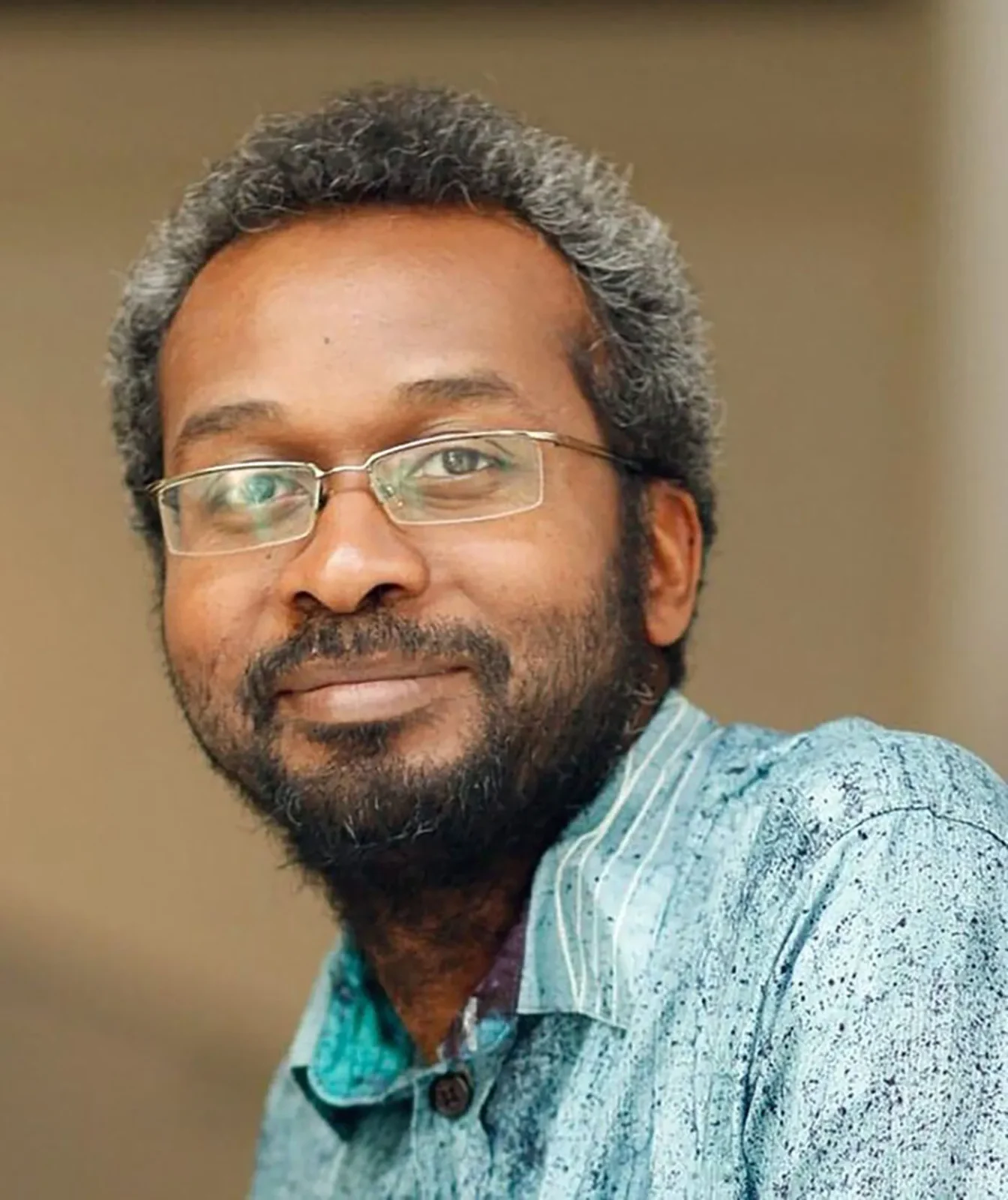
Hamza Boukari, researcher-essayist: “Fanon is an integral and transversal thinker”
Based on Frantz Fanon, Hamzat Boukari, essayist and researcher engaged in issues of critical thinking and decolonization, offers a demanding reading, without soft reverence. The work and thoughts of the Martinican psychiatrist are examined in the light of the present. These include, among other things, unfinished decolonization, internalized violence, political impasses.
One hundred years after his birth and 65 years after his death, why does Frantz Fanon remain an essential intellectual and political reference?
Fanon remains a reference, because his struggles and his ideas are still useful in today’s world. Colonialism, racism and the different forms of economic, cultural and political predation that he fought continue to operate. His books also remain resources for understanding contemporary issues and power relations.
Fanon is often read as a thinker of violence. Is this not a reductive reading of his work? Yes, Fanon was a psychiatrist. He had a theory of violence, in a colonial context, which is often misunderstood. He also had a concrete commitment to the war for the liberation of the Algerian people. He carried the idea of revolutionary violence which is the basis of resistance movements in a precise historical context. It is not so much violence, but the ethics of liberation and the sense of the balance of power that animate him when he emphasizes that colonialism only retreats in the face of revolutionary violence.
Can the question of disalienation, central to Fanon, still structure public policies in contemporary African states?
Yes, we need ministries of decolonization in our contemporary African states to carry out public policies of a Fanonian nature. There can be no lasting progress without this work of uprooting the colonial framework.
What do you think “Continue Fanon” means today?
To continue Fanon is to study him further, to translate him into reforms in the areas of health, the organization of spaces and social struggles. It also means developing revolutionary and pan-African diplomacy.
Fanon wrote that each generation must discover its mission and accomplish it or betray it. What would be that of the current African generation?
The current African generation must already take up the torch from previous generations without burning their wings by getting lost in deserts and seas. She must demand and take power. For this, she must train. It must make Pan-Africanism a real project of solidarity and collective liberation that leaves no one aside.
Can Fanonian thought shed light on the current geopolitical reconfiguration marked by the emergence of the Brics?
Yes, undoubtedly. But it is above all in the need for Africa to build its own model that Fanonian thought can enlighten us. African unity is the only path that can give our continent real weight in the context of this reconfiguration.
Can we speak of a return of Fanon to African intellectual debates?
The conference at the Museum of Black Civilizations showed the centrality of Fanon. We must continue, because Fanon is a useful figure in the sciences and the humanities, in reflection and research in law, geopolitics, medicine, literature. Fanon is a place of knowledge.
Where are we today in the decolonization of knowledge?
We are in the middle of this process. Languages, history, thoughts, methodologies, epistemologies, etc. We are in the vast work of the African renaissance. How can we prevent Fanon from being transformed into a frozen icon? By involving youth, by democratizing and modernizing our approaches, by opening Fanon to social movements, political processes, and spaces of artistic creation, we give him a relevance that makes him come alive. How does Fanon differ from other anticolonial thinkers like Césaire, Cabral or Nkrumah? All these thinkers have their importance. For Fanon there is the posterity of these works like “The Wretched of the Earth” and “Black Skins in White Masks”, but also his work as a psychiatrist which he put at the service of the revolution and anti-colonialism. How does interdisciplinarity (psychiatry, philosophy, politics) structure Fanonian thought? Fanon is an integral and transversal thinker. We can use it to move from one discipline to another and we can, without leaving Fanon, bring together a total critique, particularly of the colonial system. This is what makes it so effective and powerful for thinking about colonialism up to the present day, and finding tools for intellectual resistance.
Can we speak of a Fanonian anthropology?
Studying is in itself a way of decolonizing anthropology. His reflection on what the new man should be, decolonized, brotherly and united is essential. He also considered human relationships and the environment of societies as an essential criterion of healing processes. Fanon poses a political anthropology through the link between his work, made of practical and concrete case studies, and his activist commitment.
Is Fanon’s critique of postcolonial elites still valid today?
Absolutely. Fanon was worried that African elites were content to take the place of the colonists. He had perceived the dangers of neocolonialism from his work on the desire for mimicry, alienation and the inferiority complex. His attack on the African bourgeoisies remains very relevant. He did not hesitate to denounce leaders serving non-African interests.
What place does “new humanism” occupy in Fanon’s work?
I cannot say precisely, because the debates on the new humanism are quite confused. Fanon, on the contrary, provides a certain clarity on what our humanity must be in the 21st century and which must bring reparations and healing to the wretched of the earth. Fanon, thinker of rupture or refoundation? He is a fundamental thinker for both rupture and refoundation. He can reconcile our struggles and our conditions and this is also what makes his pan-Africanism powerful.
Amadou KEBE
