
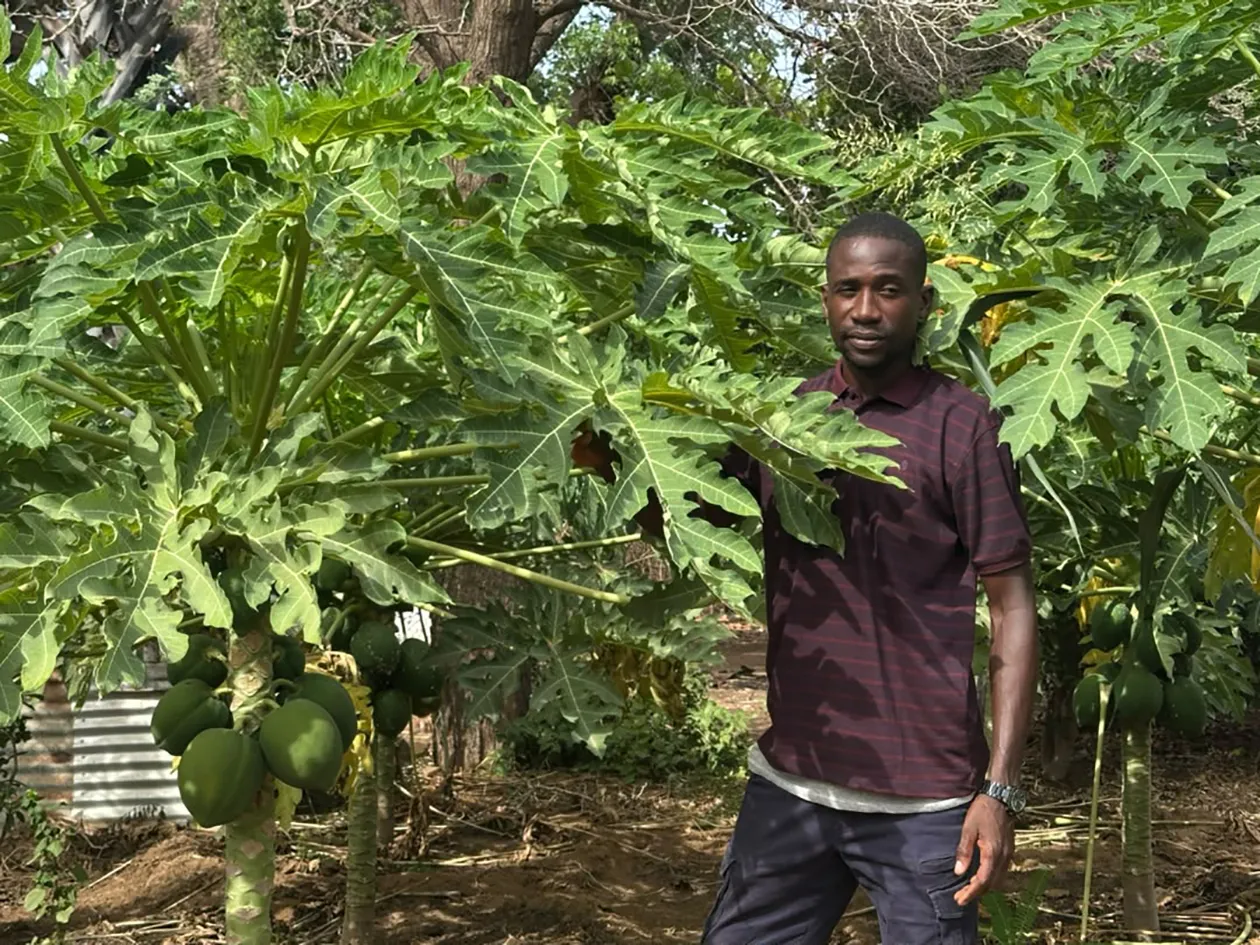
From irregular emigration to agroecology: Mouhamed Camara’s winning bet
Ten years of wandering, hardships and disappointed hopes did not get the better of him. Today a successful agripreneur and employer at home, the former candidate for exile Mouhamed Demba Camara proves that the land also nourishes the finest revenge.
At the entrance to his field, on a wall visible from the first steps, Mouhamed Demba Camara wrote in clear letters: “Only he who renounces is defeated”. This sentence sums up the journey of this man from Fimela, in Sine, and former candidate for irregular migration who became a model agroecological agripreneur. About ten years ago, like thousands of young Senegalese people, Mouhamed Demba Camara dreamed of elsewhere. His goal was simple, but vital: to seek well-being, help his family and achieve something during his lifetime. He was unable to resist the temptation of adventure and lived for six years in Mauritania and two years in Mali.
Back in Senegal, he traveled the regions: Fatick, Casamance… In total, almost 10 years of wandering, struggles and disappointed hopes. “It didn’t work,” he sums up. However, today he has reason to be proud of himself. Back in his village, he contacts the director of his old school, Gora Ndiaye, and tells him about his adventures and his doubts. He encourages him to try “another experience”. In 2017, he joined the “Kaydara agroecological farm school” (Jardins d’Afrique), in Keur Samba Dia, in the commune of Fimela. Supported by the Food and Agriculture Organization of the United Nations (FAO) and local partners, this nine-month training in agroecology and organic agriculture will change everything.
On this farm, learning is practical: each trainee has an individual plot of around 1000 m² which they cultivate under their own responsibility. Mouhamed discovers multi-stage cultivation, crop associations, sustainable soil management, natural treatments, seed and nursery production as well as the basics of breeding and processing. The training also includes an essential component: entrepreneurship (financial management, marketing and development of a personal project). Hope At the end of this immersion which has just offered him a real professional qualification, he obtains a developed hectare which he transforms into a model of diversification. Mangoes, coconuts, citrus fruits, nurseries… Mouhamed achieves a feat by combining so many crops on such a small area. His garden is green even though winter has barely begun.
This field is the symbol of his self-sacrifice and his ability to always surpass himself despite a difficult journey to say the least. “We were taught about multi-stage culture. Everything is diverse here. We produce a little bit of everything,” he explains with pride. After the harvest, the agripreneur seizes digital opportunities to sell his production. He finds his customers via WhatsApp and social networks. He acquired these skills thanks to training supported by the FAO. Today, the result exceeds his expectations. Mouhamed Demba Camara employs around fifteen people depending on the period, including a permanent worker, and manages to save to finance other projects, such as the construction of his house. Versatile, he is also a well digger and carries out works whose cost varies from 500,000 to more than 1,000,000 FCfa.
When asked what motivates him to no longer attempt the adventure, he replies: “With good training, you can succeed by staying at home. Those who know me see the difference.” He also claims that this piece of land is synonymous with a “second birth”. Mouhamed embodies this generation of young Senegalese who, after tasting the bitterness of a failed migration, chose to invest their energy in the land. He affirms that his story is not that of a forced return, but of a successful reconversion. Today, this successful farmer is also an employer. His happiness is in the meadow and he has finally understood it. Better, this is now his new identity.
Assane FALL
