
(Data journalism) General policy statement: the Prime Minister presents his economic diagnosis and his recovery plan
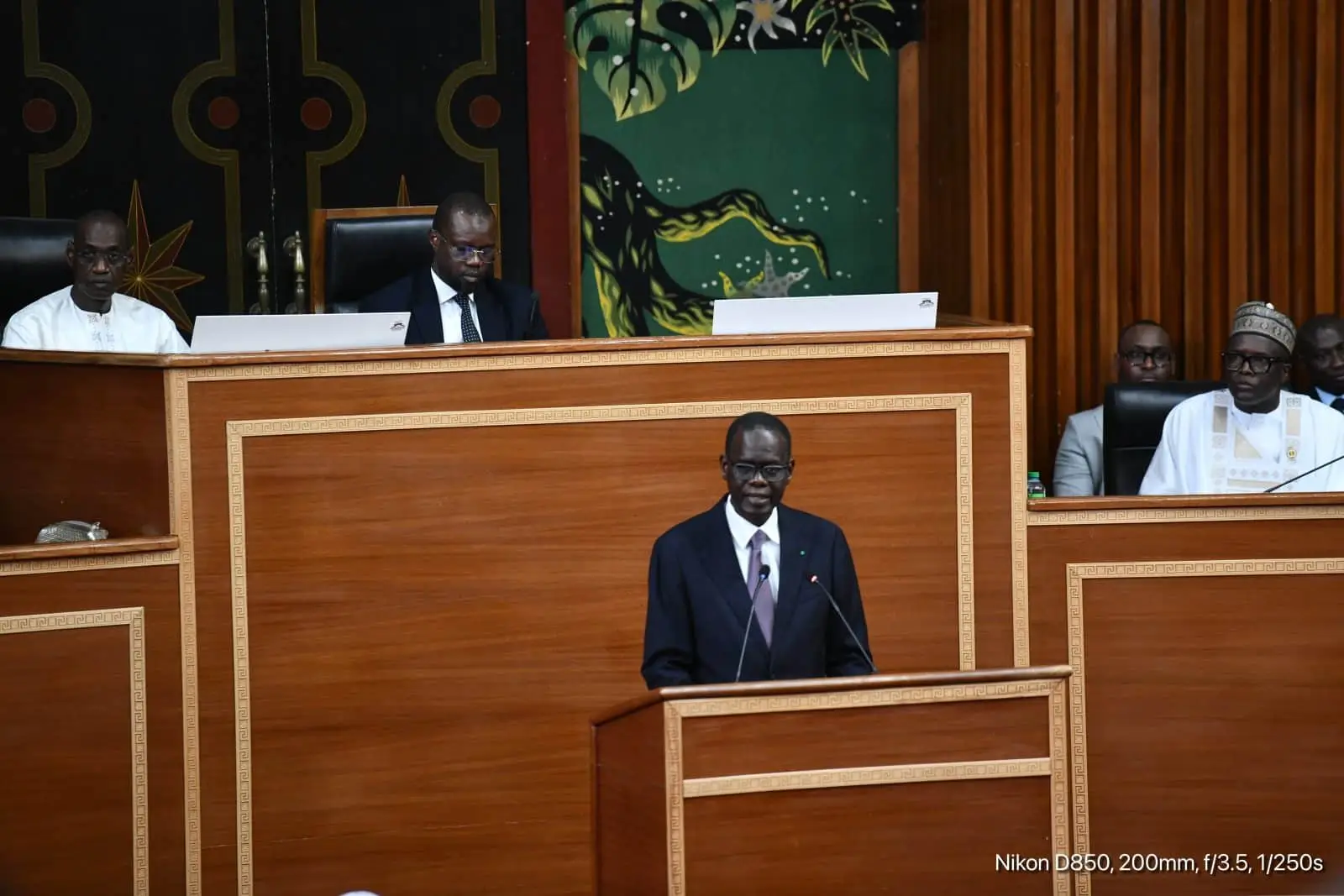
Before the National Assembly, Prime Minister Ahmadou Al Aminou Lô delivered his General Policy Declaration (DPG) this Tuesday, September 8, 2026, dominated by a diagnosis of inherited public finances and the presentation of a vast economic and social recovery plan.
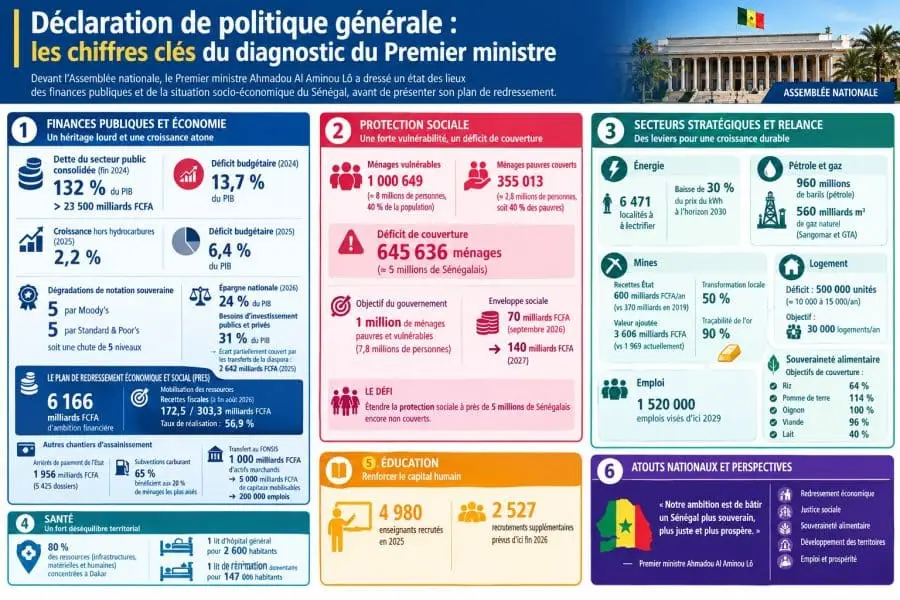
The head of government recalled the scale of the budgetary shock discovered by the new authorities. According to his words, “at the end of 2024, the consolidated public sector debt stood at around 132% of gross domestic product, or more than 23,500 billion CFA francs”. The deficit for the year, for its part, “was reassessed at 13.7% of GDP”.
The situation did not improve in 2025: non-hydrocarbon growth remained sluggish, at 2.2%, while the budget deficit remained at a high level of 6.4% of GDP. As a direct consequence of this deterioration of public accounts, Senegal suffered five successive downgrades from the Moody’s agency and as many from Standard & Poor’s, representing a drop of five levels in the sovereign rating scales.
The Prime Minister also pointed out a structural imbalance between savings and investment: national savings should only represent 24% of GDP in 2026, far from the public and private investment needs estimated at 31% of GDP, a gap partially filled by transfers from the diaspora, estimated at 2,642 billion FCFA in 2025.
Read also: Alhaminou Lô: “No country in the world lives in self-sufficiency anymore”
The PRES, a plan worth more than 6,000 billion FCFA
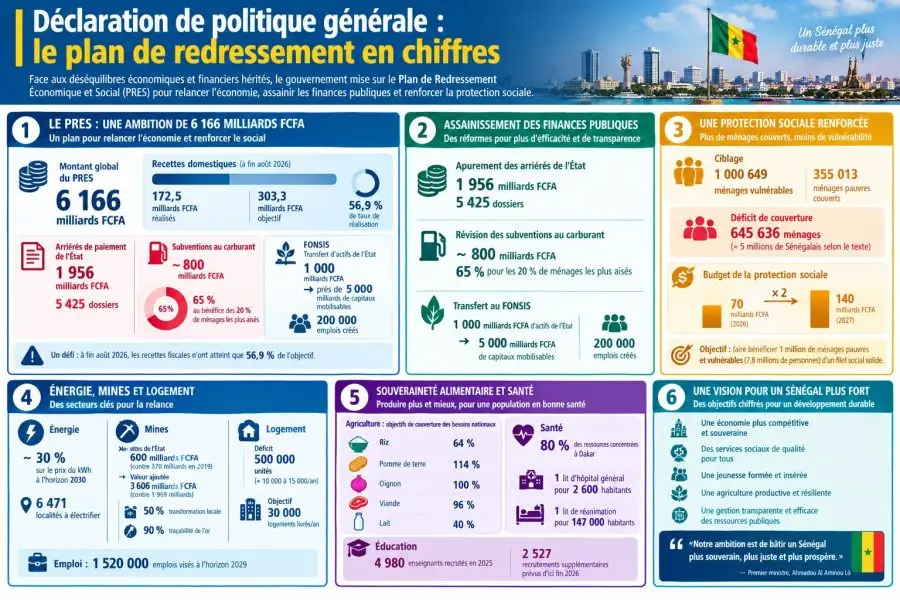
To straighten out the trajectory, the government is banking on the Economic and Social Recovery Plan (PRES), with a financial ambition of 6,166 billion FCFA. But its implementation is already encountering difficulties in mobilizing resources: at the end of August 2026, domestic revenues, particularly tax revenues, amounted to 172.5 billion FCFA, for a target of 303.3 billion, i.e. an achievement rate of only 56.9%.
Among the clean-up projects announced is the clearance of State payment arrears, estimated at 1,956 billion FCFA at the end of March 2025, spread over 5,425 files. The government also intends to review the fuel subsidy system, considered unfair: of around 800 billion FCFA in subsidies, 65% would benefit the 20% wealthiest households in the country.
Another lever announced: the transfer to the Sovereign Fund for Strategic Investments (FONSIS) of State market assets for an amount of 1,000 billion FCFA, an operation expected to generate nearly 5,000 billion FCFA in mobilizable capital and create 200,000 jobs.
Social protection: a coverage gap to be filled
On the social aspect, the Prime Minister drew up a worrying inventory of poverty and vulnerability. One million Senegalese households are statistically recognized as vulnerable, or around 8 million people, 40% of the total population.
According to figures from the National Agency for Statistics and Demography (ANSD), 1,000,649 vulnerable households are identified, but only 355,013 poor households are actually covered by existing systems, leaving a coverage gap of 645,636 households, or nearly five million Senegalese left behind.
The government has set itself the objective of providing one million poor and vulnerable households (7.8 million people) with a solid social safety net. With this in mind, the dedicated envelope, already increased to 70 billion FCFA in September 2026, will be doubled to reach 140 billion FCFA in 2027.
Energy, mines and housing: the levers of sectoral recovery
The Prime Minister also spoke of the country’s natural resources, with proven reserves estimated at 960 million barrels of oil and 560 billion cubic meters of natural gas on the Sangomar and Grand Tortue Ahmeyim (GTA) deposits. On the energy front, the government is aiming for a 30% reduction in the price of a kilowatt hour of electricity by 2030, while 6,471 localities still need to be electrified.
The mining sector is also expected to gain momentum, with an annual revenue target for the State raised to around 600 billion FCFA, compared to 370 billion in 2019, for a targeted added value of 3,606 billion FCFA (compared to 1,969 billion currently). The government aims for a local processing rate of 50% and traceability of 90% of gold production.
Concerning housing, the deficit is estimated at 500,000 units, with an annual worsening of 10,000 to 15,000 additional units. The government sets a target of 30,000 homes delivered each year. In terms of employment, an overall potential of 1,520,000 jobs is targeted by 2029.
Food sovereignty and health: quantified objectives
In agricultural matters, the Prime Minister set targets for covering national needs through local production: 64% for rice, 114% for potatoes, 100% for onions, 96% for meat and 40% for milk.
On health, the observation is that of a strong territorial imbalance, since 80% of the infrastructural, material and human resources of public and private health services are concentrated in Dakar. The country has only one general hospital bed for nearly two thousand six hundred inhabitants, and one intensive care bed for one hundred and forty-seven thousand inhabitants.
Finally, on the education front, the government recalled the recruitment of 4,980 teachers in 2025, with 2,527 additional recruitments planned by the end of 2026.
OBN and CTN
