
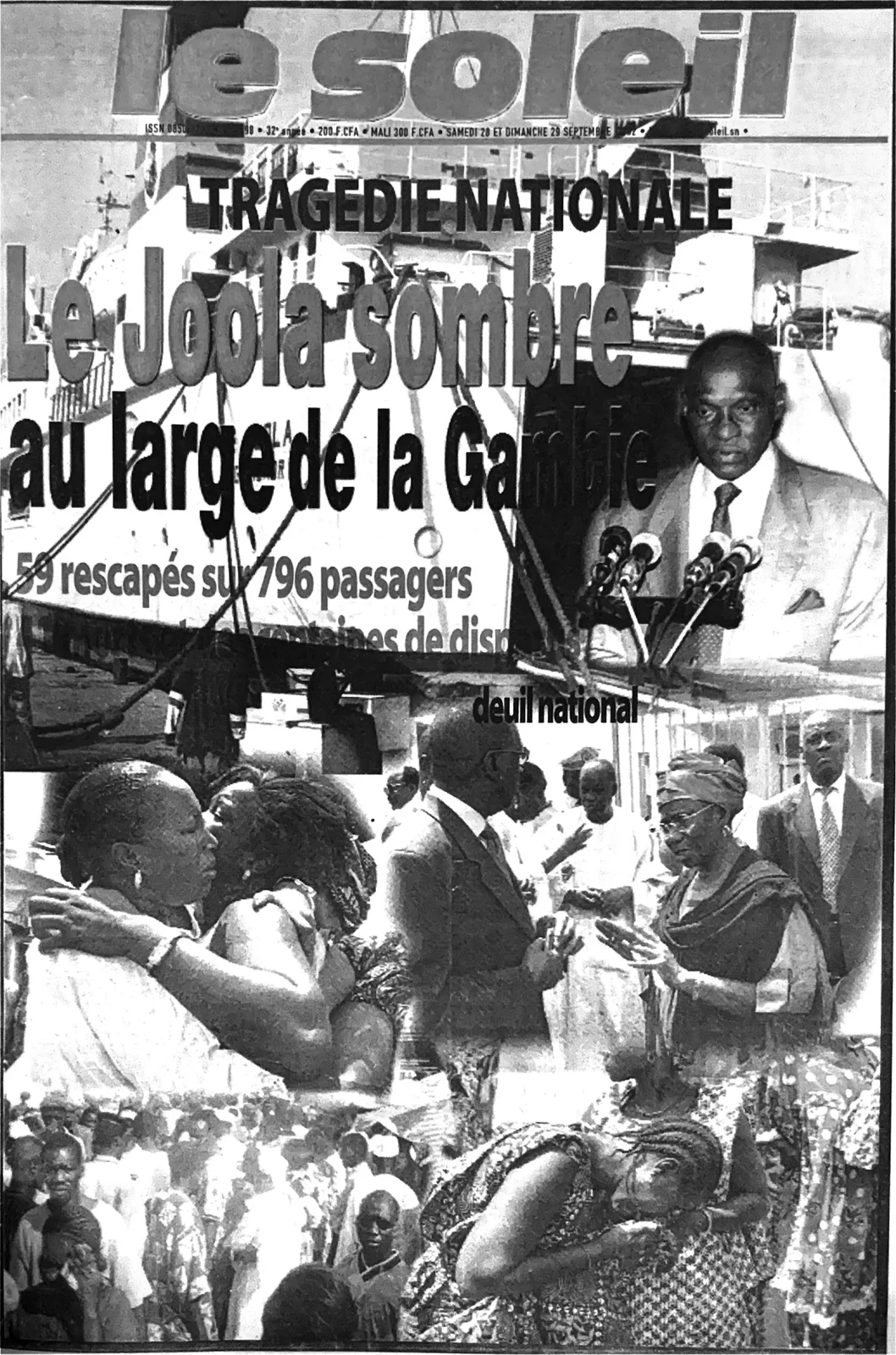
“The Joola” sank, hundreds of passengers “left with the waves”
On the night of September 26 to 27, 2002, the Joola sank off the coast of the Gambia, taking with it hundreds of lives. The day after the tragedy, Le Soleil recounted the astonishment, the pain and the first rescue operations, while already raising the question of responsibilities. Twenty-four years later, its archives bring to life the dark hours of a national tragedy.
Master Abdoulaye Wade, who we know is vigorous and at ease in front of any microphone, appears in a photo with his head slightly lowered, his gaze lost, searching for who knows what word. In another image, his then Prime Minister, Mame Madior Boye, speaks. His expression is serious. Another image, other people, a crowd of anonymous people. They too, synthesizing the mines of Wade and Boye. Another image: a lady collapsed in tears, in the hands of another. Another image: a lady, whose tears are collected by the hands of another. These are, mounted one on top of the other, the images with which Le Soleil of Saturday September 28 and Sunday September 29, 2002 illustrates the national tragedy. The boat “Le Joola” sank. When ? On the night of the 26th to the 27th. Where? Off the coast of the Gambia. How ? “After a storm”. For what assessment? According to the one “still provisional, given by the Prime Minister, Mame Madior Boye, during her visit to the Autonomous Port of Dakar, there would be 41 deaths and 32 survivors out of the 796 passengers on board the boat”. It was with this information and Kankoué Nouwodjro’s paper that Le Soleil opened the series of articles devoted to the sinking of the Joola.
“A heavy silence”
In Zinguinchor, on Thursday, we waited for the arrival of travelers. On Friday, we panicked. And this Friday will be described as “black”, by the pen of Babacar Bachir Sané. Around 10 a.m., the dark cloud of the news eclipses the Ziguinchor sun. The central information is there, the versions of how diverge, and people want to be clear about it. “It was in such an atmosphere that the pier of the boat and the harbor master’s office of the port of Ziguinchor were invaded by the curious and the parents of the passengers of the “Joola” which left the city of Ziguinchor the day before, at 1 p.m., for its third Dakar-Ziguinchor rotation, since September 10,” wrote Mr. Sané, whose title of the article bore the epithet “fatal” associated with “rotation”. A “Black Friday at the Ziguinchor pier”, yes, Mr. Sané. “A day of desolation in Dakar”, yes, Ibrahima Ndiaye. And, as if connected by the same feeling of… (we will search for the word for years to come!), the people of Dakar acted like those of the southern capital. On September 27, 2002, “as soon as the news was announced, the port market was stormed by thousands of people coming from all walks of life in the capital city,” wrote Ndiaye, who expressed “the desolation and dismay” of everyone in the columns of the national daily. Both were not just written. They were also photographed and then documented on an entire page in the “Soleil”. Hoard up, people. And distinct heads, like that of Landing Savané. And, perhaps, the waters had warned. And, perhaps a sign had been given. “Bad omen or strong coincidence”? We’ll never know! We only know this: “The sea carried away a person at the Port of Ziguinchor, at the time when the ferry Joola was boarding passengers for its last Dakar-Ziguinchor-Dakar rotation.” But, Babacar Bachir Sané, who would have guessed that this fact reported later, in his paper, could have been considered a sign of the waters! The fact, later sung by Dread Maxim, remains that “the reaper, once again, has struck hard” and the others “have gone with the waves.” The news therefore had something to slow down Master Wade’s approach. She had enough to impose “a heavy silence” when Mame Madior Boye, General Mamadou Niang (Minister of the Interior), Youba Sambou (Minister of the Armed Forces) received President Wade as he got off the plane, returning from his trip. His “we are going to shed all light” will be collected by Mbaye Sarr Diakhate for “Le Soleil”. Without doubt, Heaven for its part had collected bundles of prayers for the rest of those who “left with the waves”. Senegal prayed: “A three-day national mourning decreed,” headlined Mr. Diakhaté in a box. Where, repeating the Prime Minister, it was said that: “The rains and the wind combined, it is a natural phenomenon following a storm that the boat overturned”. But, where the author of the article also wrote this: “Shutdown since August 2001 due to a failure of one of its engines, the ship resumed its rotations on September 10.” Rain and wind… However, “is the fault only the storm? “, asked Malick M. Diaw. Its text is punctuated with question marks. Which does not prevent him from expressing one certainty, which is that this Joola “had no place at sea and even less so with nearly 800 men, women and children on board”.
Almost recurring incidents
Because, argues Mr. Diaw, “it is an open secret that the condition of the building had, over the years, deteriorated, punctuated by almost recurring incidents which had led to its immobilization for almost a year”. Reminder: “the sea swept away a person at the Port of Ziguinchor, at the time when the ferry “Le Joola” was boarding passengers for its last Dakar-Ziguinchor-Dakar rotation.” Does this have alert value? Who knows, Babacar Bachir Sané! But we know that, we knew, and Aliou Ba’s paper clearly noted it: “The damage which cost the lives of hundreds of Senegalese is not the first that the boat has experienced since it was put into service. A little over a year ago, the ship disappeared in the open sea, before appearing off the coast of Ziguinchor after hours of anguish.” But, what happened happened. After the evil, we had to act. Intern Joseph Sène announced that the Minister of the Interior had triggered the National Emergency Organization Plan (Orsec). The General Staff of the Army will, for its part, trigger the Sar (Rescue, Assistance and Search) alert. A crisis unit will thus be set up, and placed under the authority of Mame Madior Boye. There we find the ministers of the Armed Forces, Justice, the Interior, Social Development and National Solidarity, that of Mines, Energy and Hydraulics, that of Health and Public Action, among others. In a summary by D. Sarr Niang, we also learn that “a reception and relief system has been put in place”. And, that “all hospitals in Dakar and the Kaolack hospital have been requisitioned”, while “military and personal medical resources and materials are made available to the military and civil authorities responsible for organizing relief”… Rain and wind? Dilapidated condition of a building? A constant fact: the others “went with the waves” and from almost everywhere, the journalists of Le Soleil collected the ills of the populations. “The consternation in Fouladou” could be read in the newspaper through the lines of Moussa Sadio. Through the lines of Mamadou Cissé, it is the “sadness in Louga” that we read. Under these conditions, Podor could only cancel his cultural days, as reported by Ibrahima Khaliloulah Ndiaye.
By Moussa Seck
