
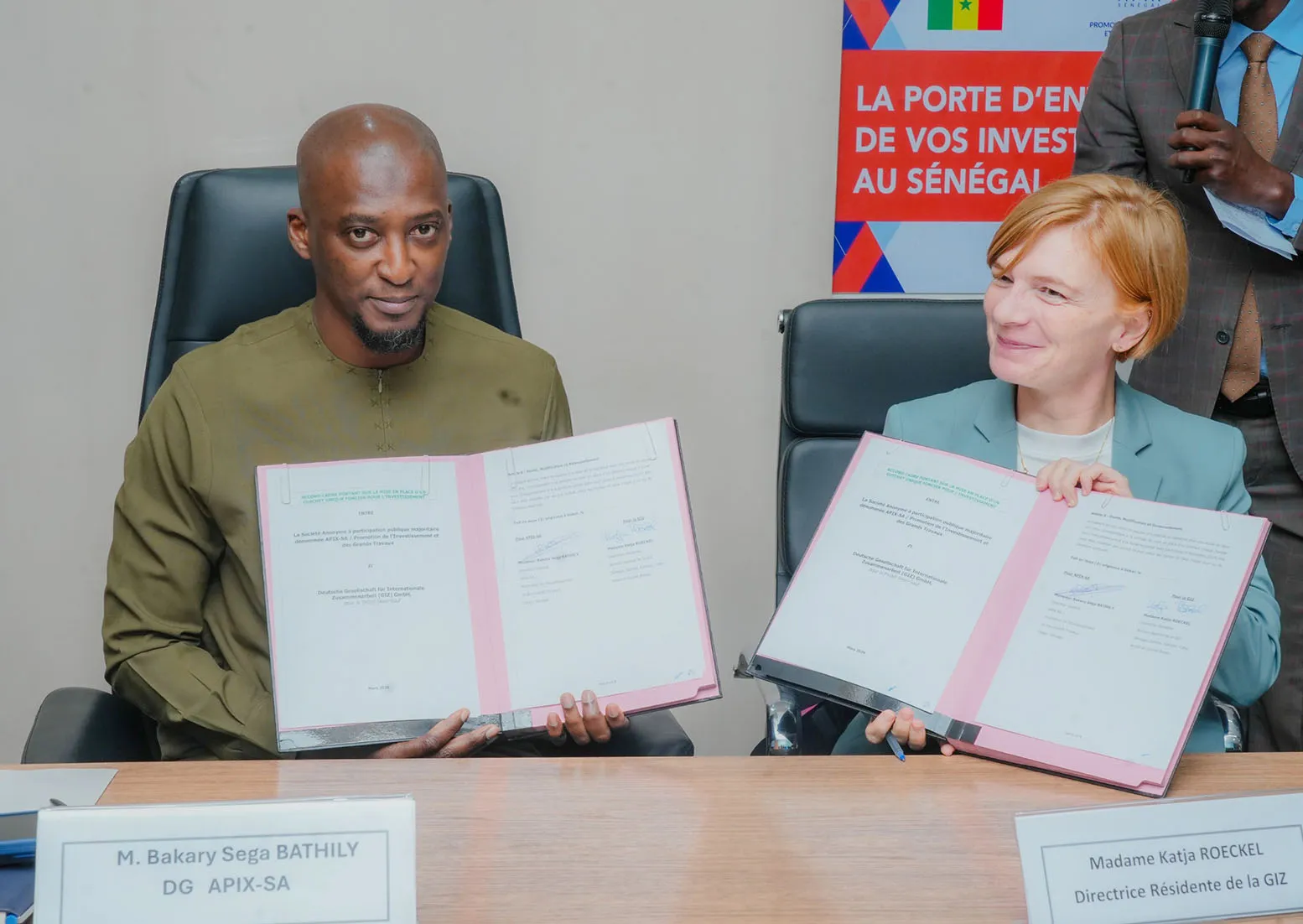
Apix and Giz join forces to remove the last investment barrier March 15, 2026
Faced with the blockage represented by access to land, where only 6% of titles are the subject of formal procedures, the Senegalese Agency for the Promotion of Investments and Major Works (Apix) and German Cooperation (Giz) signed a strategic partnership on Thursday March 12. The objective is to create a one-stop shop to secure and accelerate land procedures previously considered “impossible” for investors.
It is a figure which constitutes an acknowledgment of failure. In Senegal, only 6% of land is the subject of formal deliberation. The rest, buried in endless procedures and an opaque legal maze, constitutes a repellent for capital.
It is to break this “bottleneck” that the Agency for the Promotion of Investments and Major Works (Apix) and the regional office of German Cooperation (Giz) formalized, on March 12, an unprecedented partnership agreement. This aims to develop the regulatory framework for a “One-stop shop for land investment”, a promise of transparency in an area hitherto plagued by prohibitive delays.
For the general director of Apix, Bakary Séga Bathily, the equation is simple: without secure land, no sustainable investment.
“The Single Window for Investment is therefore an operational response to this imperative following signature. It will be the preferred interface between investors and the administration, thus making it possible to centralize land procedures, reduce delays and guarantee the traceability and transparency of procedures,” he declared.
An admission, implicitly, of the current burdens that the State intends to combat through digitalization and centralization of processes.
But the ambition displayed goes beyond simple administrative simplification. By joining forces with German expertise, via the “Seen Suuf” project, the Senegalese government is mainly seeking to establish a method.
Germanic cooperation, praised for its consultation work with local stakeholders, provides legitimacy and know-how in land mediation, a highly sensitive area where customary rights, local authorities and private interests collide.
“The land issue cannot be resolved by a single institution,” Mr. Bathily acknowledged to his partners. According to him, it calls for a collaborative, inclusive approach, which integrates local authorities, State services, the private sector and civil society.
The agreement, which commits the human and financial resources of both parties, received the anointing of Kai Baldow, German ambassador to Senegal, visibly satisfied to see this “dynamic cooperation” result in a structuring project.
In the presence of Katja Roeckel, resident director of Giz, Apix made a firm commitment to operationalize this window as soon as possible, promising to provide the necessary means to popularize the system.
The two institutions are betting on making this tool a “catalyst for the economic and territorial development of Senegal” by transforming land, often a source of conflict, into a “silent, but effective” player in growth.
Pathe NIANG
