
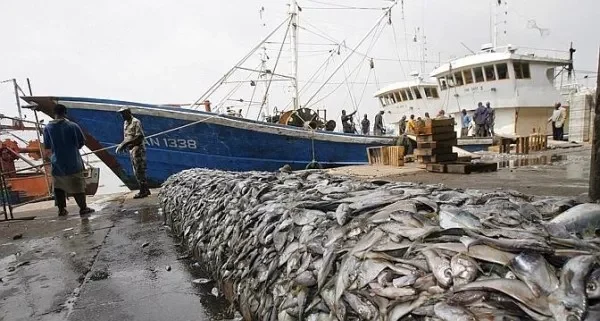
Fight against IUU fishing in West Africa: Eight vessels boarded as part of Operation Espadon
The Sub-Regional Fisheries Commission (Csrp) presented yesterday the results of the “Swordfish” operation. Carried out jointly, from February 9 to 22, 2026, by Senegal, Mauritania, Gambia and Cape Verde, this mission resulted in the boarding of eight industrial fishing vessels. Thanks to satellite targeting and enhanced cooperation, Member States are marking a decisive turning point in the fight against illegal fishing (Inn).
As part of joint operation “Espadon”, the naval forces of Senegal, Mauritania, Gambia and Cape Verde joined forces to comb their maritime zones. Coordinated by the Sub-Regional Fisheries Commission (Csrp) and supported by the European Union through the “Agir-Inn” project, this mission sends a message of firmness to those involved in illegal fishing (Inn) in the sub-region.
In less than two weeks (February 9 to 22, 2026), eight industrial fishing vessels were neutralized, said Dr Khallahi Brahim, permanent secretary of the commission. Mauritania comes first with four seizures, followed by Gambia where two vessels were intercepted. Senegal carried out a boarding while in Cape Verde, the operation resulted in the interception of an artisanal boat. The incriminated vessels fly various flags: Gambian, Mauritanian, Senegalese, but also European, notably Spanish. Inspectors noted a range of serious offenses ranging from lack of license to non-emission of GPS signals, including the use of nets with prohibited mesh sizes and exceeding fishing quotas.
According to Ibrahima Salif Sylla, coordinator of the monitoring, control and surveillance division at the commission, the great novelty of this operation lies in the targeting strategy. No more blind patrols where fraudulent ships, alerted by radio, had time to flee. “Previously, fraudster vessels alerted each other as soon as a patrol boat was at sea,” he recalls. “This time, thanks to technical assistance from the European Fisheries Control Agency, our patrol boats went directly on suspicious targets identified by satellite and data analysis,” says Mr. Sylla.
Senegal deployed the “Walo”
This method not only made it possible to increase the success rate, but also to achieve substantial savings in time and fuel for the States involved, said Dr. Khallahi Brahim, praising the collaboration during the operation. Senegal deployed its new generation high seas patrol vessel, the “Walo”, Mauritania its vessel “Awkar” while Gambia and Cape Verde ensured coastal surveillance with speedboats. Once boarded, the vessels were handed over to the respective national authorities. “It is now up to each State to apply its own legislation to sanction offenders,” specifies the Permanent Secretary of the Commission.
Despite this success, the Csrp does not intend to stop there. If it recognizes weaknesses in terms of organizational communication, the organization plans a new operation in the South zone, encompassing Guinea-Bissau, Guinea and Sierra Leone. However, the issue remains that of sustainability. If the support of the European Union is crucial today, the CSRP aims for total autonomy. The idea is to transform these one-off operations into permanent and sovereign surveillance. “The main thing is the exchange of information,” insists Dr. Khallahi Brahim, affirming that thanks to the convention on the right of pursuit and that of 2025 on the coordination of the fight against Inn fishing, a fraudulent vessel spotted in Senegal will no longer be able to find refuge in neighboring waters.
Mamadou GUEYE
