
Cross strikes between the United States, Israel and Iran: the risk of a regional conflagration
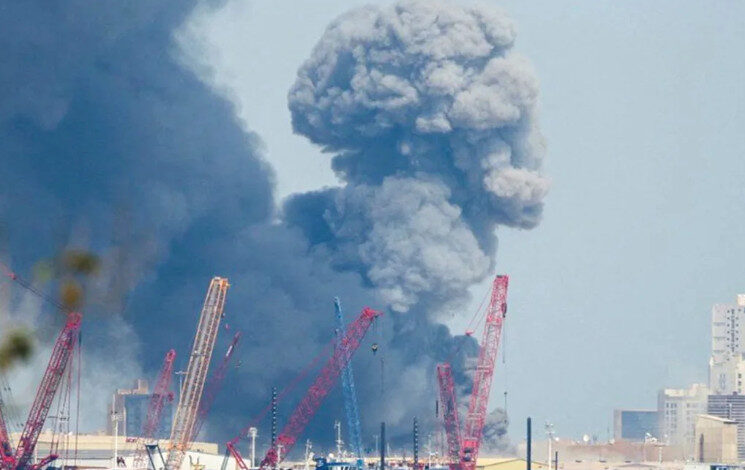
The United States and Israel carried out a series of strikes against Iran on Saturday, with the Israeli public broadcaster reporting that the supreme leader had been targeted, while the Islamic Republic responded with salvos of missiles, raising fears of a regional conflagration.
At least 51 people have been killed at a school in southern Iran, state television cited a local official as saying.
Explosions were reported in several Gulf cities, including US bases, and many countries in the region closed their airspace, leading to a series of cancellations of flights to the Middle East.
An operation called “Epic Fury”
Called “Epic Fury,” the American operation aims to “eliminate imminent threats” from Iran, President Donald Trump said.
“The hour of your freedom is at hand,” he told the Iranian people from his residence in Palm Beach, Florida.
“When we are finished, seize power, it will be up to you,” he said in a video message.
“To the members of the Islamic Revolutionary Guard Corps, the armed forces, and all police, I say today that you must lay down your arms and have total immunity or, otherwise, face certain death,” added Donald Trump.
“Roaring lion” on the Israeli side
Israeli Prime Minister Benjamin Netanyahu confirmed a joint “operation”, called on the Israeli side “Roaring Lion”, against the “existential threat posed by the terrorist regime in Iran”.
The Israeli army then indicated that it had struck “hundreds of Iranian military targets”, targeting several meetings of senior Iranian officials in Tehran.
These strikes will continue “as long as necessary”, according to a security source.
Iran’s Supreme Leader Ayatollah Ali Khamenei and President Massoud Pezeshkian are among the targets, Israeli public broadcaster KAN reported.
Loud detonations in Tehran
In Tehran, several loud detonations were heard by AFP journalists.
Plumes of smoke rose in the center, east and west of the capital, where ambulances were sent.
While residents rush to their homes to take shelter, panicked parents try to pick up their children from school.
Many traffic jams formed in the center and long lines in front of the bakeries.
According to the Isna press agency, the Pasteur district, where the residence of the supreme guide and the presidency are located, in the center of Tehran, were targeted.
According to Iranian media, explosions also affected the cities of Isfahan, Qom, Karaj, Kermanshah, Minab, Lorestan and Tabriz, across the country.
Iranian response and tensions in the region
In Jerusalem and several regions of Israel, explosions were heard by AFP journalists.
Anti-aircraft warning sirens sounded, the army claiming to have detected missile fire coming from Iran.
The authorities established a “special and immediate state of emergency” and closed the airspace to civilian flights.
The Revolutionary Guards announced the launch of a “first wave of massive attacks” against Israel.
The head of Iranian diplomacy, Abbas Aragchi, described all sites involved in operations against Iran as “legitimate targets”.
Strikes and explosions in the Gulf
Explosions were also heard in Riyadh and Abu Dhabi, and US bases targeted in Manama and Doha.
The United Arab Emirates said it had intercepted Iranian missiles, and Qatar said it had “repelled” several attacks targeting its territory.
Jordan said it shot down two ballistic missiles targeting the kingdom.
At least one person was killed in the UAE capital by missile debris, according to the Defense Ministry.
The United States had previously asked its diplomatic staff and nationals in the Gulf to “take shelter.”
Iraq and Syria also affected
In Iraq, a bombing targeting the military base of Jurf al-Sakher (south), sheltering a pro-Iranian group, killed at least two fighters and injured five, according to sources close to the armed group Kataeb Hezbollah.
In southern Syria, the fall of an Iranian missile killed four people, according to Damascus.
International calls for de-escalation
Diplomatic reactions poured in.
Moscow denounced a “dangerous adventure” which threatens the region with “catastrophe”.
European Commission President Ursula von der Leyen called for “maximum restraint”.
“The dangerous escalation for all” must “stop,” added French President Emmanuel Macron.
Qatar’s Emir Sheikh Tamim bin Hamad al-Thani and Saudi Arabia’s de facto ruler, Crown Prince Mohammed bin Salman, delivered a similar message, calling for a “return to the table” in negotiations.
The African Union (AU) urged “urgent de-escalation” to avoid “worsening global instability”.
The son of the last shah of Iran, overthrown in 1979 by the Islamic Revolution, said he was confident in the “final victory” against the regime, saying he wanted to “rebuild Iran”.
Context of persistent tensions
In June 2025, Israel and Iran fought a 12-day war. The United States joined the Israeli offensive by bombing three Iranian nuclear sites.
New tensions emerged after the repression in January of a vast Iranian protest movement.
Washington had until now favored the diplomatic route, while maintaining military pressure on Tehran with the deployment of a significant air-naval force in the Gulf then the sending to the Mediterranean of the largest aircraft carrier in the world, the Gerald Ford.
But Donald Trump said on Friday that he was unhappy with the negotiations carried out since the beginning of February.
Accusing Tehran, which denies, of wanting to acquire an atomic bomb, the United States insists on a total ban on uranium enrichment, while Iran defends its right to civilian nuclear power.
Washington also wants to limit Iran’s ballistic program, an issue that Tehran refuses to address.
With AFP
