Public agricultural waqf for goat breeding: 110 goats and goats handed over to beneficiaries in Missira Wadene October 22, 2026
After Aéré Lao, in the department of Podor, the High Waqf Authority and Heifer International Senegal proceeded, Thursday, October 22, to the delivery of 100 goats and 10 goats to Missira Wadène, as part of the public agricultural Waqf for goat breeding (WAPEC). The project targets 2,000 women and young people in ten municipalities in the Podor and Koungheul departments.
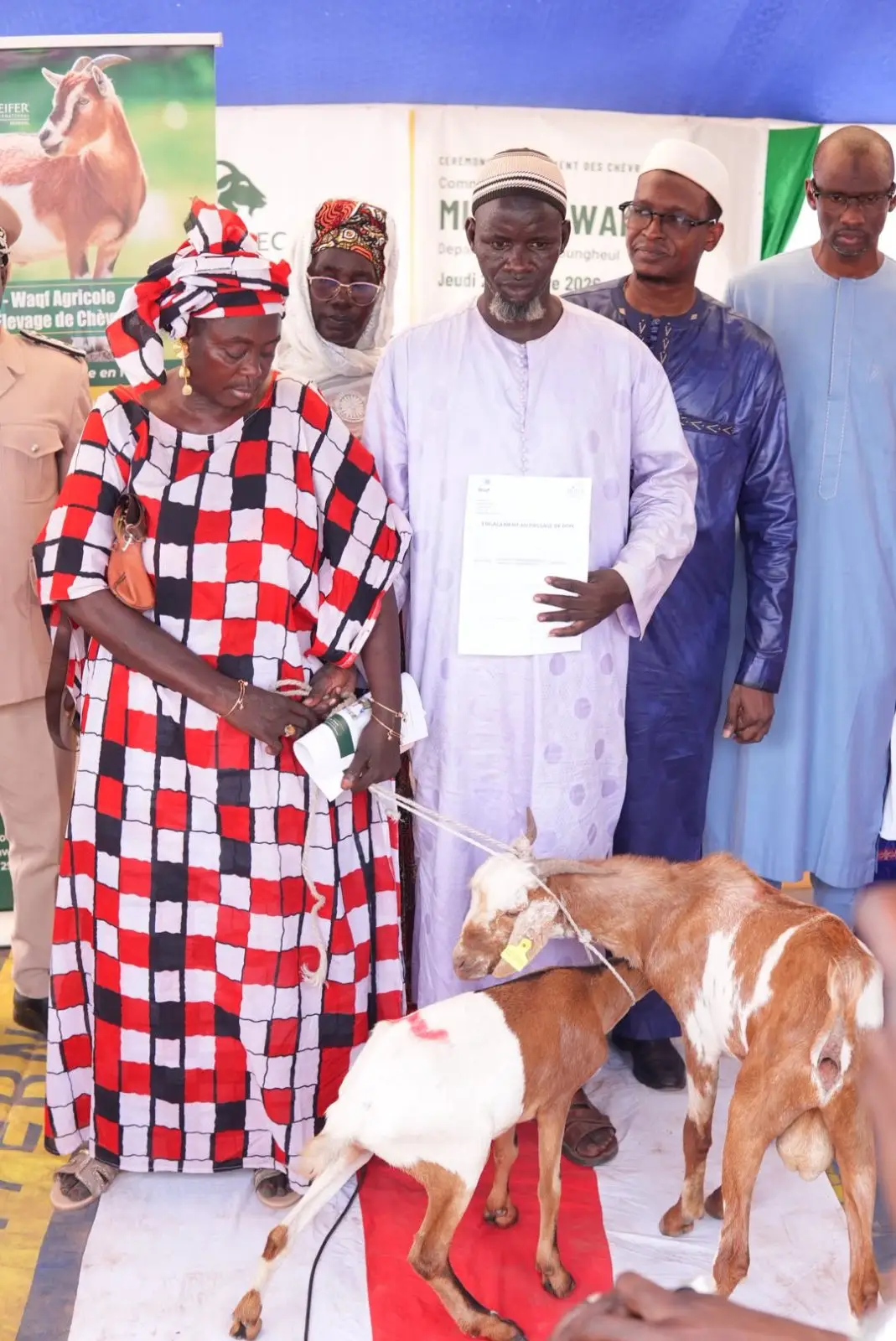
The High Authority of Waqf (HAW) and Heifer International Senegal are continuing the deployment of the public agricultural Waqf for goat breeding (WAPEC). Two days after a first stage in Aéré Lao, in the department of Podor, the two partners proceeded, Thursday, October 22, to the placement of 110 goats in Missira Wadène, in the department of Koungheul.
The ceremony, chaired by Moustapha Seck, deputy to the sub-prefect of the district of Missira Wadène, took place in the presence of administrative authorities, local elected officials and project partners. The lot given includes 100 goats and 10 goats. Across the Koungheul department, 500 goats and 50 goats must be placed in five communes.
The first public agricultural waqf dedicated to goat breeding, WAPEC provides for the gradual delivery of 1,000 goats and 100 goats to 2,000 women and young people, grouped into 100 groups in ten communes in the departments of Podor and Koungheul. Costing 148.45 million FCFA, the project is financed from HAW’s own funds, while Heifer International Senegal ensures its technical implementation.
A lasting solidarity mechanism
Beyond the delivery of animals, the project is based on a principle of transmission. Each beneficiary family must give the same number of animals received to another, while sharing the knowledge acquired. A mechanism which aims to gradually extend the benefits of the program to other households.
For the Director General of the HAW, Dr Ahmed Lamine Athie, the ambition is to “make the waqf a concrete instrument for the fight against poverty, food security and sustainable income for women and young people”.
He recalls that “the waqf is a good that is given forever, so that its fruits benefit the community”. In this logic, he invited the beneficiaries to take care of the animals “like a deposit, a dënkaane”, emphasizing their responsibility towards the families who will, in turn, receive animals.
The national director of Heifer International Senegal, Dr Daouda Ndao, also insisted on the importance of management and support. The placement “will take on its full meaning when the animals are well cared for, the groups manage their resources rigorously and the gains will gradually benefit other families”.
For him, “receiving allows you to get started; transmitting allows others to progress in turn.” The manager recalled that Heifer has supported more than 231,000 families in Senegal since 2007, while emphasizing that the success of the project depends on the organization of the beneficiaries, training, technical monitoring and insurance, and “not just the number of animals handed over”.
From breeding to income creation
Access to financing is also an issue to ensure the viability of activities. Representing Al Rahma Islamic Microfinance, Cheikhou Oumar Sall presented the support possibilities of the institution, which intends to finance without interest the different stages of the value chain, from inputs to breeding, including processing and marketing.
“A goat alone is an animal. A well-fed, well-cared-for goat, whose milk is processed and the product sold at the right price, is a business,” he illustrated, assuring that the institution would be alongside the beneficiaries “from the herd to the market”.
On behalf of the Minister of Microfinance and the Social and Solidarity Economy, Dr Abdou Karim Diaw welcomed an initiative likely to make waqf a lever for economic and social development. According to him, the provision of productive assets to women and young people contributes “to transforming assistance into sustainable economic empowerment”. He hoped that the experience would be “consolidated and extended to other territories of Senegal”.
Training and insurance to secure acquired knowledge
The handover of the animals takes place after several months of preparation. In the Koungheul department, 50 village assemblies mobilized 520 people, including 351 women. The groups benefited from training in leadership, gender, governance and good breeding practices. They also set up their savings and credit systems.
Securing livestock is among the other components of the program. Each animal is identified by a tag bearing a unique number and benefits from livestock insurance provided by the National Agricultural Insurance Company of Senegal (CNAAS), in collaboration with Heifer International Senegal.
Coverage extends for one year. In the event of a claim, the breeder receives 80% of the insured value. The State subsidy also makes it possible to reduce the insurance premium from 8% to 4%.
On behalf of the beneficiary groups, Yacine Seck thanked the authorities and partners, while emphasizing the expected impact on the daily lives of families. She pleaded for the sustainability and expansion of the project.
Part of the Senegal 2050 National Transformation Agenda, WAPEC intends to contribute to food sovereignty, the structuring of agricultural value chains and the strengthening of household resilience. Placements must continue in the four other municipalities of Koungheul and in those of Podor, according to the operational calendar.
YEAR
