
Rural farms: In the heart of the fields, on the fringes of resources
In rural areas of Senegal, women play an essential role in agricultural production and household food security. However, they continue to face numerous inequalities, particularly in terms of access to land and financing. As part of this report, we collected testimonies from women who are active in the agricultural sector. Furthermore, data collected by organizations such as the Agricultural Prospective Initiative (Ipar) highlights the gap between the contribution of women to Senegalese agriculture and the resources available to them to develop their activities.
It’s 6 p.m. and dust in Kaffrine. During this harvest time, Fana Touré is sitting on a brick couch, like many found inside homes in the Diamaguene district. After a long day spent working in the fields, Fana holds two large bowls filled with millet between her legs. Like her, many rural women do not have access to land. Their daily life is reduced to working for the benefit of their husbands or third parties. “We who live here only have the land as a source of income. With my co-wives, I am used to going to our husband’s fields to support him,” she explains. The woman, aged around 40, believes that there is no shortage of difficulties faced by women in rural areas. To his left, Ami Touré, his co-wife, highlights the lack of resources to develop agricultural processing activities or acquire sewing machines. “Sometimes, there are initiatives offered to us thanks to certain women’s groups, but we struggle to obtain enough equipment,” she explains.
In Kaffrine, as in many localities in Senegal, women occupy a central place in agricultural work. They participate in sowing, weeding, harvesting, processing of products and their marketing. However, when it comes to land ownership or farm management, they remain poorly represented.
Different realities depending on the region
In Darou Khoudoss, in the Tivaouane department, Aïda Cissé has been following these questions for more than three decades. Former local elected official for six terms and president of the National Network of Rural Women of Senegal, she now coordinates a network of 36,000 members spread across 42 associations from the primary sector.
According to her, awareness campaigns are starting to produce results, even if work remains to be done. “Today, thanks to the support of partners and awareness, we can say that 60% of rural women understand the challenges of access to land,” she says.
In the same vein, on a continent-wide scale, the Food and Agriculture Organization of the United Nations (FAO) estimates that 66% of jobs held by women in sub-Saharan Africa are in agri-food systems.
However, according to Aïda Cissé, progress remains variable depending on the regions of Senegal with regard to access to land. “For example, in Niayes and in certain localities in the Thiès region, women obtain plots more easily than before,” she explains.
However, she does not fail to emphasize that, in several other areas, customary practices continue to influence access to land. “In certain parts of Kaolack, we are used to saying that the salt lands belong to women. It’s a way of confining them to salt cultivation and excluding them from the most fertile lands,” notes the president of the women’s groups of Darou Khoudoss.
During her career as an activist for the cause of rural women, Aïda Cissé was particularly touched by the case of women she met in a locality in Koussanar, forced to travel several kilometers before reaching their fields. “These women arrive already tired when they start their work and are exposed to security problems because the land allocated to them is located several kilometers from their village. When I had to meet them, it made me very sad,” she says. For her, the efforts made must now focus on the effective implementation of the rights recognized by law.
In this wake, the data produced by the Agricultural and Rural Prospective Initiative (Ipar), the National Agency for Statistics and Demography (Ansd), UN-Women and the Directorate of Analysis, Forecasting and Agricultural Statistics (Dapsa) confirm, as Aïda Cissé points out, that women play a major role in the agricultural economy, without benefiting from the same access as men to productive resources.
At the heart of Senegalese agriculture
When interviewed, Ipar researchers, Dr Marame Cissé Sow and Dr Ndèye Yandé Ndiaye, underline that the situation of rural Senegalese women does not reflect their real contribution in this area, because the place of women in agriculture has long remained underestimated. “Rural women are at the heart of Senegalese agriculture. They ensure a considerable part of food production, agri-food processing and household food security,” says Dr Marame Cissé Sow, coordinator of the theme “Young people, women and entrepreneurial strategies and mobility” at the Ipar Think Tank.
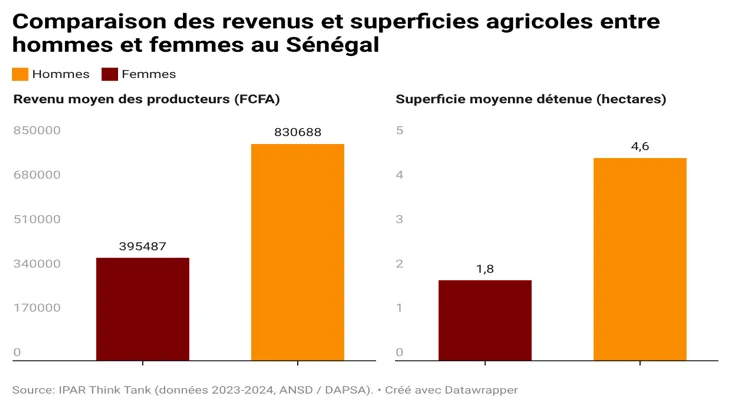
However, these difficulties do not present themselves with the same intensity everywhere. For the Ipar researcher, difficulties in accessing land do not constitute an isolated problem. “Limited access to land produces a domino effect whose consequences are mutually reinforcing,” she believes. For his part, Dr Ndèye Yandé Ndiaye believes that the absence of secure land rights reduces investment capacity, limits access to credit and slows down the acquisition of agricultural equipment. “Available data shows that 68% of motorized equipment, including tractors, motor pumps and mechanization equipment, is owned by men compared to only 32% by women. Women remain mainly present in post-harvest processing activities, but they have few structured commercial outlets,” she explains.
Nevertheless, women living in rural areas in Senegal represent a significant economic weight in agricultural evaluations. “The joint analysis of Ansd and UN-Femmes, in 2022, on the contribution of female entrepreneurship and leadership to the added value of the agricultural sector reveals that female entrepreneurship in informal agriculture generated 458.4 billion CFA francs, or 27% of the total added value of the sector, even though women control proportionally fewer agricultural operations than men,” underlines Ndèye Yandé Ndiaye, coordinator of the theme “Inclusive governance of natural and land resources”.
For her, there are structural inequalities in access and control of land, despite a Senegalese legal framework which formally recognizes equality between men and women in terms of access to land. “Senegal has a progressive legal arsenal, but its effectiveness remains largely insufficient on the ground. Custom frequently conflicts with the law and obstructs its application,” she notes.
She cites as proof that “at the national level, the parity index measuring the proportion of women among those responsible for agricultural plots stands at 0.2, which means that, for every ten plot managers, barely two are women,” she adds.
This figure, however, has notable regional variations, specifies the expert. According to her, it is higher in the south of the country, particularly in Casamance, with 0.6 in Sédhiou and 0.3 in Ziguinchor, “where socio-cultural configurations historically grant women a more assertive role in land management”. This means that, in the vast majority of Senegalese regions, women only access land through their husbands, their family or the community, without their own land security.
By Marième Fatou DRAMÉ
