
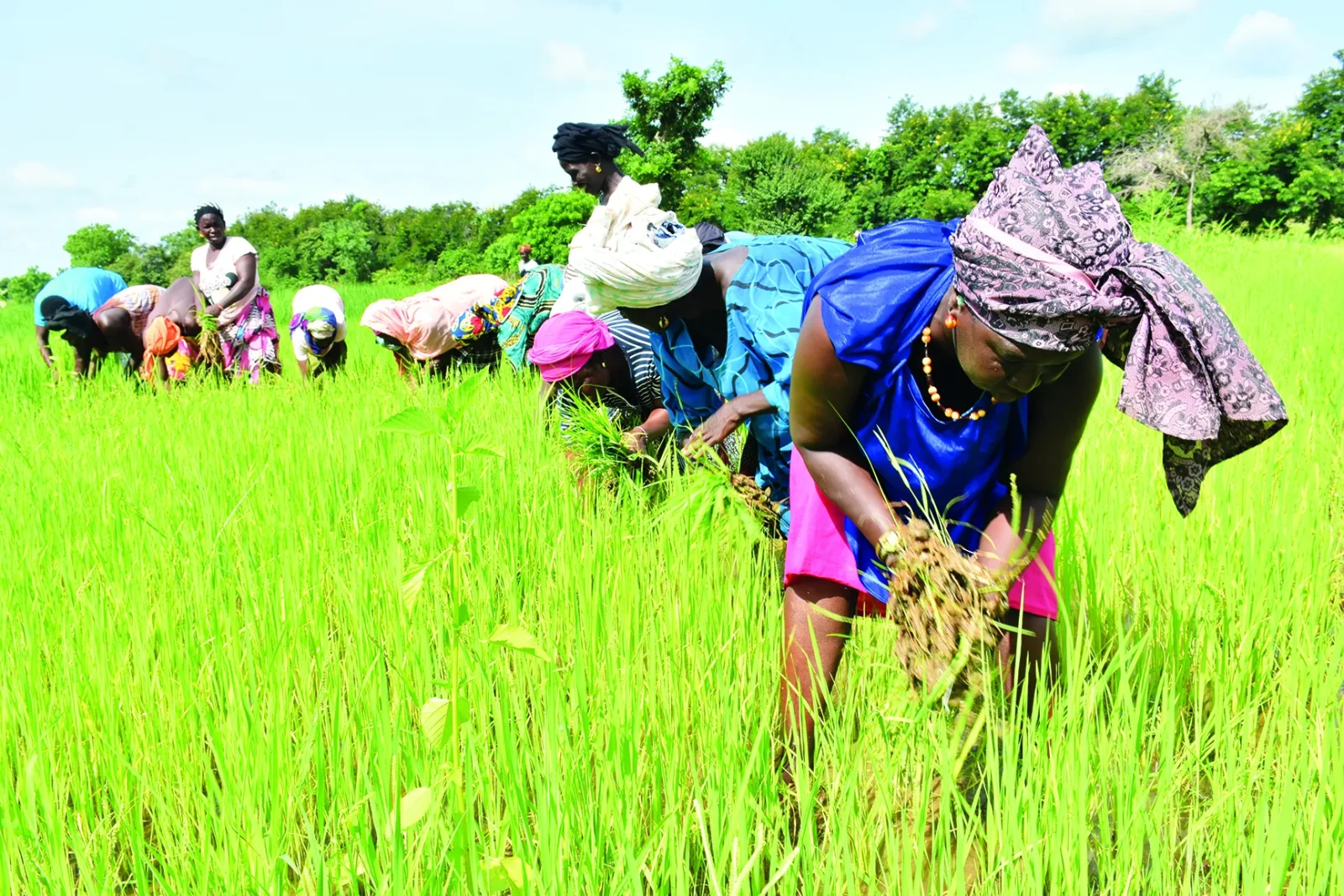
Agricultural land: Women only hold around 12%
In Senegal, rural women contribute significantly to agriculture while remaining faced with profound land, financial and material inequalities. Nationally, they only hold 12% of agricultural land.
Despite their central role in agriculture, women own only a small share of land and earn significantly lower income from their activities than men. Thus, access to land remains one of the main structural inequalities faced by rural women, according to Ipar studies which show in particular that women only own around 12% of land nationally in 2023. “This result is close to that of the Annual Agricultural Survey of 2024, revealing that women represent 15% of farm managers in Senegal”, specifies Marame Cissé Sow, who also emphasizes that “only 2.7% of women have an individual title to the land they operate and 24.3% of the women surveyed say they hold rights to agricultural land, compared to 40.5% of men, while 40.4% of women access land mainly by loan, compared to 15.7% of men. Still only 41.5% of women with access to land obtained it through inheritance, compared to 72.5% of men. In addition, the average area owned by households headed by women is estimated at 1.82 hectares compared to 4.57 hectares for households headed by men. In this context, other work carried out by Ipar on the horticultural value chain in Niayes, an area of large agricultural production, reveals, for example, “that 96.3% of women surveyed participate in horticultural activities, compared to 88.1% of men”, underlines the coordinator of the theme “Young people, women and entrepreneurial strategies and mobility” at the Ipar Think Tank.
For her part, Ndèye Yandé Ndiaye indicates that the training deficit constitutes another factor which limits women. In this wake, the work of Ipar demonstrates, according to her, that less than 3% of those responsible for agricultural plots in Niayes have benefited from formal agricultural training, even if agricultural practices are still largely based on family transmission of knowledge. “The Ipar results show that the average productivity of the national agricultural workforce is estimated at 3,524 FCfa per working day. Farms run by women have high levels of productivity,” underlines Ndèye Yandé Ndiaye, coordinator of the “Inclusive governance of natural and land resources” theme.
This observation, however, contrasts sharply with income levels: women producers in fact earn an average income from their agricultural activities that is half that of men, respectively 395,887 FCfa compared to 839,888 FCfa, underlines the Ipar researcher.
According to these Ipar researchers, the available statistics mainly relate to farm managers or plot owners, leaving much of the work carried out on family farms in the shadows. For their part, data from the National Agency for Statistics and Demography (Ansd) and UN-Women also make it possible to assess their economic weight.
Lower income
For Dr Marame Cissé Sow and Dr Ndèye Yandé Ndiaye, these figures reflect an important development in the understanding of the role of women. “This contribution of women to agriculture, long underestimated, is now beginning to be solidly documented. This paradox highlights their capacity for action and their determining role in agricultural production and the food security of family farms,” they emphasize. For researchers, this difference is mainly explained by differences in access to productive resources. Experiences conducted in Niayes show that women who benefit from better access to land, adapted financing mechanisms, solar energy and technical training improve their productivity while increasing their income. Ipar also emphasizes that the available statistics do not always reflect all of the activities carried out by rural women, due to the fact that a significant part of their activities falls within the informal sector or family farms. “The statistical invisibility of rural women in agriculture is not a reflection of their absence, but of the limits of our data systems,” underlines Dr Marame Sow. The researchers nevertheless welcome the progress made with the gradual integration of data disaggregated by sex in agricultural surveys. According to them, this information is essential to better guide public policies.
Several initiatives carried out in different regions show that developments are possible. “Awareness campaigns have enabled women to better understand their land rights and to take steps to obtain plots. Other projects, relating to solar irrigation, entrepreneurial support or access to financing, have contributed to improving the performance of farms run by women,” notes Marame Sow Cissé. The researchers believe, however, that these experiences still remain limited. “The challenge now is to scale up so that these documented good practices benefit a much larger number of rural women,” she says. To do this, they recommend in particular strengthening the security of women’s land rights, improving their access to equipment, financing and markets, but also better coordinating the interventions of different public institutions. According to them, the discussions undertaken within the framework of the future agrosylvopastoral and fisheries orientation law (Loasph) may be among the opportunities likely to strengthen the consideration of rural women in agricultural policies. In this context, the Loasph, currently being developed, includes a chapter dedicated to the “Promotion of women and young people and social equity in rural and peri-urban areas”.
In this sense, the two Ipar researchers recommend that “Circular No. 0989, applied since 2018, which provides in particular for the allocation of a share of developments, inputs and financing, also deserves to be evaluated with a view to changing its status towards a more restrictive legal form”. Likewise, the introduction of a guiding law for the economic empowerment of women would constitute a framework policy capable of consolidating the progress made, believe among others the experts.
In the meantime, in Kaffrine, Fana Touré continues to work without pay on her husband’s land, like many women met in rural areas. * This WanaData article was supported by Code for Africa and the Digital Democracy Initiative as part of the Digitalise Youth project, funded by the European Partnership for Democracy (Epd).
By Marième Fatou DRAMÉ
