
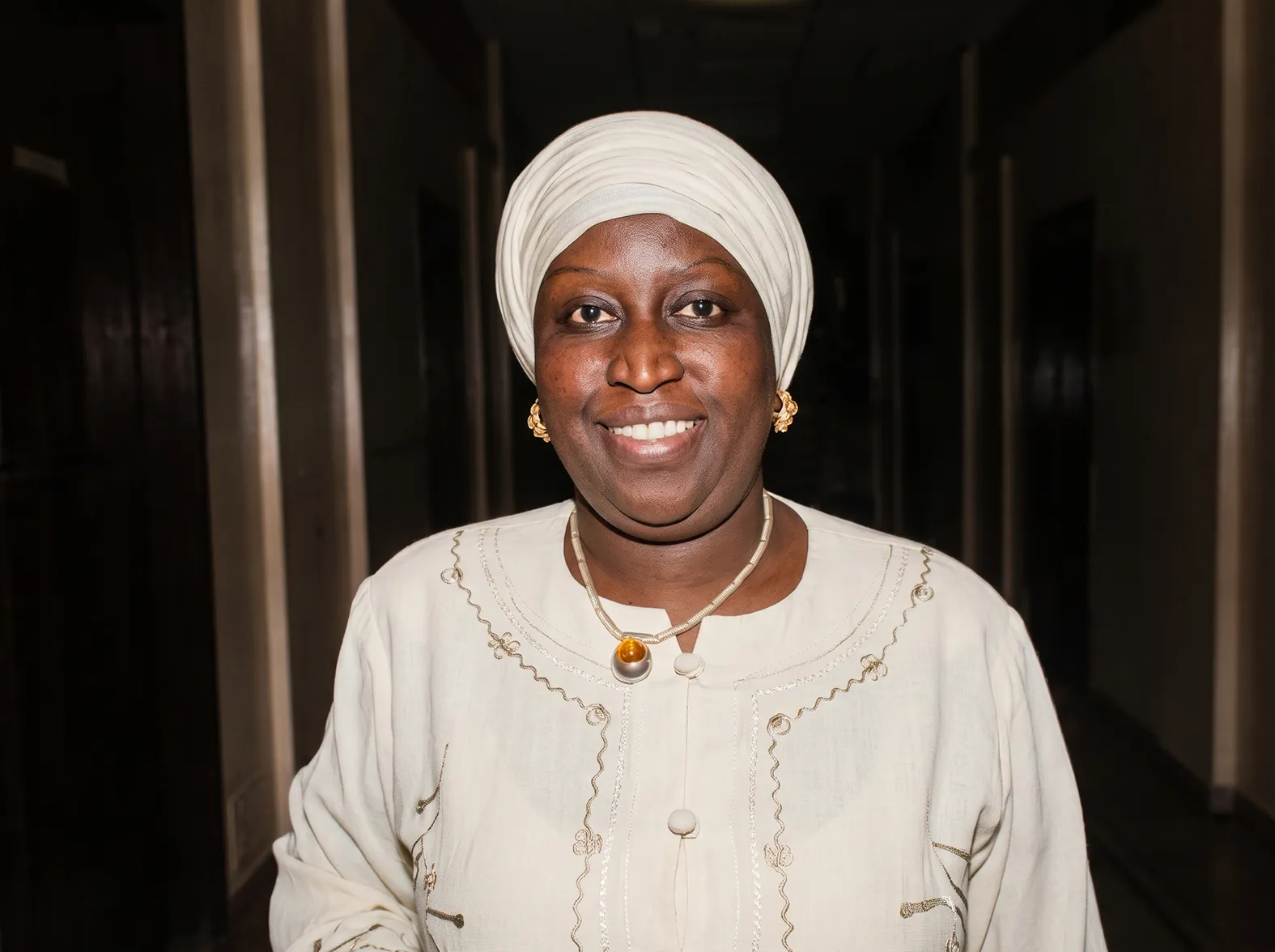
Penda Mbow, a life of struggle October 27, 2026
Write a life, think a society. This is the project of Fabienne Samson and Saliou Ngom through the work that they have just published by Présence Africaine entitled “Penda Mbow. A committed intellectual.” It traces the story of a woman in all her complexity, her choices, with the political and social history of Senegal as a backdrop.
If I had been a man, my destiny would have been quite different.” This sentence pronounced by Penda Mbow in the work dedicated to him by Fabienne Samson and Saliou Ngom, entitled “Penda Mbow. A committed intellectual”, published by Présence Africaine, summarizes the trajectory of this significant figure in public debate in Senegal. As she admitted during the presentation ceremony of the work, Wednesday October 21, 2026 at the Warc in Dakar, all the thinkers of modernity in Islam have paid dearly. As examples, she cites Egyptian theologian and jurist Ali Abderraziq, who argued that the caliphate is not Islamic, and Tahar Al-Hussein executed in 1985.
For her feminist commitment and her positions on Islam, Penda has also experienced ostracism, personal attacks, death threats and even, she reveals, an assassination attempt. Thus, underlines Professor Rokhaya Fall de l’Ifan, this book traces above all the journey of a woman who refuses the role and the place that society has assigned to her. “She made the choice of freedom of thought and commitment,” explains Professor Fall, who has been working with Penda Mbow for several decades and shares with her the desire to find a place in a world dominated by men: the university.
A commented biography
The idea of writing this book was born from an academic conference organized by Fabienne Samson and Saliou Ngom in July 2023 at the Museum of Black Civilizations in Dakar as part of a two-week doctoral school. Invited to deliver the inaugural lesson on female religiosity, Penda Mbow dwelled at length on the thinkers of modernity in Islam. His feeling was that this had not particularly interested the organizers. To her great surprise, a few weeks later, they offered to write a book about her.
“Initially,” explains Fabienne Samson, “the idea was to write a scientific work on the history of Senegal through the evocation of its political and feminist activism. But over time, we decided to place the interviews at the heart of the work.”
However, the work goes beyond a simple journalistic interview. The project evolved into an annotated biography. “The idea was not only to tell the story, but to make it dialogue with Penda’s trajectory, with what she said about the history of Senegal,” adds Saliou Ngom, speaking of a delicate exercise, because it was necessary to rework the interviews and take a critical look at them.
“We did not always agree with her positions and she accepted this critical view,” explains Saliou Ngom. The work is thus divided into three large parts, each with a question/answer section: her personal trajectory, her feminist commitment and her political journey.
The publication of the work by Présence Africaine is not insignificant. The founder of this publishing house, Alioune Diop, whom she mentions extensively in the book, played a fundamental role in her decision to return to teach in Senegal after her thesis in France.
Portrait of an era
Beyond the intellectual portrait of Penda Mbow, this book is also a social painting of an era. It traces a human story, the cultural universe in which she grew up. It restores memories, voices and significant figures. Through the personal trajectory of Penda Mbow, we can read the history of Senegal from the 1950s to the present day.
Born in Dakar in 1955, she spanned the half of the previous century and the first quarter of the current century, establishing herself as one of the most significant female figures in the Senegalese intellectual landscape. Which makes it a privileged witness to political and social history.
In the book, she evokes her links with Senghor, Cheikh Anta Diop, Alioune Diop and many others, but also places like Rukku Bu Sess in the Medina, the neighborhood where she grew up. This is why, underlines Professor Rokhaya Fall, this work raises the question of transmission and memory.
“The question he invites us to ask is what to do with the memory of the notable figures of Senegalese society? », Indicates Professor Fall.
Unclassifiable on the political spectrum, Penda Mbow attended Senghor, rubbed shoulders with Macky and was even briefly Minister of Culture for Abdoulaye Wade. However, she claims to have never agreed to be an activist in a political party, because she does not agree with the role assigned to women.
A committed woman
The only constancy remains his commitment. From “Set Setal”, which she initiated in the 1980s, to her positions on the role of women in Islam, through her fight for the inhabitants of public housing and the denunciation of the caste system, her life is strewn with struggles.
The marker of her life remains the fight against all forms of exclusion of women, male domination and the sexual division of labor within political parties and social movements. In a word, to deconstruct all forms of oppression against women.
Known for her outspokenness, she has never been afraid to express her ideas and go against the tide of dominant thinking. Even if it didn’t only create friends for him.
Beyond the female activist known to the public, we discover in this book a woman deeply anchored in her culture. The public present at the presentation ceremony of the work had an illustration of this with a musical performance by local artists singing its genealogy.
“I’m with them all the time, that’s how I live,” explains Penda Mbow. Many of this audience are present in the book.
Anchored in its culture, attached to its religion
But what may surprise those who don’t really know her is that we discover, through this book, a pious woman deeply attached to the Muslim religion. She says she never misses her daily prayers, even during her travels, and says she has unwavering faith in God.
Which may surprise those who focus on his positions against patriarchy in the land of Islam. But not those who really know her.
In the end, Penda Mbow embodies this paradox of our society: she is one of the voices and faces that are familiar to us but that we do not necessarily know. Hence the merit of Fabienne Samson and Saliou Ngom through this publication.
By Seydou KA
