
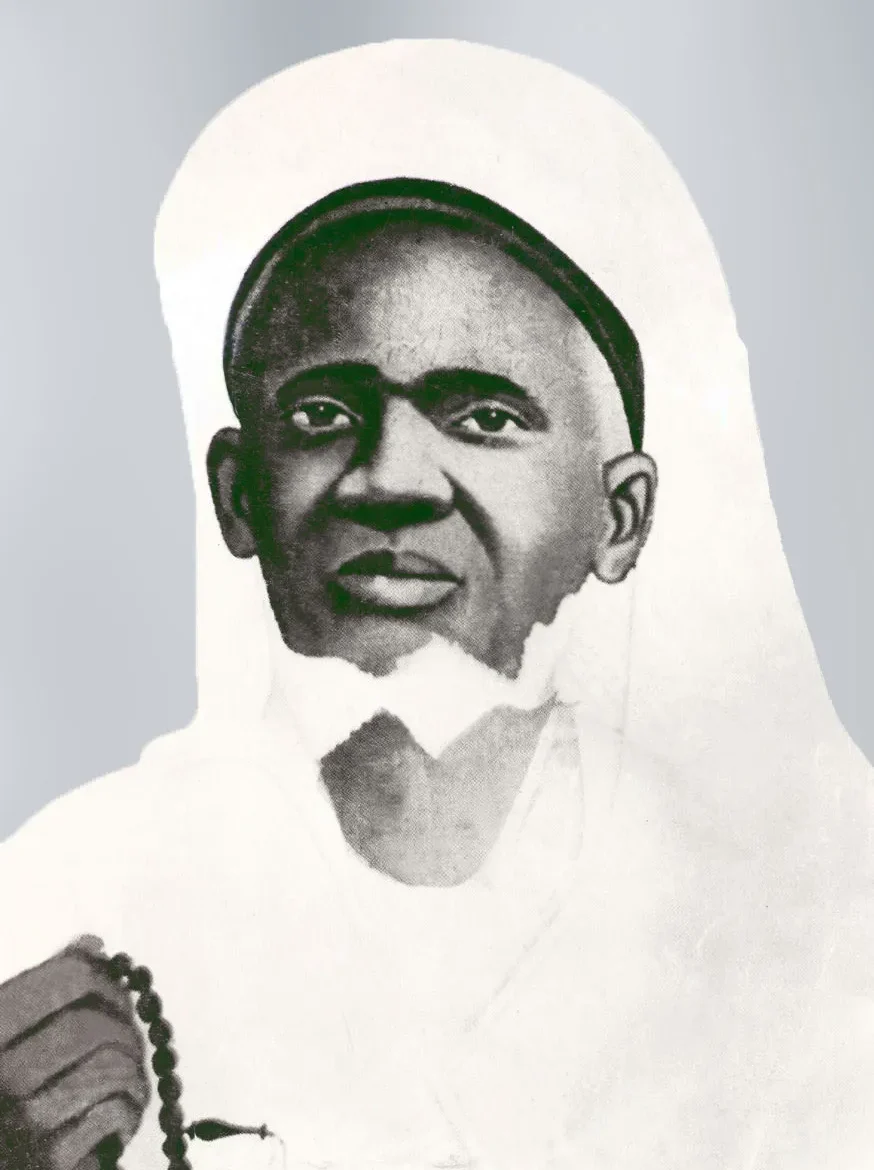
Life of El Hadj Malicky Sy: Link between the rosary and the pen
Faced with colonization, El Hadji Malick Sy Maodo did not choose weapons. He opposed the force of spirituality and that of knowledge. He made his rosary an instrument of peaceful resistance and his pen a weapon against ignorance, religious excesses and injustice.
El Hadji Malick Sy had a strategy to respond to colonial domination: spirituality and knowledge to the detriment of weapons. Precisely the rosary to preserve the space of freedom and the feather to free consciences. “The Zawiya of Tivaouane is the place where rosary and feather come together,” immediately explains Serigne Mbaye Ba, member of the “Sirâj Al-Hadra Al-Malkiyya de Tivaouane” association and of the Gamou scientific committee and researcher at the Zawiya El Hadji Malick Sy library in Tivaouane. In his eyes, the Tivaouane scholar had understood very early on that direct confrontation with the colonial power would lead to failure. We had to resist differently. Facing the colonists, the rosary represented the weapon. His “canon”, he himself told the authorities of Saint-Louis, was none other than his rosary. A method which allowed him to erect zawiyas even in the centers of colonial power, in Saint-Louis as in Dakar. Mr. Ba evokes, as a reminder, the episode of the ban on the wazifa (daily liturgy of the brotherhood) in Kaolack. When Serigne Abdou Hamid Kane was prevented from doing so, Maodo relied, he said, on the Prophet (Psl). A few days later, the colonial administrator concerned left office. “This episode symbolizes the power of prayer in the fight led by the religious guide,” explains the researcher.
Raise awareness
However, protecting space was not enough. This space still had to be filled with knowledge. Because, for El Hadji Malick Sy, real enslavement was not only political. “He was also intellectual. A society deprived of knowledge becomes a vulnerable society. A faith without understanding becomes a fragile faith,” he recalls. It is against this ignorance that Maodo mobilized his second weapon: the pen. “The pen therefore served to raise awareness. The Senegalese and African populations had, for the most part, understood nothing of the message of Islam. Most of them could neither read nor write in Arabic. Their faith was mediocre,” explains Mr. Ba. Through abundant production, the religious guide undertakes to teach all the disciplines of Islam, to popularize knowledge and to train believers capable of also understanding their responsibilities.
Basically, explains the researcher, the two struggles are inseparable. “The rosary secures the space for the pen to teach. And the pen forms men so that the rosary has conscious disciples. By combining them, he led his fight with the pen against ignorance while leading his fight with the rosary against colonization,” he says, adding that all of Maodo’s thinking is contained in this articulation: resist without destroying, instruct in order to liberate. This same logic permeates his great writings.
Messages from Khilâçu Zahab and Ihfam
In the Tidiane tradition and particularly in the work of Maodo, Khilâçu Zahab occupies a unique place. According to Mr. Ba, this is the only biography of the Prophet Muhammad (Psl) that has ever been written since the appearance of this material in Senegal. The central message that Maodo wanted to convey through this text is that of purification, defense and transmission of the true Tidiane Sufi doctrine. In other words, it was to restore the purity and orthodoxy of Sufism. “Cheikh El Hadji Malick Sy wrote Ifhâm in a context marked by socio-cultural and religious practices misused by imposter marabouts in the name of Sufism who used religion for basely materialistic purposes,” recalls Serigne Mbaye Ba. According to the latter, Maodo’s response is unambiguous: Sufism cannot exist outside of the Koran and the Sunnah. It cannot be dissociated from Sharia law. The work thus becomes an argued defense of the Tijâniyya. The religious guide explains the foundations, the rules and the initiatory chain, while responding to the criticisms addressed to the brotherhood.
But his ambition goes beyond mere doctrinal controversy. For Serigne Mbaye Ba, Maodo seeks above all to form “a conscientious citizen, concerned with social justice”, capable of living a balanced spirituality, sheltered from radicalism. This desire for reform reaches its most direct expression in Kifâya Ar-râghibîn. In this work, indicates the researcher, Maodo draws up an indictment against the religious excesses of his time, namely greed, the instrumentalization of the sacred, the commerce of religion, superstition, magic, witchcraft or innovations contrary to prophetic tradition. Kifâya is presented as a work of high moral and social significance. It has, he says, caused a total upheaval in terms of social justice and respect for human rights.
By Aliou DIOUF
